
Query fan out is how an AI engine turns one question into several related searches before it writes an answer. Google says AI Overviews and AI Mode "may" use the technique, according to its Search Central page "AI features and your website", updated December 10, 2025. This guide covers how the technique works, how Google AI Mode, AI Overviews and ChatGPT apply it, what Google's patents describe, what the published studies measure, and how a page covers the sub-queries.
What is query fan out in AI search?
Query fan out is the technique by which a generative engine generates several related sub-queries from one question, runs them in parallel across data sources and compiles their results into one answer. Google's glossary defines the technique as "a set of concurrent, related queries generated by the model to request more information and fetch additional relevant search results to address the user's query", in its guide "Optimizing your website for generative AI features on Google Search", updated July 10, 2026. The definition applies to generative AI features on Google Search, such as AI Overviews and AI Mode. Two spellings of the name circulate, and the next question settles which one this guide uses.
What does "query fan out" mean?
Query fan out means the spread of one query into several related queries, and Google writes the term "query fan-out" with a hyphen. This guide writes query fan out without the hyphen, the form that Google's autocomplete completed on every non-tool suggestion in our measurement of November 17, 2026, in the United States. The bare words "fan out" stay out of this guide, because they name software, electronics and hardware concepts that fill most of the People Also Ask questions we measured for that query. The origin of the term comes next.
Where does the term query fan out come from?
Google names query fan out for AI Mode in its launch post of March 5, 2025, "Expanding AI Overviews and introducing AI Mode", which presents AI Mode as an early experiment in Labs. The post says AI Mode "uses a 'query fan-out' technique, issuing multiple related searches concurrently across subtopics and multiple data sources and then brings those results together to provide an easy-to-understand response". The post of May 20, 2025, "AI in Search: Going beyond information to intelligence", announces that Google is "rolling out AI Mode in the U.S." with "no Labs sign-up required", and words the technique differently: AI Mode "uses our query fan-out technique, breaking down your question into subtopics and issuing a multitude of queries simultaneously on your behalf". Search Central then documents the technique on pages last updated December 10, 2025 and July 10, 2026. Estimated monthly searches for query fan out in the United States were 480 in November 2025, 720 from March to June 2026 and 590 in October 2026, in our measurement. Where query fan out sits in SEO and AI search comes next.
Where does query fan out sit in SEO and AI search?
Query fan out sits among the mechanisms of generative engines, not among the practices, in our reading: generative engine optimization (GEO) and answer engine optimization (AEO) are the practices that account for it. On that reading, query fan out names what the engine does with a question before it answers, and a site does not perform it. The guide to GEO, AEO and the other practices of AI search maps the field this mechanism belongs to. The mechanism itself, from question to answer, comes next.
How does query fan out work, from question to answer?
Four steps take query fan out from one question to one answer, in our order of the parts that Google names.
- Divide the question: the engine divides the question into subtopics, one sub-query for each, as Google's Search Help page on AI Mode describes: "dividing your question into subtopics".
- Generate the sub-queries: the model generates "concurrent, related queries" to "request more information and fetch additional relevant search results", according to Google's guide of July 10, 2026.
- Run the sub-queries in parallel: the searches run "simultaneously across multiple data sources", according to Google's Search Help page on AI Mode.
- Compile the results: the engine brings the sub-query results together into one easy-to-understand response, according to Google's Search Help page on AI Mode.
Google names the parts of this process, not a numbered sequence, so the order of the four steps is ours. How the model produces the sub-queries of the second step is the next question.
How does an engine generate the sub-queries of a question?
In query fan out, the model generates the sub-queries of a question to request more information and fetch additional relevant search results, according to Google's guide of July 10, 2026. None of the Google pages read for this guide on November 17, 2026 documents how the model picks them, in our reading. The words of each sub-query come from the model, not from the searcher. One question and its sub-queries make the idea concrete.
What do the sub-queries of one question look like?
The sub-queries of one question look like short searches, one for each subtopic the question touches, as the query fan out of a purchase question shows. The table below is an illustration: six sub-queries that we invented for the question "Which accounting software should a freelancer choose?", one per subtopic, and not queries that Google ran.
| Subtopic | Illustrative sub-query |
|---|---|
| Price | accounting software for freelancers pricing per month |
| Features | freelancer accounting software invoicing expenses taxes features |
| Requirements of a one-person business | accounting software for a one-person business requirements |
| Alternatives | accounting software alternatives for freelancers |
| Reviews | freelancer accounting software reviews |
| Getting started | how to set up accounting software as a freelancer |
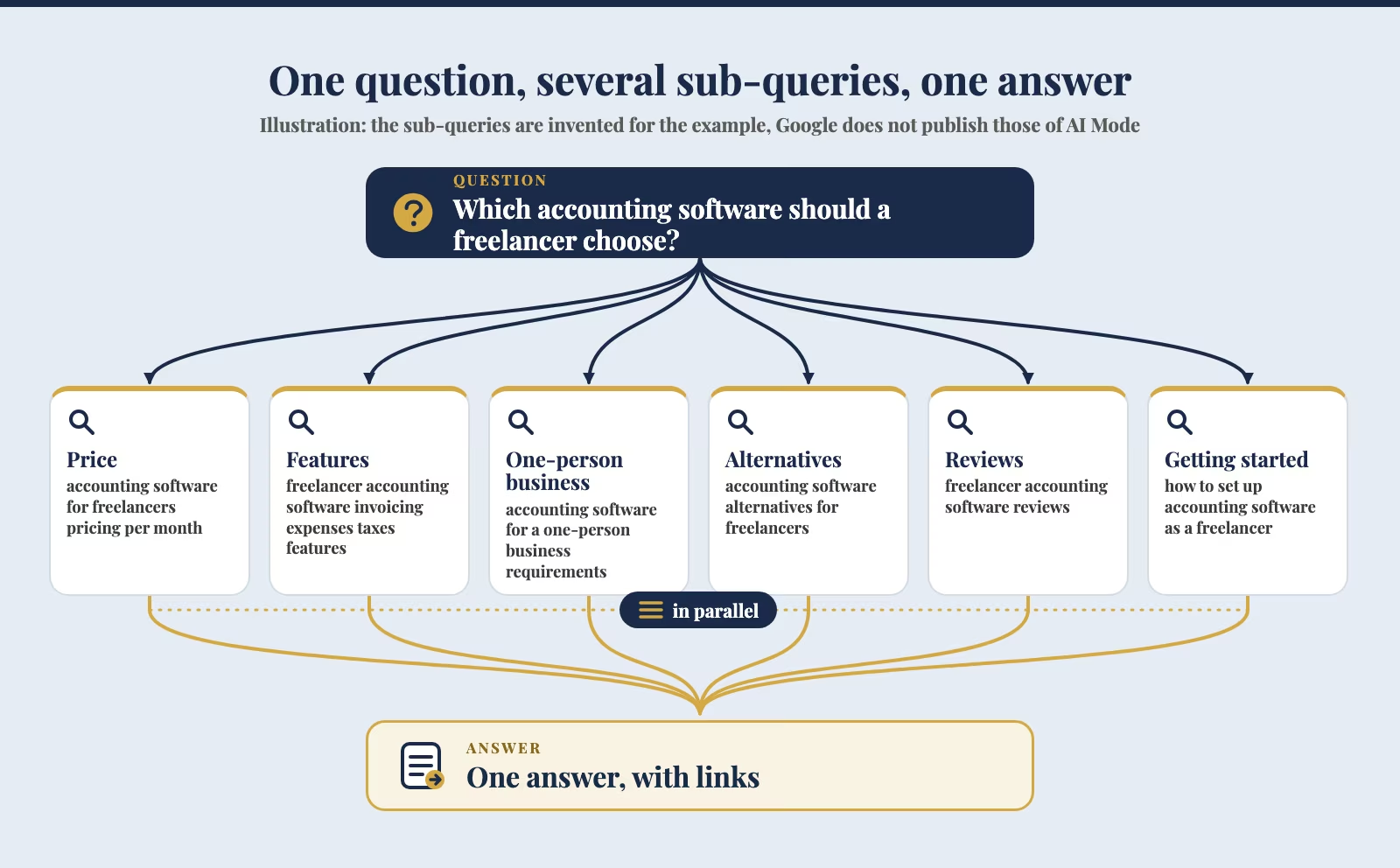
The count of six has no measurement value. Which searches start this process is the next question.
Which searches trigger query fan out?
None of the Google pages read on November 17, 2026 documents which searches trigger query fan out, in our reading. Google describes AI Mode as "particularly helpful for questions that need further exploration, comparisons and reasoning", in its launch post of March 5, 2025 on the Labs experiment. In our reading, questions that cover several subtopics benefit most from query fan out. How the results of the sub-queries come back together is the next question.
How do the sub-query results become the sources an answer cites?
In query fan out, the engine compiles the sub-query results into one answer and shows the sources that support the answer as links. Google's guide of July 10, 2026 describes generative AI features "showing prominent, clickable links to relevant web pages that support the information in the response". In our reading, the pages cited come from what the sub-searches return, and Google's guide does not say that the sub-query results come from its core Search ranking systems. How an engine selects those sources is covered in the guide to how SEO gets a page cited. How this differs from a classic search is the next question.
How does query fan out differ from query reformulation and classic search?
Query fan out differs from classic search and from query reformulation by running several concurrent, related queries for one question, as Google's definition of the technique describes. In our reading, classic search matches the typed query to one page of results, and query reformulation replaces the typed query with one rewritten query. Google's 2017 patent on query variants is the closest sourced neighbour of reformulation: it describes variants of an original query, and its text never uses the term query fan out or the name AI Mode. In our reading, variants of one query and a question divided into subtopics are two different operations. Which engines apply query fan out comes next.
Which engines use query fan out?
The sources read for this guide document query fan out in two engines, listed here with the kind of source each rests on.
- Google AI Overviews and AI Mode: Google's Search Central page covers both surfaces, and the Search Help page on AI Mode and the two 2025 launch posts cover AI Mode only, so all four describe query fan out and its sub-queries.
- ChatGPT: a study of ChatGPT's interface captured the sub-queries that ChatGPT issued.
The sources differ by engine, first-party pages for Google and a study for ChatGPT, in our reading. How Google applies the technique in AI Overviews and AI Mode comes first.
How does Google use query fan out in AI Overviews and AI Mode?
Google applies query fan out in AI Mode by dividing a question into subtopics, searching for each one simultaneously across multiple data sources and compiling the results, according to its Search Help page. For AI Overviews, Search Central's page of December 10, 2025 describes the technique as "issuing multiple related searches across subtopics and data sources". Which model generates the sub-queries? Google's guide says "the model" without naming one. Google's Search post of November 12, 2026 says Gemini 4 Hydrogen is "now available globally in Google Search for all users" and that its "advanced reasoning supercharges our query fan-out technique in Search". The Help page says "Gemini 4 Hydrogen in AI Mode is helpful for fast, all-around assistance on most questions", a sentence that does not mention query fan out. The guide to Google AI Mode covers how AI Mode searches. ChatGPT and the other engines come next.
What about ChatGPT and other engines?
ChatGPT and other engines differ on query fan out: ChatGPT issues several sub-queries for one question, as AirOps and Kevin Indig captured from its interface in a study dated April 13, 2026. In that sample of 16,851 queries, 88.6 percent generated exactly 2 sub-queries, a ChatGPT-only figure. OpenAI's crawler documentation says OAI-SearchBot "is used to surface websites in search results in ChatGPT's search features". No maker page read for this guide describes other engines' sub-queries, in our reading. The guide to ChatGPT SEO covers how ChatGPT picks its sources. Who can see these sub-queries comes next.
Can you see the sub-queries an engine runs?
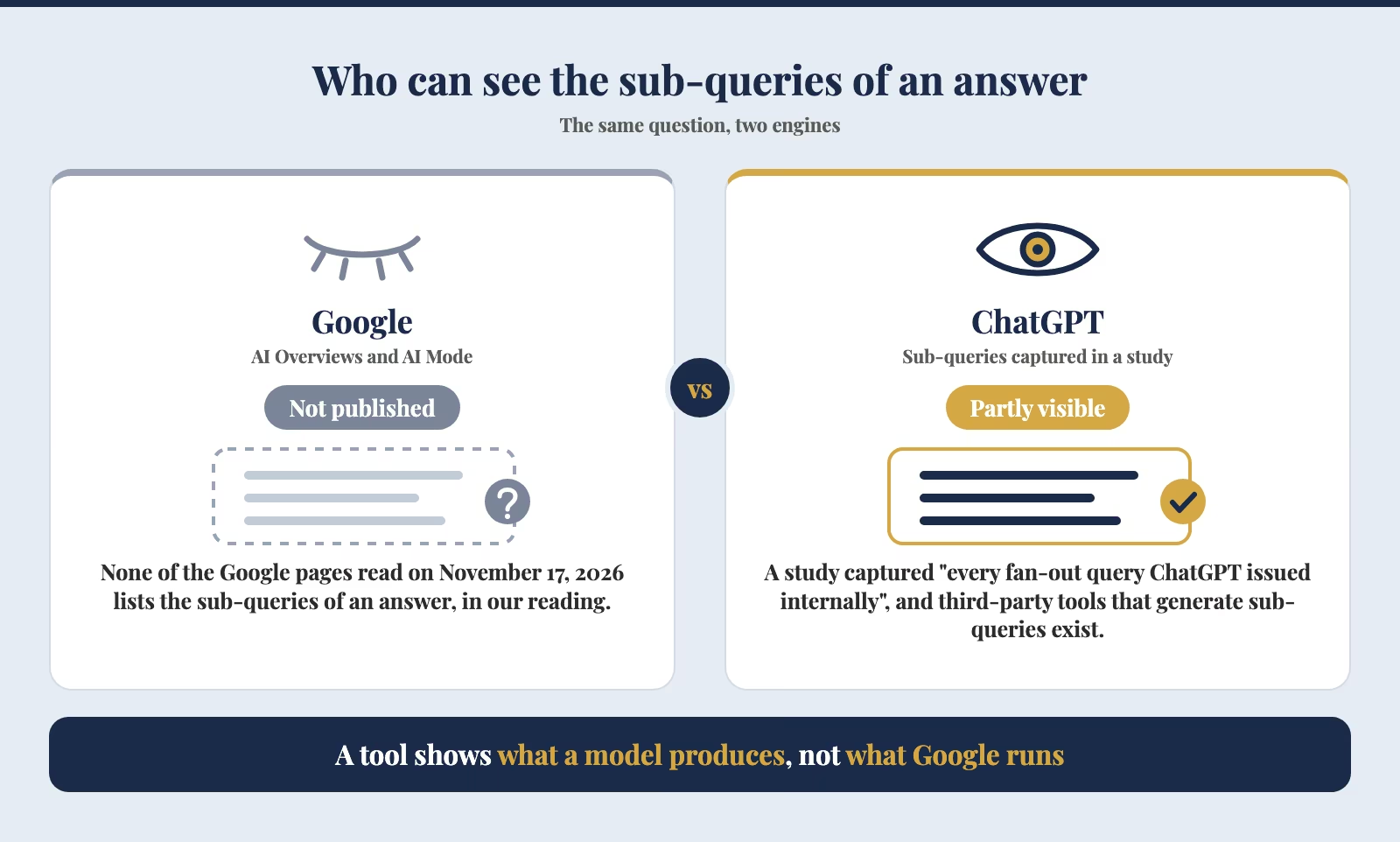
No for Google and partly yes for ChatGPT when you want to see the sub-queries an engine runs in query fan out. None of the Google pages read on November 17, 2026 lists the sub-queries of an AI Mode or AI Overviews answer, in our reading. Surfer's page "67.82% of AIO Citations Don't Rank In Google's Top 10", updated September 17, 2026, says "there's no way to see exactly which fan-out queries AIOs actually search for". The AirOps and Kevin Indig study captured "every fan-out query ChatGPT issued internally", and third-party tools that generate sub-queries exist. A tool shows what a model produces, not what Google runs, and the studies of Google's technique read the queries of a Gemini model, a proxy for AI Mode or AI Overviews and not the answers as served. What Google's patents describe about generating queries is the next question.
What do Google's patents say about generating queries?
The Google LLC patent US11663201B2 on generating queries describes a trained generative model that takes the tokens of an original query as input and generates at least one variant of that query. Titled "Generating query variants using a trained generative model", it has a priority date of April 29, 2017, was filed on April 27, 2018 and was granted on May 30, 2023. Claim 1 includes trained control models that determine whether any query variants are generated. In some implementations, several variants of one query are submitted to a search system, each with its own response. The patent's list of query variants includes an equivalent query, a follow-up query, a generalization query, a specification query and a language translation query. A patent describes an invention and does not prove that a system uses it. In our reading, the patent shows an older way of producing several queries from one, and it does not show that AI Mode works this way, because its text never uses the term query fan out, the name AI Mode or the word parallel. The page on the generative summaries patent covers a separate Google patent family that this guide does not retell. What studies measure about query fan out comes next.
What do studies measure about query fan out?
In our reading, the published studies of query fan out measure different engines, units and dates, so their figures do not add up. The list below gives four studies, each with its engine, its unit and its date. The Seer Interactive and Nectiv counts come from Gemini 3, before Google's Gemini 4 Hydrogen post of November 12, 2026, which says Hydrogen's advanced reasoning "supercharges our query fan-out technique in Search", so their per-prompt counts describe the earlier model and not Hydrogen.
- AirOps with Kevin Indig, ChatGPT only (April 13, 2026): 16,851 queries and 353,799 pages, from an AI-search platform vendor; pages whose H1 to H4 headings closely match the user's query are cited 41 percent of the time against 29 percent for weak matches, and, among pages with a primary heading similarity of 0.8 or more, pages covering 26-50 percent of the query fan out subtopics are cited at 38.2 percent against 34.0 percent for pages covering 100 percent.
- Seer Interactive, "Initial Research: Gemini 3 Query Fan-Outs", a Gemini 3 API proxy with grounding forced (November 21, 2025): across 501 prompts, an average of 10.7 fan out queries per prompt, minimum 3 and maximum 28, and 95 percent of the fan out queries with a global search volume of 0, which Seer says does not necessarily mean zero demand.
- Nectiv, a Gemini 3 API proxy with grounding (page without a date, written in November 2025): across about 9,000 prompts, an average of 9.06 fan out queries per prompt and a maximum of 28, with 59 percent of prompts holding between 5 and 11 and 24 percent between 12 and 19, and Nectiv says it does not know for sure that AI Mode works the same way.
- Surfer, "Query Fan-Out: What It Is, How It Works, and How to Optimize for It", a Gemini proxy for AI Overviews (published September 9, 2026, updated October 22, 2026): across 10,000 keywords and 33,000 fan out queries, 51.2 percent of the cited pages that rank ranked for the main query and at least one fan out query, against 19.6 percent for the main query alone, which Surfer words as 161 percent more likely to be cited, as a correlation and not causation.
The stability of the sub-queries comes next.
Do the sub-queries stay the same from one answer to the next?
No, the sub-queries do not stay the same reliably: Surfer found only about 27 percent of fan out queries consistent across repeated runs of the same prompt. Its page, updated October 22, 2026, reports 66 percent of the fan out queries appearing only once and 0.6 percent in every run, over 1,600 runs with Gemini grounding, a proxy. In a second sample of its own tracked prompts on the Gemini 3 API, Seer Interactive reports in its page "Identifying Signal from Noise: 6 Ways to Leverage Query Fan Outs for AI Search Strategy", dated January 27, 2026, that it pulled the fan out queries twice each day for a week and that only 8 queries appeared in all 13 runs. Ahrefs states that AI Overviews are "probabilistic" and that their "content, citations, entities, and fan-outs change with every query", in its page of March 2, 2026, an assertion and not a measured figure. In our reading, a one-time reading of a page's visibility on one answer is therefore not a stable measure. What query fan out changes for a site's SEO comes next.
What does query fan out change for a site's SEO?
In our reading, query fan out makes a page compete on the sub-queries of a question, not only on the main query. The visible gain is a citation next to the answer and not only a click, in our reading. Three questions follow from this: whether query fan out is SEO or GEO, what makes a page cited, and how to cover the sub-queries.
Is query fan out SEO or GEO?
Neither one alone: query fan out is an engine mechanism that both SEO and GEO account for, in our reading. On that reading, SEO ranks pages on the sub-queries of a question, GEO aims at the citation of those pages, and the differences between the two lie in that target while their overlaps lie in the signals they share. The guide to the differences, overlaps and priorities among SEO, GEO and AEO holds the full comparison. What makes a page cited when a sub-query reaches it is the next question.
What makes a page cited when a sub-query reaches it?
In our reading, five points govern whether a page is cited when a sub-query of a query fan out reaches it.
- Ranked versus cited: a page that ranks for the main query can be absent from what a sub-query returns, since each sub-query runs as its own search.
- Passages: the passage that answers a sub-query is the part of a page that an answer can reuse.
- Information gain: a page that holds a fact the other results for a sub-query lack gives the engine a reason to cite it.
- Eligibility for a sub-query: a page can be shown as a supporting link in Google AI Overviews and AI Mode only if three conditions hold: it is indexed, it is eligible to be shown in Google Search with a snippet, and its site is included in "Search generative AI features" in Search Console (the third condition comes from Google's guide of July 10, 2026).
- Owner guides: the guides to Google AI Overviews, Google AI Mode and AEO on this site hold the figures and controls behind each point for a sub-query.
In our reading, none of the Google pages read on November 17, 2026 documents a setting for query fan out itself. How to cover the sub-queries in a page comes next.
How do you cover the sub-queries of a question in a page?
To cover the sub-queries that query fan out generates for a question, a page gives each real subtopic its own section, in our method of five steps.
- List the subtopics of the question, each one a candidate sub-query.
- Give each subtopic its own section, with a question as heading and a direct answer as first sentence, one section per sub-query.
- Check the subtopics against what searchers ask, in autocomplete, related questions and People Also Ask, since the Google pages read on November 17, 2026 do not list the sub-queries of an answer.
- Keep the page's macro context, so that every section answers a sub-query of the same question and a sub-query outside the page's topic goes to another page.
- Re-run the question on a fixed list of prompts, record which pages the answers cite for each subtopic and read the trend.
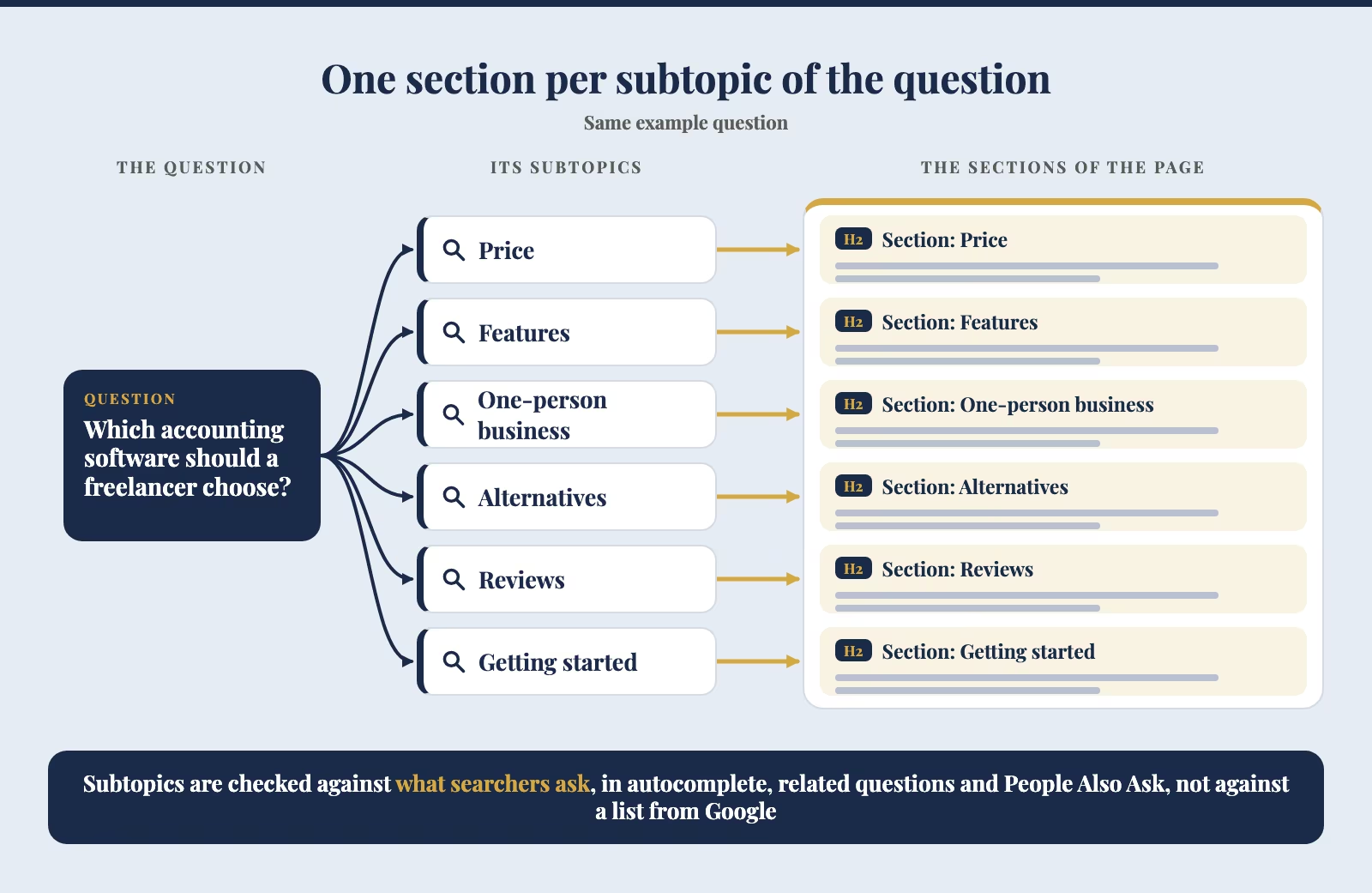
In our reading, the plan is one section per real subtopic of the question, never one page per sub-query and never a list of sub-queries. Google's guide of July 10, 2026 warns that creating separate content for every possible variation of how people search, including "fan-out queries", "primarily to manipulate rankings or generative AI responses in Google Search violates Google's scaled content abuse spam policy". The AirOps and Kevin Indig report of April 13, 2026, a ChatGPT study, says the query fan out subtopics are not a content checklist. In our reading, depth on each subtopic serves a page better than breadth across all of them, and a section per subtopic fits better than one exhaustive pillar page. Where to start comes next.
Where should you start, and who needs this?
In our reading, you start where pages already rank on a broad question and miss some of its subtopics, and who needs this is any site whose pages answer broad questions, and not pages with a single narrow answer. Does query fan out replace keyword research? No. Seer Interactive found that 95 percent of the fan out queries it collected from the Gemini 3 API, over 501 prompts with grounding forced, had a global search volume of 0, in its page of November 21, 2025, and says that 0 volume does not necessarily mean zero demand. In our reading, a keyword tool does not list the sub-queries that a model generates, so keyword research stays for the main query and the subtopics. A page per sub-query is the practice that Google's guide warns against when its aim is to manipulate rankings. When to hand this work over is the last question.
When should you hire a GEO agency to cover the sub-queries?
In our reading, a GEO agency fits when the sub-queries of a site's questions are too many to cover page by page in-house. The work of covering query fan out at scale grows with the number of pages and subtopics, and each page calls for a measure against the sub-queries derived from its question, a job that a generative engine optimization agency runs across a whole site.