Answer engine optimization (AEO) is the practice of structuring a page so that an answer engine takes its content into the direct answer and cites the page, a term Google's guide names. AEO targets that answer, not a position in a list. From Google Search's perspective, optimizing for generative AI search is "optimizing for the search experience, and thus still SEO", says Google's guide updated July 10, 2026. This guide covers the definition, the difference from SEO, the mechanism, the method, GEO and agencies.
What is AEO (answer engine optimization)?
AEO (answer engine optimization) is the work of preparing a page so that an answer engine finds it, understands it and presents its content as the answer, a definition close to Microsoft Advertising's for AI agents and assistants.
The unique attribute of AEO is the destination: a page is taken into the answer, not listed as a result. What is AEO in marketing? Search marketing that earns a place in the answer instead of a rank. AEO covers four answer surfaces, listed below.
- Featured snippets: AEO targets what Google's Help calls "a little piece of a website that helps answer your question".
- Voice answers: AEO targets the spoken answer: featured snippets are "helpful when you use a phone or talk to your device", says Google's Help.
- AI-written answers in Google Search: AEO targets Google AI Overviews and AI Mode, which Google presents as AI-powered responses with links.
- AI-written answers in chat engines: AEO targets ChatGPT search, documented by OpenAI, and Microsoft Copilot, an AI-powered assistant per Microsoft.
Four questions refine this definition: the acronym, the sources' definitions, the place of AEO in AI search optimization and its origin.
What does AEO stand for?
AEO stands for answer engine optimization, according to Google's guide, which writes that "AEO" stands for "answer engine optimization" and "GEO" for "generative engine optimization".
About 5,400 US searches a month use "what is aeo" and about 2,400 use "answer engine optimization" (Google Ads, US, monthly averages, measured November 13, 2026); the bare "aeo" mixes several senses. The same letters are a clothing retailer's stock ticker, which Google's own AI Overview for "how much does aeo cost" showed on November 13, 2026 (our observation), and the European Commission's Authorised Economic Operator customs program. This guide covers the SEO sense only.
How do sources define AEO?
Sources define AEO around one target, a place in an engine's answer, but they do not stretch AEO over the same engines. The table sets each definition beside the engines it covers (sources checked November 13, 2026).
| Source | What the source calls AEO | Engines covered | Date |
|---|---|---|---|
| Google Search Central, AI optimization guide | A term for "work specifically focused on improving visibility in AI search experiences", still SEO from Google Search's perspective | Generative AI features of Google Search | Updated July 10, 2026 |
| Microsoft Advertising, "From discovery to influence: A guide to AEO and GEO" | "Answer/Agentic Engine Optimization (AEO)": content for AI agents and assistants such as Copilot or ChatGPT | AI agents and assistants | Undated PDF, created December 2025 |
| HubSpot blog, "Answer engine optimization best practices marketers can't ignore in 2026" | Formatting content so that AI-powered systems can extract and cite it | AI Overviews, ChatGPT, Perplexity | Updated November 10, 2026 |
| English Wikipedia, "Generative engine optimization" (redirect from "Answer engine optimization") | Another name for generative engine optimization, with "no consensus definition" | AI-generated responses | Undated, checked November 13, 2026 |
HubSpot's product page "Show Up in AI Search with Answer Engine Optimization (AEO)" words the term differently, as improving how often and how accurately a business appears in AI-generated answers. Search Engine Journal reported Google's guide on May 15, 2026, under the headline "Google's New AI Search Guide Calls AEO And GEO 'Still SEO'"; Google's own page is dated July 10, 2026. The sources agree on the target and differ on its reach: vendors list several engines, Microsoft narrows the term to agents and assistants, Google files it under SEO. The place of AEO among these labels comes next.
Where does AEO sit in AI search optimization?
AEO sits in AI search optimization as one of its three common names, the one that takes the angle of the answer engine, next to GEO and LLMO, the naming that this site's guide to AI search optimization uses.
What is specific to AEO in that family is the answer an engine writes and the sources it shows. The guide that covers GEO, AEO, ChatGPT and AI Overviews maps the whole family, from the umbrella term to each engine. The family is recent, but the answers it targets are not.
When did people start talking about AEO?
No source read dates the term AEO itself, but voice search, one of its answer surfaces, predates generative AI, as Google's blog post "10 things you may have missed at Google I/O" of May 24, 2016 reports.
In that post Emily Wood wrote for Google that "on the Google app on Android, over 20 percent of the searches we get in the U.S. are now by voice". "Passage" is the word of the patents and of this guide; Google says "a little piece of a website". That history frames the difference between AEO and SEO.
What is the difference between AEO and SEO?
The difference between AEO and SEO is that SEO works for a position in a list of results, while AEO works for a page's content to be taken into the direct answer, the split of this site's guide to AI search optimization.
Both work on the same indexed page and the same base: Google's guide says "the best practices for SEO continue to be relevant because our generative AI features on Google Search are rooted in our core Search ranking and quality systems" (Google Search only). AEO adds work on the form of the answer, our reading. Which is better, SEO or AEO? The question compares a base with a layer. Three questions detail it: what AEO keeps, gives and changes.
What does AEO keep from SEO?
AEO keeps four parts of the SEO base; the overlap is listed below for Google's features.
- An indexed page: AEO needs a page that Google has indexed, the first of three conditions in its guide.
- Text that answers the question: AEO relies on important content "available in textual form", a fundamental that Google lists in "AI features and your website".
- Eligibility to be shown with a snippet: AEO keeps the second condition; the third is a site included in "Search generative AI features" in Search Console.
- Structured data that matches the visible text: AEO needs no special markup, since "there's no special schema.org markup you need to add".
Where AEO departs from SEO is the result: a citation instead of a click.
What does AEO give a site: a click or a citation?
With AEO, a site gains a citation inside the answer, and a click only if the reader follows the link, since Google's responses show "prominent, clickable links to relevant web pages", according to its guide.
Search Console counts a click on an external link in an AI Overview or AI Mode as a click, says Search Console Help, and reports it within the "Web" search type of the Performance report, says Google's page "AI features and your website", last updated December 10, 2025. Impressions have their own generative AI performance report, rolled out to all websites on August 31, 2026. Both reports bear on visibility and traffic.
What does AEO change for a site's visibility and traffic?
AEO changes a site's visibility and traffic by moving the site's presence inside the answer, with the source shown, according to Google's description of its AI features.
An AI Overview, Google says, helps "people get to the gist of a complicated topic or question more quickly". Why does AEO matter? Because in these features the gist comes first and the links second. A citation without a click is not traffic, and Google counts AI-feature traffic in the "Web" total. The sequence that produces these answers is the mechanism behind AEO.
How does AEO work?
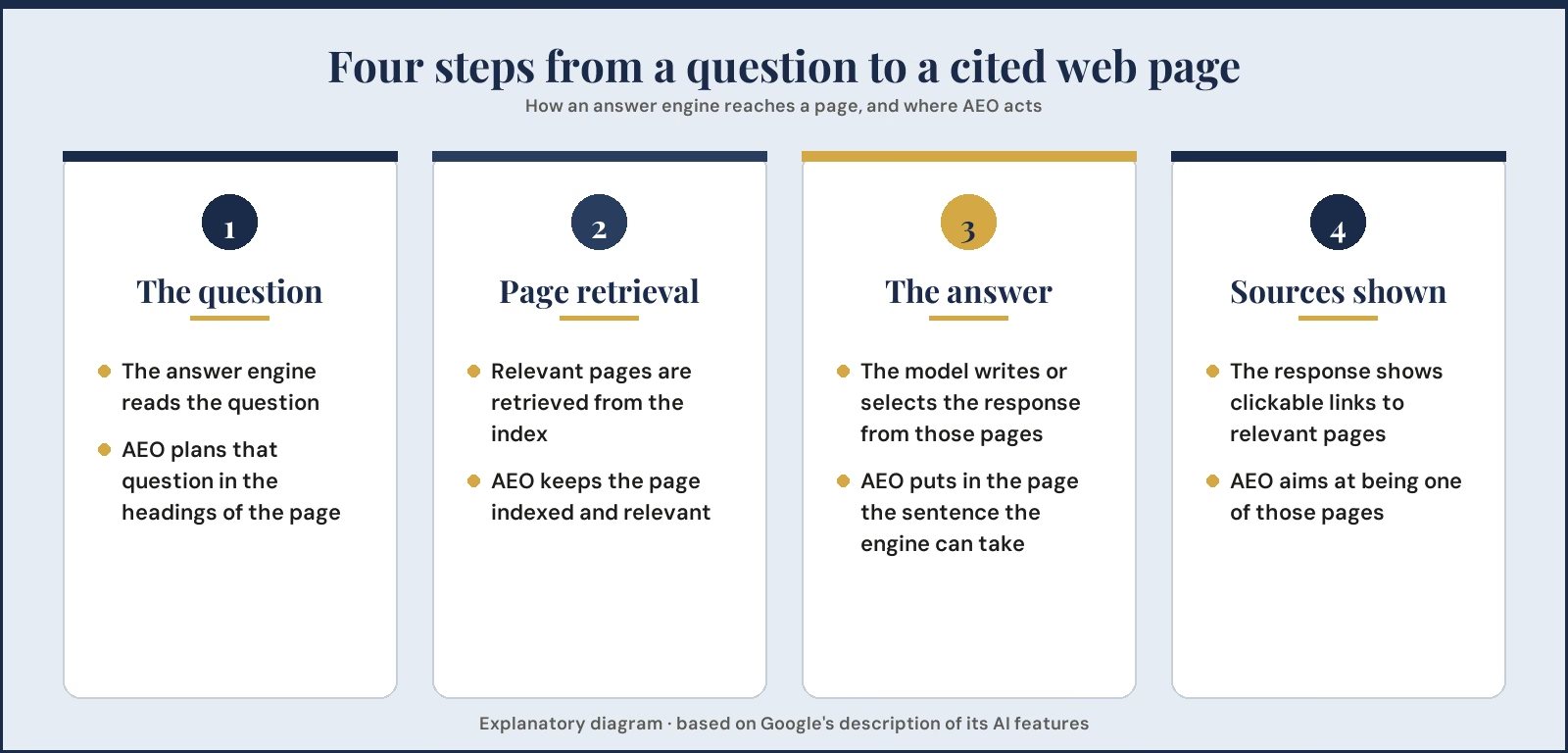
AEO works on the page's side of a sequence in which an answer engine reads the question, retrieves pages, writes or selects an answer and shows links to its sources, as Google describes for its AI features.
An answer goes through four steps, and AEO acts on the page at each of them.
- The question: the answer engine reads the question, and AEO plans that question in the headings of the page.
- The retrieval of pages: Google's AI features rely on core Search ranking systems "to retrieve relevant, up-to-date web pages from our Search index", and AEO keeps the page indexed and relevant.
- The answer: the model writes or selects the response from the retrieved pages, and AEO puts in the page the sentence that the engine can take.
- The sources shown: the response shows "prominent, clickable links to relevant web pages", and AEO aims at being one of those pages.
Google says AI Mode and AI Overviews "may use different models and techniques, so the set of responses and links they show will vary", so this guide names no model. Seven questions detail the mechanism: engines, searches, page choice, ranking versus quoting, conditions, ads and accuracy.
Which answer engines does AEO target?
AEO targets the answer engines of four companies, listed below.
- Google AI Overviews and AI Mode: AEO targets the two generative features of Google Search that Google's guide covers.
- ChatGPT search: AEO targets ChatGPT search, where OpenAI says its OAI-SearchBot "is used to surface websites in search results in ChatGPT's search features".
- Microsoft Copilot: AEO targets Copilot, which Microsoft describes as "an AI-powered assistant".
- Perplexity: AEO targets Perplexity, which says that when users ask a question it "might visit a web page" and "include a link to the page in its response".
Which searches trigger those answers is the next question.
Which searches does AEO concern?
AEO concerns the searches where Google's answer features add to the classic results, according to Google Search Central.
AI Overviews "were designed to show up on queries where they can add additional benefits beyond what people might already get on Search", and AI Mode suits queries needing "exploration, reasoning, or complex comparisons". A featured snippet appears when Google "thinks people want answers that can be found in a short piece of a website", says Google's Help.
How does an answer engine choose the pages AEO aims at?
An answer engine chooses the pages whose content answers the question and that it can show with a link, as Google's guide describes for its AI features.
ChatGPT search, Perplexity and Google's AI features share that trait: each surfaces or links websites next to the answer, per OpenAI, Perplexity and Google. Selection rules per engine sit in the guides to Google AI Overviews and Google AI Mode. Three layers detail the choice: query fan-out, the top 10 share and a patent.
What is query fan-out for AEO?
Query fan-out for AEO is the technique by which an answer engine issues several related searches across subtopics and data sources before writing the answer, a technique that both AI Overviews and AI Mode "may use", according to Google Search Central.
Google's guide defines it as "a set of concurrent, related queries generated by the model". In our reading, a page can be reached through a sub-query, not only through the user's wording. The pages that sub-queries bring back raise the question of the top 10.
What share of AEO sources comes from the top 10?
The share of AEO sources that comes from the top 10 varies by engine and by study, so this page gives no figure.
One fact holds for Google: a page absent from the index cannot be a source, since its guide says a page "must be indexed" to be eligible. A patent sits behind the selection of sources.
Which patent explains how AEO sources are selected?
The patent that explains how AEO sources are selected, in our reading, is Google's US 11,769,017 B1, "Generative summaries for search results", granted on September 26, 2023: it describes a summary written from documents selected among the search results, a portion of the summary tied to a document that verifies it.
A patent describes what a system can do, not that Google Search uses it. The passage is the other half of quoting.
Why isn't a well-ranked page always quoted by AEO?
A well-ranked page is not always quoted by AEO because ranking decides whether a page is a candidate, while extraction decides whether a passage is used, in our reading of two Google patents. The patents are US 9,940,367 B1, "Scoring candidate answer passages" (granted April 10, 2018), and US 9,959,315 B1, "Context scoring adjustments for answer passages" (granted May 1, 2018).
They describe the scoring of candidate passages and its adjustment by the heading above; applying them to generated answers is our reading, and Google's guide says "There's no requirement to break your content into tiny pieces for AI to better understand it." A buried answer gives the engine nothing clear to take, so we recommend placing the answer under a heading that asks for it. Conditions come next.
What conditions must a page meet for AEO?
A page must meet three conditions for AEO in Google's AI features: it is indexed, it is eligible to be shown in Google Search with a snippet, and its site is included in "Search generative AI features" in Search Console, according to Google's guide, last updated July 10, 2026.
Search Console Help names the setting the Search generative AI control: Include is the default, and a property with a parent property inherits its parent's value by default. The rest is the SEO base; these conditions describe Google's features only. Three questions detail access and controls: crawlers, exclusion and llms.txt.
Which AI crawlers should AEO allow in robots.txt?
The AI crawlers that AEO allows in robots.txt are set per user agent, since each engine publishes its own tokens.
For Google, Googlebot governs crawling for Search, and Google-Extended is a separate token that "does not impact a site's inclusion in Google Search".
Can you exclude a page from AEO?
Yes, you can exclude a page from AEO in Google: nosnippet, data-nosnippet, max-snippet and noindex "limit the information shown from your pages in Search", says Google Search Central.
For a whole site, the Search generative AI control takes three values, Include, Exclude or Inherit control from parent; Exclude keeps the site's content out of Search generative AI features.
Does an llms.txt file help AEO?
No, an llms.txt file does not help AEO in Google Search, generative AI features included. Google's guide, last updated July 10, 2026, says that creating such a file "will neither harm nor help your site's visibility or rankings in Google Search, as Google Search ignores them".
Other services may read the file, and this page makes no claim for them.
Are there ads in the answers AEO targets?
Yes, there are ads in the answers AEO targets in the United States: Google Ads Help says ads in AI Overviews and AI Mode "are available in English in the United States and select English-speaking markets", labeled "Sponsored" (consulted November 13, 2026).
Standard ads can still appear above or below an AI Overview.
Are the answers AEO targets accurate?
The answers AEO targets are not always accurate: Google's Search Help says "AI Overviews can and will make mistakes" and "AI responses may include mistakes" in AI Mode, and both pages tell users to click the links to the sources.
A clear, sourced passage is easier to check, in our reading. Checking the answer leads to the practice itself.
How do you get quoted by an answer engine with AEO?
With AEO, you get quoted by an answer engine by applying the SEO best practices and shaping the form of the answer, our reading of Google's guide updated July 10, 2026.
Google says "You don't need to write in a specific way just for generative AI search", so AEO adds the form of the answer, not a separate technical step. Five questions detail the practice: formats, writing, signals, where to start and measuring.
Which answer formats does AEO aim to get quoted?
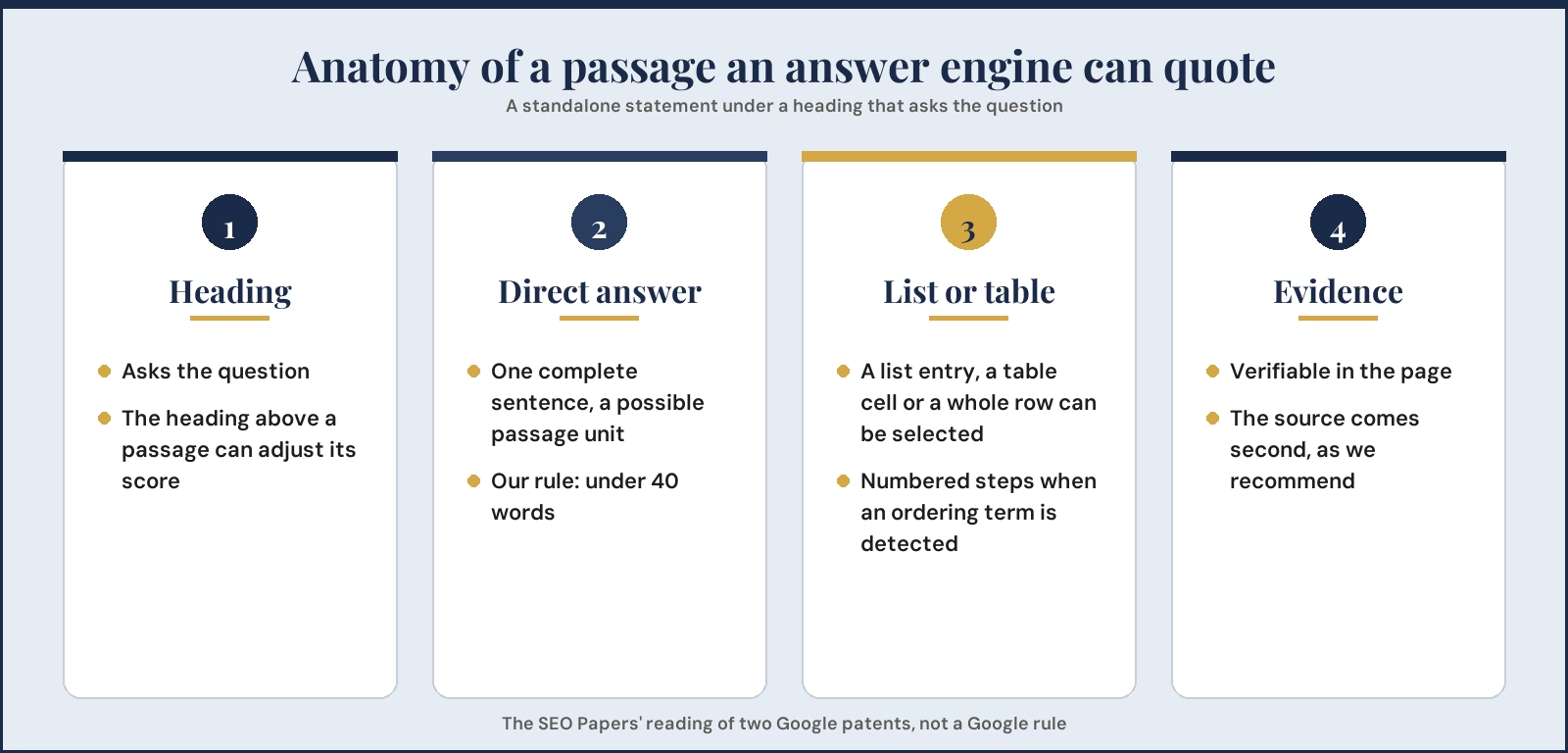
AEO aims to get quoted a passage that stands alone: a precise statement under a heading that asks the question, verifiable in the page, in our reading of two Google patents.
Google's guide says there is "no requirement to break your content into tiny pieces for AI", so the five formats that the patents describe, listed below, are options, not requirements.
- A one-sentence direct answer: AEO can aim at a complete sentence, which US 9,940,367 B1 describes as a possible "passage unit".
- A list: AEO can aim at a list: "a header, sentence, or list entry may be selected", says the same patent.
- A table: AEO can aim at a table: the patent describes selecting a "table entry (such as a cell value or even an entire row)".
- Numbered steps: AEO can aim at a step list: the patent includes "all steps from the structured content" when an ordering term is detected.
- A passage under a heading that matches the question: AEO can aim at it: US 9,959,315 B1 calls the match "a signal that within the scope of these two headings is a useful passage".
Writing the passage is the next step.
How do you write a page for AEO?
To write a page for AEO, we recommend putting the answer in the first sentence under a heading that states the question, then the evidence, an order that is our method, not a Google rule.
What does an AEO-ready passage look like? An illustration, not a measured case: under "What is a sitemap?", the weak passage opens with the history of search and reaches the definition in its third sentence, while the AEO-ready passage opens "A sitemap is a file that lists the URLs of a site for search engines" and gives its source second. Our rule is a first sentence under 40 words. Signals decide whether that passage is picked.
Which signals help AEO get a page quoted?
The signals that help AEO get a page quoted, in Google's documentation, are a page indexed and eligible to be shown with a snippet, a site included in "Search generative AI features" in Search Console and solid SEO fundamentals, according to Google's guide.
The patents describe two more, a passage that stands alone and the heading above it, which we read as AEO signals. Information gain is the last signal.
Does information gain help AEO?
Yes, in our reading, information gain helps AEO: Google's patent US 11,354,342 B2, "Contextual estimation of link information gain", granted on June 7, 2022, describes a score of the information a document adds beyond the documents the user has already seen, and its use by answer engines is our reading.
Where should you start: SEO or AEO?
You start with SEO and move to AEO once the page is indexed, eligible to be shown with a snippet and on a site included in "Search generative AI features" in Search Console, according to Google's guide.
AEO does not replace that base, since Google says SEO best practices continue to be relevant. Starting there leads to the measure of the result.
How do you measure your presence in AEO?
You measure your presence in AEO, for Google, in Search Console: the generative AI performance report shows impressions, and the Performance report, search type "Web", shows clicks, according to Search Console Help and Google's page "AI features and your website".
For other engines, ask the question and note whether the page is cited, with dated readings repeated over time. No standard AEO score exists, in our reading: a score is a vendor's own metric. Google says "No third-party tool has access to our internal ranking or AI systems". AI-visibility trackers run fixed questions across engines and record which pages are cited; AthenaHQ ("cross-platform AI visibility tracking"), HubSpot AEO and LLMrefs ("track keyword rankings, citations") describe themselves that way. Measuring leaves one question open: how AEO fits next to GEO and SEO.
How do AEO, GEO and SEO fit together?
AEO, GEO and LLMO fit together as three names for one target seen from three angles, with AEO taking the angle of the answer engine and its direct answer, while SEO is the discipline that aims at a ranking. GEO is generative engine optimization, the angle of engines that write an answer from several sources.
A separate guide compares SEO, GEO and AEO and sets out their differences, overlaps and priorities; this guide keeps only what is specific to AEO. Three questions detail the fit: AEO and GEO, the three names and AEO in SEO.
What is the difference between AEO and GEO?
The difference between AEO and GEO is mostly one of naming: both aim at being used in an AI answer, and AEO takes the angle of the answer engine.
Google treats AEO and GEO as two terms for work on visibility in AI search, according to its guide, and Microsoft Advertising separates them by target, AEO for AI agents and assistants such as Copilot or ChatGPT and GEO for generative AI search environments, so, in our reading, the split is a naming convention more than two disciplines.
What is the difference between AEO, GEO and LLMO?
The difference between AEO, GEO and LLMO is the angle: AEO takes the answer engine, GEO the generative engine and LLMO the large language model (LLM) behind both.
Is AEO part of SEO or GEO?
AEO is part of the AI search optimization family, next to GEO and LLMO, and part of SEO from Google Search's perspective: Google's guide, updated July 10, 2026, calls optimizing for generative AI search "still SEO", a Google position and not a rule for every engine.
Will AEO replace SEO?
No, AEO will not replace SEO: Google says the best practices for SEO "continue to be relevant" in its generative AI features.
When should you hire an agency for AEO?
In our reading, you hire an agency for AEO when the work needs several skills at once, pages written as answers, technical eligibility and a measure in each engine, and in-house work costs more than a handover; otherwise the SEO base and pages written as answers are enough.
No agency can promise a citation, in our reading, since Google says no third-party tool has access to its internal ranking or AI systems. The SEO Papers, the publisher of this guide, is an online SEO and GEO agency built on Google's patents: its office is in Paris (122 rue Amelot, 75011 Paris, France) and receives no clients, it has no US office, and all work runs remotely for clients in the United States, France and worldwide. Brands that outsource the work hire an answer engine optimization agency, sold under a second label as a generative engine optimization agency or GEO agency.
What does AEO agency work cost?
AEO agency work costs a monthly retainer whose published range depends on the source and on the scope, in US dollars as each source publishes it.
Stackmatix, an agency, writes on March 12, 2026 that small-business AEO retainers typically range from $1,500 to $5,000 a month, mid-market from $5,000 to $10,000 and enterprise from $10,000 to $20,000 or more. Digital Elevator, an agency, writes in a guide modified October 21, 2026 that most credible AEO and GEO retainers for mid-market businesses land between $2,000 and $10,000 a month, and enterprise programs between $10,000 and $30,000 or more. HubSpot, a software vendor, puts a mid-range AEO retainer at roughly $1,500 to $5,000 a month and a full-service program at roughly $10,000 to $15,000 or more (guide updated September 8, 2026). Prices go up with scope, says HubSpot, so a range is a market indication, not a quote.