AI search optimization (AI SEO) is the part of search engine optimization that makes a site found, cited and recommended inside the answers of generative engines such as Google AI Overviews and AI Mode, ChatGPT, Perplexity and Gemini. A generative engine writes one answer and cites a few pages as its sources instead of only listing ranked links. Understanding AI SEO means knowing what changes for a site's visibility, what stays from SEO, what the names GEO and AEO cover, which engines to target, how they pick their sources, which crawlers feed them and how to measure the result.
Free check
Does your site let AI crawlers in?
Enter your domain: the tool reads your robots.txt and tells you, crawler by crawler, who can read your site and what it is for.
To read a site's robots.txt file yourself, crawler by crawler, the section on AI crawlers below gives the method and the full list of tokens.
What is AI SEO?
AI SEO is the optimization of a site so that engines that generate an answer retrieve, use and cite its content, the work Google Search Central associates with the terms AEO and GEO. Its guide "Optimizing your website for generative AI features on Google Search" explains that "AEO" stands for "answer engine optimization" and "GEO" for "generative engine optimization", "terms you may see used to describe work specifically focused on improving visibility in AI search experiences".
The acronym GEO comes from the research paper "GEO: Generative Engine Optimization", submitted to arXiv on November 16, 2023 by Pranjal Aggarwal and co-authors. On its own benchmark, the paper reports that GEO can boost visibility by up to 40% in generative engine responses.
The phrase AI SEO covers two distinct readings. The first, SEO for AI, makes a site visible in the answers of generative engines: it is the subject of this page. The second, AI used for SEO work, names the AI tools that help optimize a site; this page treats it briefly at the end. What is the relationship between SEO and AI optimization? AI search optimization is SEO aimed at a new kind of results page, one that writes the answer and cites its sources. This new kind of answer changes what visibility means.
What does AI search optimization change for a site's visibility?
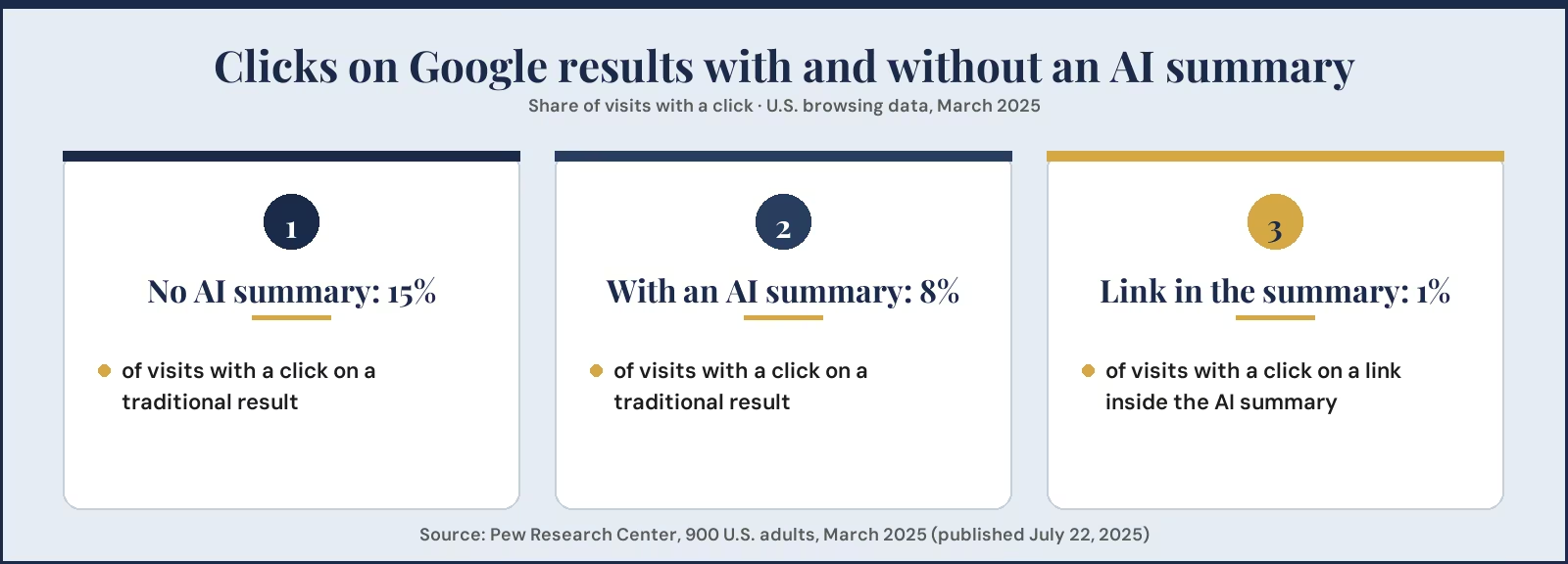
AI search optimization changes a site's visibility by moving it from a click on a ranked link to a citation inside a written answer, and fewer clicks reach the sites, according to the Pew Research Center. Pew measured it on the browsing data of 900 U.S. adults in March 2025, in a short read published on July 22, 2025: users clicked a traditional search result in 8% of visits when Google showed an AI summary, against 15% of visits without one.
A link inside the AI summary itself drew a click in just 1% of visits. Users ended their browsing session after 26% of pages with an AI summary, against 16% of pages with traditional results only. These figures describe U.S. users.
Google presents its AI Mode as particularly helpful for queries where further exploration, reasoning or complex comparisons are needed. Is a citation worth a click? Not in traffic terms, yet a citation exposes the site's name and content inside the answer itself, where AI SEO now competes. What does not change is the base that makes a page eligible for those citations.
What stays the same from SEO in AI search optimization?
What stays the same from SEO in AI search optimization is its entire base, because Google's generative AI features are rooted in its core Search ranking and quality systems, according to Google Search Central. To be shown as a supporting link in AI Overviews or AI Mode, a page must meet three conditions. The first two are being indexed and being eligible to be shown in Google Search with a snippet (the two conditions Google's page "AI features and your website" names). The third is sitting on a site included in Search generative AI features in Search Console, where "Include" is the default, according to the Search Console Help. Google's page "AI features and your website", which predates the Search Console control, adds no additional requirements to those two conditions and no other special optimization.
The indexing and snippet rules of search engine optimization, with its goals and pillars, are therefore the rules Google's AI features reuse. Getting cited by AI on Google starts with getting indexed in the search engine the AI draws its sources from.
A good ranking remains an advantage, not a guarantee of citation. In Ahrefs' study, the share of URLs cited in AI Overviews that held a top-10 position for the query was about 76% in July 2025, then about 38% in its update of March 2, 2026, run on 863,000 keyword SERPs and 4 million cited URLs after an improvement of its parsing method. Our reading of the two measures: indexing is the entry ticket, a top-10 ranking helps without securing a citation, and AI search optimization does not stop at ranking for the main query. Since the base stays the same, the new names of AI SEO mostly describe a change of target.
What is AI SEO called: GEO, AEO or LLMO?
AI SEO is called GEO, AEO or LLMO: AI search optimization goes by these three common names, which describe the same target from three angles.
- GEO (generative engine optimization): optimization for the engines that write an answer from several sources; it is the name the 2023 research paper chose.
- AEO (answer engine optimization): optimization for the assistants and engines that give a direct answer to a question; US searches for "answer engine optimization" reach 2,400 a month, according to our measurement on Google US on November 11, 2026.
- LLMO (large language model optimization): optimization for the large language models (LLMs) behind answer engines; "LLM optimization" is the form people search.
Google's guide names AEO and GEO and adds that, from Google Search's perspective, optimizing for generative AI search is optimizing for the search experience, and thus still SEO. Of the three names, GEO is the one compared term by term with SEO.
What is the difference between SEO and GEO?
The difference between SEO and GEO lies in the goal: SEO aims at a position in a list of results, GEO at being used and cited inside a written answer. Google's guide treats the second as part of the first, so the GEO vs SEO gap concerns the target, not the base: in AI SEO, both rest on a page that is crawled, indexed and eligible for a snippet. The remaining differences, from content format to measurement, are set out point by point in a comparison of GEO vs SEO. GEO targets specific generative engines, and they do not all cite their sources the same way.
Which generative engines does AI search optimization target?
AI search optimization targets the generative engines that write answers for searchers: ChatGPT search, Google's AI Overviews and AI Mode, Perplexity, Gemini, Claude, Microsoft Copilot (Microsoft's AI-powered assistant), Meta AI, Mistral's Vibe and DuckDuckGo's DuckAssist. In the United States, ChatGPT draws the larger measured demand: "chatgpt seo" totals 320 searches a month and "how to rank in chatgpt" 140, against 90 for "ai overviews seo" and 30 for "ai mode seo", according to our measurement on Google US on November 11, 2026.
Several of these engines document how they show their sources. OpenAI shows websites in ChatGPT's search answers. Google shows links to supporting websites in AI Mode. Perplexity surfaces and links websites in its search results. Meta cites and links content in Meta AI's responses. Mistral includes a link to the source in Vibe's answers. DuckDuckGo's AI-assisted answers prominently cite their sources. ChatGPT, then Google's two features, each call for their own reading.
How do you rank in ChatGPT?
To rank in ChatGPT, a site lets OAI-SearchBot crawl it, because ChatGPT cites sources rather than ranking them: OpenAI says sites opted out of OAI-SearchBot will not be shown in ChatGPT search answers, though they can still appear as navigational links. GPTBot, the crawler that collects content that may be used to train OpenAI's foundation models, is a separate setting, and OpenAI states that each setting is independent of the others. For AI SEO, the rest of ChatGPT SEO plays out in the sources the engine retrieves at answer time. Google's answers follow their own rules, starting with AI Overviews.
What are Google's AI Overviews?
Google's AI Overviews are AI-generated summaries in Google Search that help people get to the gist of a complicated topic or question more quickly, with supporting links to web pages. Do all Google searches use AI now? No: Google shows AI Overviews only when its systems determine that they are additive to classic Search, and as such they often don't trigger. For AI SEO, a page therefore wins a place in Google AI Overviews only on queries that display the summary. Google's second generative feature, AI Mode, answers in a separate search mode.
What is Google AI Mode?
Google AI Mode is a search mode that gives a comprehensive AI-powered response with links to supporting websites, according to Google. Google adds that AI Mode and AI Overviews may use different models and techniques, so the responses and links they show will vary. For AI SEO, each feature is tracked on its own: a page cited in AI Overviews is checked separately in Google AI Mode. Both features pick their sources after splitting the question into several searches.
How does a generative engine split a question to pick its sources?
A generative engine such as Google's splits a question into several related searches across subtopics and data sources, then shows the pages that support its response. Google calls this technique "query fan-out" and says its AI Overviews and AI Mode may use it. Its AI-search guide describes the retrieval behind it, a technique Google calls grounding, which relies on its core Search ranking systems to retrieve relevant, up-to-date web pages from its Search index.
Ahrefs reads its drop from 76% to 38% the same way: according to its analysis, AI Overviews rely less on the direct search results and more on the sources that show up in fan-out query SERPs.
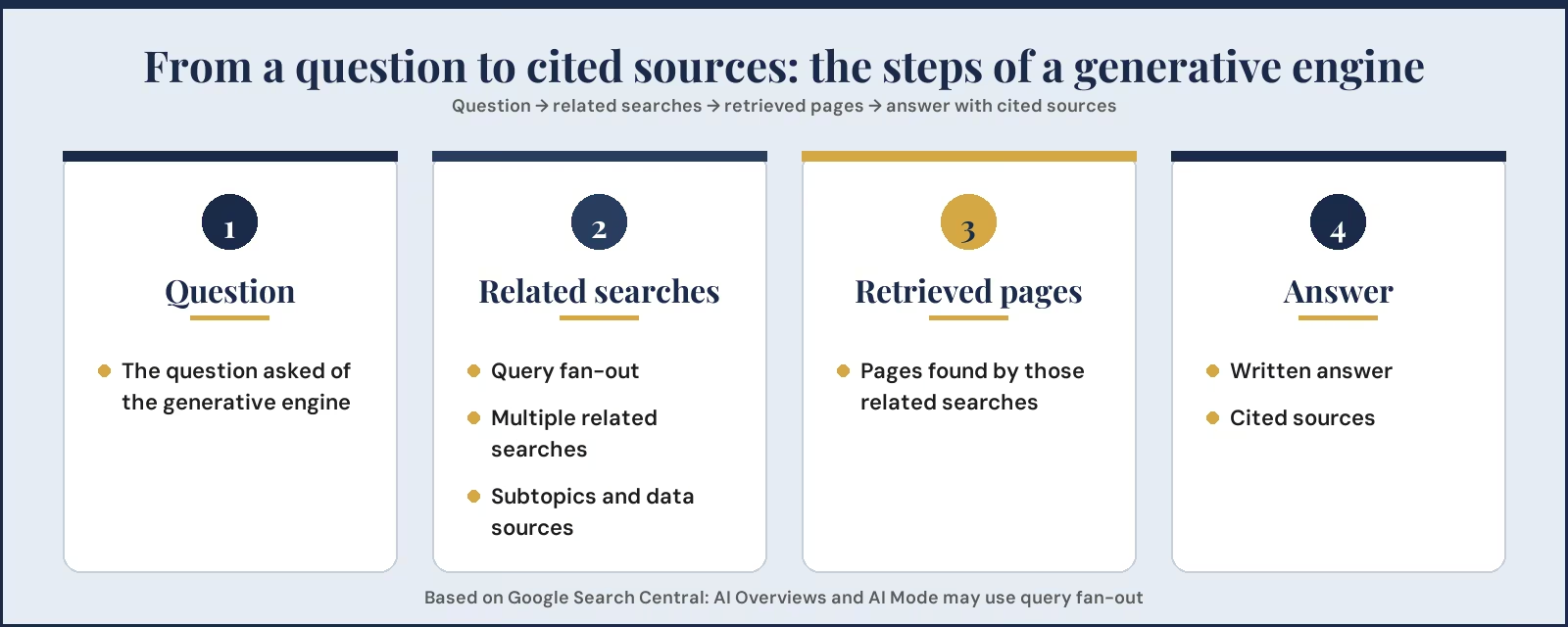
Our reading: the same question, asked several times, does not always return the same sources, since the derived searches and the retrieved pages vary from one answer to the next. For AI search optimization, query fan-out widens the competition: a page competes on the searches derived from a question, not only on its main query. The generative summaries patent, granted to Google in 2023, describes the step after retrieval: writing the answer from the selected pages.
What does Google's generative summaries patent describe?
Google's generative summaries patent describes an answer written by a large language model from the content of selected search result documents, with each verifiable portion linked to a page that supports it. Google filed patent US 11,769,017 B1, "Generative summaries for search results", on March 20, 2023, and the generative summaries patent was granted on September 26, 2023. For AI SEO, a page becomes a source by supporting a verifiable portion of the answer.
What is LLM SEO?
LLM SEO is the same AI search optimization, seen from the large language models that run generative engines. The GEO paper starts from that observation: according to its authors, the advent of large language models has ushered in a new paradigm of search engines that use generative models.
Content reaches an LLM answer by two roads. The first road is training, fed by crawlers such as OpenAI's GPTBot and Anthropic's ClaudeBot. The second road is retrieval at question time, run by crawlers such as OAI-SearchBot, Claude-SearchBot and PerplexityBot. At Google, the Google-Extended token covers both roads for Gemini: training future Gemini models and grounding answers in Gemini Apps and in Grounding with Google Search on Vertex AI. Most vendors separate these uses with distinct crawlers, which makes robots.txt an AI SEO setting in its own right.
Which AI crawlers read robots.txt?
The AI crawlers that read robots.txt go by the token each vendor publishes in its own documentation, and most vendors separate three uses: search, model training and visits a user triggers. For AI search optimization, the token is the unit a site allows or blocks.
The table below lists 22 tokens from 10 vendors, as their pages read on November 11, 2026, with the use each vendor declares and the effect of a Disallow rule.
| Robots.txt token | Vendor | Use declared by the vendor | Effect of a Disallow |
|---|---|---|---|
| GPTBot | OpenAI | Crawls content that may be used to train OpenAI's generative AI foundation models | Signals that the site's content should not be used for that training |
| OAI-SearchBot | OpenAI | Surfaces websites in ChatGPT's search features | Site not shown in ChatGPT search answers, except as a navigational link |
| ChatGPT-User | OpenAI | Visits pages for user actions in ChatGPT; no automatic crawling | Robots.txt rules may not apply |
| Googlebot | Builds Google's search indexes; always obeys robots.txt when crawling automatically | Google stops crawling the page for Search | |
| Google-Extended | Product token: Gemini model training and grounding in Gemini Apps and Vertex AI | Content left out of those two uses; inclusion in Google Search and ranking unchanged | |
| PerplexityBot | Perplexity | Surfaces and links websites in Perplexity search; no crawling for AI foundation models | No crawling for Perplexity search |
| Perplexity-User | Perplexity | Supports user actions within Perplexity | Robots.txt rules generally ignored |
| ClaudeBot | Anthropic | Collects web content that could contribute to training Anthropic's generative AI models | The site's future materials excluded from training datasets |
| Claude-SearchBot | Anthropic | Navigates the web to improve search result quality | Content not indexed for search |
| Claude-User | Anthropic | Accesses websites when people ask Claude questions | Content not retrieved in response to a user query |
| Meta-ExternalAgent | Meta | Use cases such as training foundation AI models | No crawling for those use cases |
| Meta-WebIndexer | Meta | Improves Meta AI search result quality | Loss of the access that helps Meta AI cite and link the site |
| Meta-ExternalFetcher | Meta | Fetches individual links at a user's request | Robots.txt may be bypassed |
| MistralAI-Index | Mistral AI | Indexes content for Mistral search, which answers in Vibe; no generative AI training | No indexing for Mistral search |
| MistralAI-Training | Mistral AI | Builds datasets to train Mistral generative AI models; no search indexing | No collection for training |
| MistralAI-User | Mistral AI | Visits pages to answer users in Vibe, with a source link; no training | No visits for those answers |
| DuckAssistBot | DuckDuckGo | Crawls pages in real time for AI-assisted answers that cite their sources; not used to train AI models | No crawling for those answers |
| Applebot | Apple | Powers search in Spotlight, Siri and Safari; data may help train Apple foundation models | No crawling by Applebot |
| Applebot-Extended | Apple | Training of Apple's generative foundation models | Content opted out of that training; Applebot may still crawl the site |
| Amazonbot | Amazon | Improves Amazon products and services; may be used to train Amazon AI models | No crawling by Amazonbot |
| Amzn-SearchBot | Amazon | Improves search experiences in Amazon products and services; no generative AI training | No crawling; when not named, it follows the rules given to other search bots |
| CCBot | Common Crawl | Open repository of web crawl data, accessible and analyzable by anyone | Stops the crawler, with User-agent: CCBot then Disallow: / |
Reading a robots.txt file by hand takes three steps.
- Open the site's
robots.txtaddress, for exampleexample.com/robots.txt. - Find the
User-agentgroup that names the crawler's token, or else theUser-agent: *group. - Read that group's
DisallowandAllowlines for the path/:Disallow: /closes the whole site to the crawler, and anAllowline reopens the path it names.
Three limits frame this AI SEO setting.
- User-triggered fetchers (ChatGPT-User, Perplexity-User, Meta-ExternalFetcher) partly escape the file, according to their vendors.
- Google-Extended does not change a site's inclusion in Google Search, and Google does not use it as a ranking signal.
- Blocking Googlebot stops Google from crawling the page, so the page can no longer meet the eligibility conditions of supporting links in AI Overviews and AI Mode.
On November 11, 2026, among the 20 domains ranking on page one in the United States for "ai seo" and "ai search optimization", 19 had a readable robots.txt, none blocked an AI crawler at the root, and 3 excluded some paths for named AI crawlers, according to our own check: one observation, not a rule. A second file, llms.txt, raises a neighboring question.
Does an llms.txt file help AI search optimization?
No, an llms.txt file does not help AI search optimization on Google: Google Search does not use it, and creating one neither harms nor helps visibility or rankings there. Google's guide "Optimizing your website for generative AI features on Google Search", last updated July 10, 2026, confirms it. The dedicated guide covers the file in detail; crawler access is set in robots.txt. Once that access is set, the question becomes how to measure visibility in AI answers.
How do you measure AI visibility?
To measure AI visibility, a site reads Search Console's Performance report for Google and repeats the same questions on the other generative engines. Google reports traffic from sites in AI Overviews and AI Mode in Search Console's Performance report, within the "Web" search type, according to Google Search Central, and its AI-search guide points to the Generative AI performance report in Search Console.
Outside Google, measuring AI search optimization takes repeated tests: ask each engine the same questions several times, record the cited sources and read a trend, never a single run, since the sources vary from one answer to the next. Google warns that no third-party tool has access to its internal ranking or AI systems. Measuring is SEO work, and AI now handles part of that work.
How is AI used for SEO work?
AI is used for SEO work in research, content structuring and repetitive tasks, the second reading of AI SEO. Google's guidance on generative AI content says generative AI can be particularly useful when researching a topic and to add structure to original content, while generating many pages without value for users may violate its spam policy on scaled content abuse. Its AI-search guide applies that policy to separate pages created for every query variation primarily to manipulate rankings or generative AI responses. Can AI do SEO, then? AI tools for SEO sort by task rather than by product: query research, content outlines, data checks and drafting under human review. Two questions remain: whether AI will replace SEO, and who runs the work.
Will AI replace SEO?
No, AI will not replace SEO, because generative engines that search the web draw on indexed pages, and Google states that SEO best practices remain relevant for its generative AI features. Is SEO dead? Not while a page must be indexed and eligible for a snippet to appear as a supporting link in AI Overviews or AI Mode: AI search optimization starts from that SEO base.
Should you hire a GEO agency for AI search optimization?
You should hire a GEO agency for AI search optimization when the site needs both sides of the work: the SEO base of indexing and snippets, and the AI-specific work on crawlers, citations and measurement. A site with a sound base and a team that already handles those three tasks keeps the work in house; other sites hand both sides to a generative engine optimization agency. The services of a generative engine optimization agency run from the technical audit to citation tracking.