SEO (search engine optimization) is the work that gets a page ranked in a search engine's results; GEO (generative engine optimization) is the work that gets that page cited as a source in the answer a generative engine writes. The main difference between SEO and GEO is the outcome: ranked, or cited. Their main overlap is the starting point: in Google patent US 11,769,017 B1, "Generative summaries for search results", the generative summary is written from documents selected among the query's search results. AEO, answer engine optimization, is the third label of the comparison. This page compares SEO, GEO and AEO in that order: how they differ, where they overlap, then what comes first.
What is the difference between GEO and SEO?
The difference between GEO and SEO is the goal: SEO gets a page ranked in a search engine's results, GEO gets it used and cited as a source inside the answer a generative engine writes.
On Google, GEO starts from SEO rankings: Google's generative summaries patent builds its summary from documents selected among the search results, so a ranked page becomes a candidate source. Google states that, from its perspective, optimizing for generative AI search is optimizing for the search experience, and thus still SEO.
The table below compares SEO, GEO and AEO on seven criteria.
| Criterion | SEO | GEO | AEO |
|---|---|---|---|
| Engines targeted | Search engines that rank pages: Google, Bing | ChatGPT search, Perplexity, Gemini, Google AI Overviews, AI Mode | AI assistants and agents such as Copilot or ChatGPT |
| Goal | A position and a click | A citation or mention in the answer | Clarity: an answer the assistant can present |
| Unit worked | The page | The passage that answers on its own | The answer to one question |
| What is displayed | A list of links | A written answer with its sources | A direct answer inside an assistant |
| Measurement | Positions, impressions, clicks (Search Console) | Citations and share of voice on fixed prompts | Answers and brand mentions in assistants |
| Shared base | Crawling, indexing, relevance, source reliability | The same base, plus, on Google, the site's inclusion in Search Console | The same base |
| Documented basis | Google's ranking documentation and patents | Generative summaries patent; elsewhere, our reading | Vendor definitions; no patent read by our team |
Live test
Ranked or cited?
Type a search: see Google's top 10 results next to the sources its AI Overview cites. Ranking is not always being cited.
On the query "geo vs seo", searched on Google in the United States on desktop on November 11, 2026, the AI Overview cited 8 sites. Of the 7 organic results on page one, only the two discussion platforms, Reddit and LinkedIn, were both ranked and cited: 0 of the 5 ranking articles was cited, according to our own check. This single observation shows the gap between SEO and GEO on one query, without setting a rule.
The labels overlap: Google treats AEO and GEO as two terms for work on visibility in AI search, while Microsoft Advertising separates them by target, so the AEO column records a convention rather than a separate discipline. The three terms are defined below.
What does GEO mean in SEO?
In SEO, GEO stands for generative engine optimization: the work that gets a page retrieved and cited by an engine that writes its answers. Here the acronym has nothing to do with geographic targeting or local SEO, a sense GEO carries in other contexts. The term comes from the research paper "GEO: Generative Engine Optimization" by Pranjal Aggarwal and co-authors from Princeton University and other institutions, submitted to arXiv in November 2023 and accepted to KDD 2024.
Why is GEO important in SEO? Because a share of search answers is now written by an engine before any click, so a page that ranks without being cited misses part of its audience: that is the stake of GEO vs SEO. The second term of the pair is older.
What does SEO mean?
SEO stands for search engine optimization: the work that gets a page ranked in a search engine's unpaid results. The goal of SEO is a high position on a query, which brings a click to the site, and ranking rests on three classic levers: technical work, content and links. These levers of search engine optimization form the base that SEO and GEO share: a page that can be crawled, that answers the query and that other sources recognize. A third acronym, AEO, sits next to GEO.
What is the difference between GEO and AEO?
GEO and AEO describe overlapping work: Microsoft Advertising, in its retail guide "From discovery to influence: A guide to AEO and GEO", defines AEO as optimizing content for AI agents and assistants such as Copilot or ChatGPT, and GEO as optimizing it for generative AI search environments. For Google, both name AI-search work that is still SEO. Are AEO and GEO the same? Largely in practice, not by definition. GEO leads because "geo vs seo" draws 2,900 US searches a month against 1,900 for "aeo vs seo" (our measurement, November 11, 2026). Each label points to its own engines.
Which engines do SEO, GEO and AEO target?
SEO, GEO and AEO target three families of engines: SEO targets search engines that rank pages, GEO targets engines that write an answer with its sources, and AEO, in Microsoft's framing, targets AI assistants and agents.
The engines of each family, with their publishers, are listed below.
- Search engines, for SEO: Google and Bing rank pages in a list of results.
- Generative search engines, for GEO: ChatGPT search, from OpenAI, surfaces websites in its search features; Perplexity links websites in its search results; Gemini comes from Google, as do AI Overviews, a quick overview of a topic with links to learn more, and AI Mode; Claude comes from Anthropic.
- AI assistants and agents, for AEO: Microsoft Copilot, Microsoft's AI-powered assistant, and ChatGPT, the two examples Microsoft Advertising names.
How ChatGPT, Gemini, Perplexity, Claude or Copilot choose their sources rests on no patent read by our team: what this page says about it is our reading. Between SEO and GEO, Google's AI Overviews hold a place of their own, since they appear inside Google's results.
Are AI Overviews part of SEO or GEO?
AI Overviews are part of both SEO and GEO: they appear in Google's results and rest on Google's core ranking systems. To appear as a supporting link in AI Overviews or AI Mode, a page must be indexed, be eligible to be shown in Google Search with a snippet, and sit on a site included in Search generative AI features in Search Console, according to Google Search Central's guide "Optimizing your website for generative AI features on Google Search". "Include" is the default control, according to the Search Console Help. Google Search Central's page "AI features and your website", updated December 10, 2025 and predating the Search Console control, names only the first two conditions and states that no other special optimization is necessary and SEO best practices remain relevant. On Google, GEO is therefore a layer on top of SEO, not a separate channel. That layer changes the expected result: a citation rather than a click.
What result do SEO and GEO aim for?
SEO aims for a position that earns a click; GEO aims for a citation, often without a click, that puts the brand inside the answer.
Most US Google searches already end without a click: in 2024, 58.5% of US Google searches resulted in zero clicks, according to SparkToro's zero-click study built on Datos panel data. Microsoft Advertising frames the AEO result in other terms: "If SEO focused on driving clicks, AEO is focused on driving clarity with enriched, real-time data."
The value of a citation therefore lies in brand exposure more than in visits, and that is where SEO and GEO part ways. The gap shows on a single query: a well-ranked page is not always cited.
Why isn't a well-ranked page always cited?
A well-ranked page is not always cited because a generative engine picks passages and draws on more than the top results. In Ahrefs' study, the share of URLs cited in AI Overviews that held a top-10 position fell from about 76% in July 2025 to 37.9% in its update of March 2, 2026, which covered 863,000 keyword SERPs and 4 million AI Overview URLs after an improvement of its parsing method.
Our own check under the comparison table goes further: on "geo vs seo", none of the 5 ranking articles was cited on November 11, 2026. Our reading of this gap between SEO and GEO: the engine widens its search to related queries, which Google calls query fan-out, a set of concurrent, related queries generated by the model to fetch additional results, and finds other pages there. Ranking and citation are therefore measured separately.
How do you measure SEO and GEO?
To measure SEO and GEO, two sets of metrics are tracked separately: positions and clicks for SEO, citations and share of voice in AI answers for GEO.
The metrics differ by what each one counts: a position, a visit or a citation.
- SEO metrics: positions, impressions, clicks and click-through rate (CTR) for each query, read in Google Search Console.
- GEO metrics: citations on a fixed set of prompts asked several times to each generative engine, share of voice against competitors in those answers, visits referred by AI engines in the analytics referrers, and brand mentions.
Part of GEO on Google is measured with SEO tools: Google reports traffic from AI Overviews and AI Mode in the Search Console Performance report, within the "Web" search type, and its AI-search guide points to the Generative AI performance report in Search Console. Google warns that no third-party tool has access to its internal ranking or AI systems. What these metrics capture rests on a set of shared signals.
What signals do SEO and GEO share?
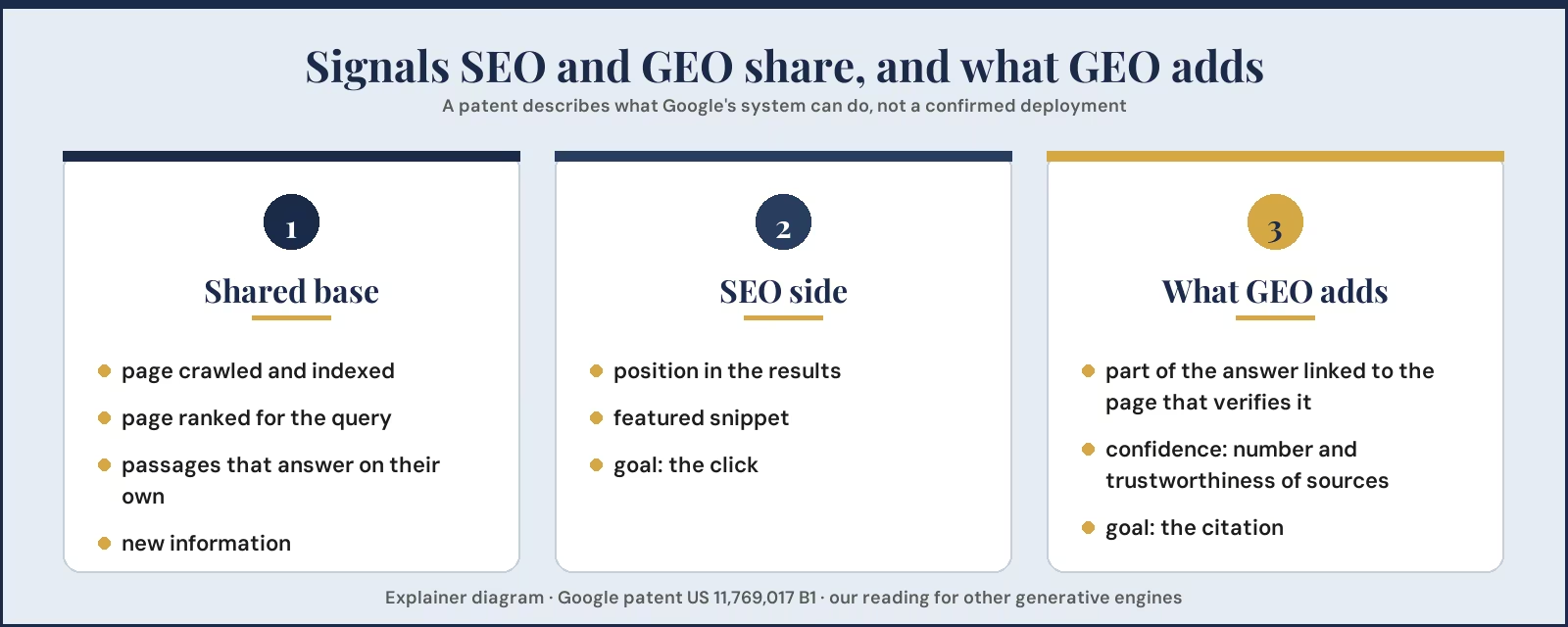
SEO and GEO share their base signals: a page that can be crawled and indexed, ranks for the query, holds passages that answer on their own, adds new information and comes from a reliable source. Google frames it in its own words: its generative AI features are rooted in its core Search ranking and quality systems.
A patent describes what Google's system can do; it confirms neither the measures used today nor their weight. Applying a Google patent to ChatGPT or Perplexity is our reading. Three shared signals carry most of the overlap: the ranking that opens the generative summary, the self-contained passage that a summary can cite, and the information gain that makes a page worth adding to an answer.
Why do AI Overviews start from SEO rankings?
AI Overviews start from SEO rankings because, in Google's generative summaries patent, the summary is written from search result documents selected for the query. In US 11,769,017 B1, "Generative summaries for search results", the system selects one or more query-responsive search result documents, then links a portion of the summary to a candidate document that verifies it. Confidence in a portion is greater when highly trustworthy documents verify it than when less trustworthy ones do. For GEO vs SEO, the consequence is direct: a page absent from the results is not a candidate source. Each step of Google's AI Overviews patent is analyzed in detail. Inside the selected documents, the summary still needs passages it can cite.
Which answer passages can a generative engine cite?
The answer passages a generative engine can cite are, in our reading of Google's patents, passages that stand on their own: a precise statement under a heading that asks the question, verifiable on the page. Google patent US 9,940,367 B1, "Scoring candidate answer passages", scores passages for answer boxes, and US 9,959,315 B1, "Context scoring adjustments for answer passages", determines a context score based in part on the heading vector. Both describe answer boxes; their use for generative answers is our reading. For SEO and GEO, one passage serves two outputs: the featured snippet and the citation. The mechanics of answer passage scoring are set out in a dedicated analysis. A passage is worth citing only if it adds something new.
What role does information gain play in SEO and GEO?
Information gain plays the role of a novelty signal in SEO and GEO alike: it scores the additional information a document holds, and an engine that synthesizes an answer has no use for identical pages. Google patent US 11,354,342 B2, "Contextual estimation of link information gain", describes such a score, indicative of additional information included in a given document; its use by generative engines is our reading. Google's AI-search guide makes the same point in its own words when it asks for non-commodity content that is helpful, reliable and people-first. How Google estimates information gain is broken down in that patent's analysis. These shared signals set the order of priorities.
Which comes first: SEO or GEO?
SEO comes first, because a generative engine that searches the web draws first on the pages it finds and ranks.
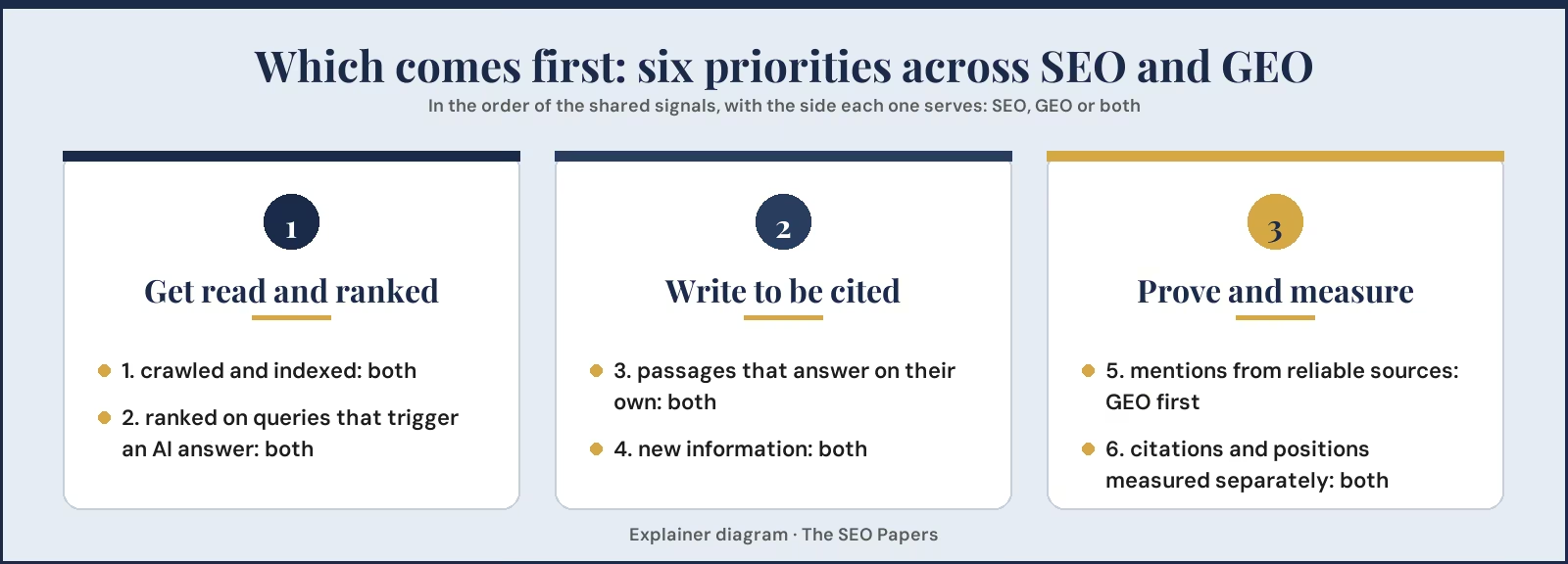
The six priorities below run from the shared base to what GEO adds, each tagged with the side it serves.
- Get crawled and indexed (SEO and GEO): an engine that cannot read a page can neither rank it nor cite it.
- Rank on the queries that trigger an AI answer (both): a page outside the results is not a candidate source for the summary.
- Write passages that answer on their own (both): one passage serves the featured snippet and the citation.
- Add new information (both): information gain makes a page worth adding to an answer.
- Earn mentions from reliable sources (GEO first): in the patent, confidence in a portion grows when highly trustworthy documents verify it, and Google warns that seeking inauthentic mentions across the web isn't as helpful as it might seem.
- Measure citations and positions separately (SEO, then GEO): a ranking gain does not show a citation gain.
Writing for GEO adds a few habits to this order.
What changes in writing for GEO?
For GEO, writing adds cited sources, quotations and statistics in the text, the three methods that raised visibility most on the GEO paper's benchmark. In "GEO: Generative Engine Optimization", accepted to KDD 2024, Cite Sources, Quotation Addition and Statistics Addition achieved a relative improvement of 30-40% on the Position-Adjusted Word Count metric, and the paper reports visibility gains of up to 40% on its benchmark, while keyword stuffing offered little to no improvement.
Google gives a different answer for its own search: you don't need to write in a specific way just for generative AI search, and there is no requirement to break content into tiny pieces. Our reading: SEO and GEO meet on clear, sourced writing, which serves the ranking and the citation at once.
How does GEO fit into the rest of SEO?
GEO fits into the rest of SEO as one layer of AI search optimization, built on the same base: AI search optimization is the wider family of work aimed at engines that write answers, and GEO is one of its names. The relationship between SEO and GEO then raises three questions: whether GEO is replacing SEO, where GEO sits within AI search optimization, and when to hire a GEO agency.
Is GEO replacing SEO?
No, GEO is not replacing SEO, because generative engines that search the web start from indexed, ranked pages, and Google states that the best practices for SEO remain relevant for AI features in Google Search. Is SEO going away with AI? Not while Google's generative AI features stay rooted in its core Search ranking systems: GEO vs SEO is a layering, not a succession.
Where does GEO sit within AI search optimization?
GEO sits within AI search optimization as one of its names, next to AEO, LLM SEO and visibility work in ChatGPT and AI Overviews. The umbrella of AI search optimization covers every engine that writes an answer, while the comparison of SEO and GEO on this page covers one of its angles.
When should you hire a GEO agency?
You should hire a GEO agency when the comparison shows that both sides need work: indexing or ranking gaps on the SEO side, and no citations on the target prompts on the GEO side. One team that handles SEO and GEO covers both, because the two act on the same pages. The work of a GEO agency runs from the technical audit to citation tracking.