Google AI Mode is a search mode in Google Search that gives a comprehensive AI-powered response with links to supporting websites, as Google Search Central describes it. Google introduced AI Mode as a Search Labs experiment on March 5, 2025 and began rolling it out to everyone in the US on May 20, 2025, with no Labs sign-up, according to its announcements on The Keyword. This guide covers what Google AI Mode is, how Gemini and query fan-out build its answers and choose its sources, how to turn it on or off and where it is available, then the controls a site has, its effect on clicks, how a page gets cited and how that presence is measured.
What is Google AI Mode?
Google AI Mode is a conversational search mode inside Google Search, run by a custom Gemini model for Search, that answers a question with an AI-written response, links to the web pages it draws on and takes follow-up questions.
Google calls that model "our custom Gemini model for Search" in its post of October 7, 2025, and since November 12, 2026 the model is Gemini 4 Hydrogen, which Google's announcement of that day says "is now available globally in Google Search for all users". Some Google AI subscribers aged 18 and above can select a more advanced model in AI Mode, with daily usage limits, according to Google Search Help.
AI Mode opens as a separate part of Google Search, apart from the classic results page, and takes questions in text, by voice, with images, with files such as PDFs or with the URL of a webpage, as Google Search Help lists. AI Mode is neither an AI Overview, the summary placed on a classic results page, nor the Gemini app, Google's separate assistant. Is Google AI Mode generative AI? Yes: a Gemini model writes each answer, and the conversation makes it partly a chatbot. The name itself states what the mode does.
What does "AI Mode" mean?
"AI Mode" means the mode of Google Search in which an AI model answers the question, instead of a list of links alone, the name Google used from its first announcement on March 5, 2025. Here, AI Mode means Google's search mode, not an "AI mode" setting on a phone or in another brand's app. In our measurement of Google Ads data on November 12, 2026, "google ai mode" averages 450,000 US searches a month and the shorter "ai mode" 3,350,000. Monthly searches for "google ai mode" went from 90,500 in November 2025 to 1,500,000 in September 2026, then 673,000 in October 2026. Behind that demand sits one mechanism.
How does Google AI Mode work?
Google AI Mode works by having a custom Gemini model split the question into subtopics, search them at once, read the pages Google's systems return, then answer with links and keep the thread open for follow-ups. Google Search Help calls this a "query fan-out" technique, "dividing your question into subtopics and searching for each one simultaneously across multiple data sources".
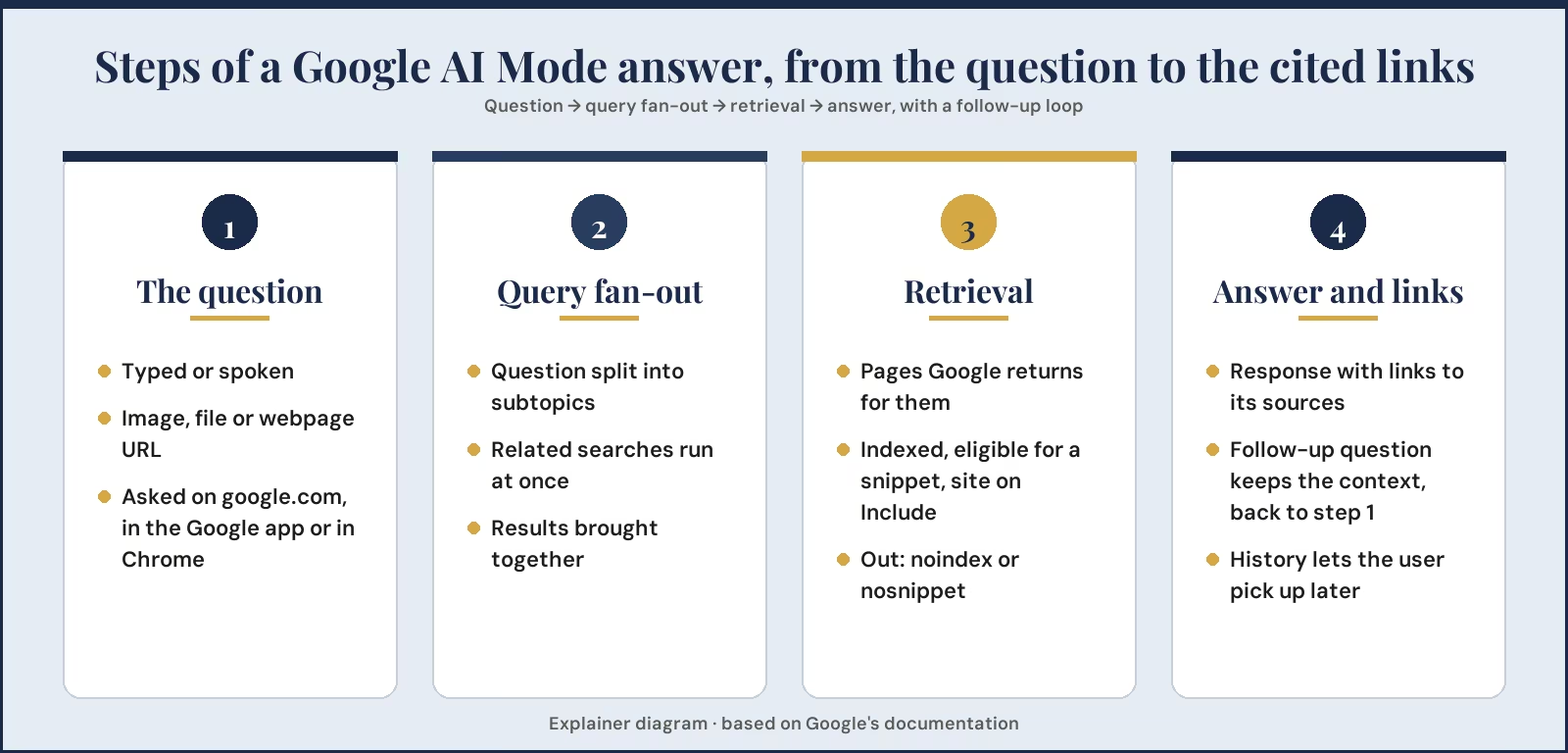
A Google AI Mode answer goes through four steps, from the question to the cited links.
- The question: the user asks AI Mode in text, by voice, with an image, a file or a webpage URL.
- The query fan-out: AI Mode issues "a multitude of queries simultaneously", in the words of Google's announcement of May 20, 2025.
- The retrieval: Google's ranking systems return pages for AI Mode that are indexed, eligible for a snippet and on a site left on "Include" in Search Console's Search generative AI control.
- The answer and the follow-up: AI Mode writes the response with links to its sources, and the next question keeps the context of the thread.
What is query fan-out in Google AI Mode? Google's AI optimization guide defines it as "a set of concurrent, related queries generated by the model", and Google Search Central notes that "Both AI Overviews and AI Mode may use" the technique. In our reading, a page therefore competes in AI Mode on those sub-questions, not only on the original query. The pages the fan-out brings back become the candidate sources.
How does Google AI Mode choose its sources?
Google AI Mode chooses its sources among the pages Google's core Search ranking systems retrieve for the question and for its related searches. Google's AI optimization guide describes AI answers "relying on our core Search ranking systems to retrieve relevant, up-to-date web pages from our Search index". Beyond eligibility, Google publishes no selection criteria, in our reading of its documentation. Why does AI Mode start from SEO rankings? Because it retrieves from the index and ranking systems behind classic results.
In our reading, AI Overviews show the kind of pool AI Mode chooses from, since both rely on Google's core ranking systems: in our observation of November 12, 2026, the AI Overview above the US query "google ai mode" cited 8 links on desktop, all owned by Google (4 Google Search pages and 4 YouTube videos), and 6 links on mobile (3 Google Search pages, 2 YouTube videos and Wikipedia). Whether AI Mode sources rank in the top 10 has been measured separately.
How many AI Mode sources come from the top 10?
Few AI Mode sources come from the top 10 organic results, according to seoClarity's vendor study "Do Better Google Rankings Translate to AI Mode Visibility?" of October 2, 2025. Across 1,000 US desktop transactional queries measured in September 2025, 28% had at least one AI Mode citation from the top 10, and 19% of 12,011 AI Mode citations came from the top 20. In our reading, the fan-out explains the gap: AI Mode's related searches bring back pages beyond the original results page. Google's patent filings describe one way such related queries are generated.
Which Google patents describe how AI Mode answers?
One Google patent application describes a search that answers in a stateful conversation, as AI Mode does: US 2024/0289407 A1, "Search with stateful chat". Google Patents lists it as filed by Google LLC on February 27, 2024, with a priority date of February 28, 2023, published on August 29, 2024 and pending. Its abstract describes "augmenting a traditional search session with stateful chat", with synthetic queries generated from the model's output. A patent application describes what a system can do, not what Google deploys, and this one never names AI Mode: the link is our reading. In that reading, each generated query gives a page one more chance to be retrieved for an AI Mode answer.
What is Deep Search in Google AI Mode?
Deep Search in Google AI Mode is a capability that can issue hundreds of searches and build a fully cited report, according to Google's announcement of May 20, 2025. Google writes that Deep Search "can issue hundreds of searches, reason across disparate pieces of information, and create an expert-level fully-cited report in just minutes". Google's AI plans page, read on November 13, 2026, lists Deep Search in AI Mode for Google AI Pro and Ultra subscribers in the US. The standard AI Mode opens from Google Search itself.
How do you turn on Google AI Mode?
To turn on Google AI Mode, you open it, because there is no setting to switch on in the US. Google Search Help lists three ways in: google.com/ai, the AI Mode button that appears after typing a question on google.com, and the AI Mode button on the Google app home screen. In Chrome on iOS and Android, an AI Mode button sits under the search bar of the New Tab page, in the US since November 5, 2025, according to Google; on a computer, AI Mode sits to the right of the address bar, which Google Chrome Help says "is not available to everyone or on every device at this time".
Using Google AI Mode takes three steps.
- Open Google Search in a browser or in the Google app.
- Choose AI Mode from the tab, the button or google.com/ai.
- Ask AI Mode a question in text, by voice or with an image, then a follow-up in the same thread.
Does every Google search open in AI Mode? No: classic results stay the default, which is our reading of Google's instruction to "tap AI Mode", so there is nothing to turn on, only a mode to choose. Past AI Mode searches saved in your account appear under "AI Mode history", where Google Search Help shows how to delete one or all of them. Who can open AI Mode depends on where they search.
Where is Google AI Mode available?
Google AI Mode is available in more than 200 countries and territories, according to Google's announcement of October 7, 2025.
Access to AI Mode varies with three criteria: the country and language, the device, and the age of the user.
- Countries and languages: Google Help's AI Mode list counts 248 countries and territories and 98 languages, in our count of November 13, 2026.
- Devices: Google Search Help covers AI Mode on computers, Android phones and tablets, and iPhones and iPads.
- Age: Google Search Help sets no age condition on AI Mode itself; 13 and above applies to the AI Mode experiment in Search Labs, and 18 or older to AI Mode personalization.
Why doesn't Google AI Mode show for everyone? The country, the language and the device decide; in the US, the Search Labs test of March 5, 2025 opened first to Google One AI Premium subscribers, before the roll-out to everyone from May 20, 2025. Opening AI Mode requires no payment.
Is Google AI Mode free?
Yes, Google AI Mode is free, because it comes with Google Search for everyone and needs no subscription. Google's pages do not use the word "free": they announce AI Mode "for everyone in the U.S." on May 20, 2025, so the word is our reading. Paid Google AI plans add capabilities, Deep Search among them, and Ultra brings higher access to the more advanced model, according to Google's AI plans page. Is Google AI free forever? Google's pages make no commitment on the future price of AI Mode. Not paying is one need; not using AI Mode at all is another.
How do you turn off Google AI Mode?
To turn off Google AI Mode, you have nothing to switch off, because AI Mode opens only when you choose it, which is our reading of the three ways in that Google Search Help lists.
Three actions keep a search away from AI Mode.
- Search from the classic results page without selecting AI Mode.
- Select the "Web" filter for links only, with no AI Mode answer; Google Search Help says this filter "displays only text-based links without features like AI Overviews".
- Unselect "Always show AI Mode" after a right-click on Chrome's address bar to hide the AI Mode shortcut, as Google Chrome Help describes.
In our measurement of Google Ads data on November 12, 2026, "turn off ai mode" draws 4,400 US searches a month, against 30 for "ai mode seo": far more people look for this exit than for the site owner's side of AI Mode. Site owners have a control of their own.
Can you keep your site out of Google AI Mode?
Yes, you can keep your site out of Google AI Mode, because Search Console's "Search generative AI" control excludes a site from AI Overviews, AI Mode and Discover's generative AI features together. Search Console Help says the control reached all websites worldwide on August 31, 2026, that "Include" is the default, and that it "isn't used as a ranking or inclusion signal affecting other parts of Search". At page level, Google Search Central points to "nosnippet, data-nosnippet, max-snippet, or noindex" to limit what Search shows from a page, AI Overviews and AI Mode included. Which crawler collects the pages Google AI Mode cites? Googlebot; Google states that "Google-Extended does not impact a site's inclusion in Google Search". A site that stays in AI Mode faces the question of traffic.
What does Google AI Mode change for a site's traffic?
Google AI Mode changes a site's traffic by sending few clicks to websites: 6–8% of AI Mode sessions led to an external website in Semrush's vendor clickstream study of July 30, 2025. Semrush analyzed almost 69 million US desktop Google Search sessions from May 1 to July 5, 2025 and counted 92–94% of AI Mode searches as zero-click.
Google's Liz Reid wrote on August 6, 2025 that "total organic click volume from Google Search to websites has been relatively stable year-over-year" and that "average click quality has increased", a statement on all organic clicks, not on AI Mode. Is all the traffic lost when people use Google AI Mode? No: AI Mode answers carry links to the pages they use. What a site receives from AI Mode is a different unit of visibility.
What does a site get from Google AI Mode: a click or a citation?
A site gets mostly a citation from Google AI Mode, and sometimes a click: the citation is a visible link inside the answer, counted as an impression in Search Console. Search Console Help defines those impressions as "how many times links to your site were shown to a user in a generative AI feature". Is an AI Mode citation worth a click? No, not click for click: it is a different unit, measured on its own. Earning that citation comes next.
How does a page get cited in Google AI Mode?
A page gets cited in Google AI Mode by being eligible, ranking for the question and for the related searches AI Mode runs, and holding a passage that answers on its own. Google Search Central states that no "special optimizations" are necessary for AI Mode beyond its eligibility conditions. How do you rank in Google AI Mode? There is no separate AI Mode ranking: the same index and ranking systems apply, and the answers they feed sit inside Google Search with links to the pages they use.
Self-contained passages are our method, since Google's AI optimization guide says "There's no requirement to break your content into tiny pieces". Information other pages lack weighs most: the guide, updated July 10, 2026, says that unique, compelling and useful content "will likely influence your website's presence in generative AI search in the long run more than any of the other suggestions in this guide". The work starts with eligibility, then moves to the sub-questions of the fan-out; the market calls it GEO, for generative engine optimization, and files it under AI SEO with AEO. The guide to AI SEO maps those methods across ChatGPT, AI Overviews and AI Mode. Eligibility comes first.
What SEO conditions must a page meet to appear in Google AI Mode?
A page must meet three SEO conditions to appear in Google AI Mode: be indexed, be eligible for a snippet in Google Search, and sit on a site left on "Include" in Search Console's "Search generative AI" control. Google Search Central, updated December 10, 2025, states that "a page must be indexed and eligible to be shown in Google Search with a snippet", with "no additional technical requirements"; Google's AI optimization guide adds that "a site must be included in Search generative AI features in Search Console". In SEO terms, robots.txt stays open to Googlebot, the page carries no noindex and no nosnippet, and the control stays on its default. What is the relationship between SEO and Google AI Mode? AI Mode retrieves from the pages SEO gets indexed and ranked, and that base stays the same. Eligibility opens the door to a citation without guaranteeing one.
Why isn't a well-ranked page always cited in Google AI Mode?
A well-ranked page isn't always cited in Google AI Mode because AI Mode draws on the results of several related searches, not only on the results page of the original query. Google Search Central adds that "AI Mode and AI Overviews may use different models and techniques, so the set of responses and links they show will vary", so a page cited in one feature has no guarantee in the other. Google does not say that a question asked twice in AI Mode returns the same links, so our method never relies on a single reading.
How do you measure your presence in Google AI Mode?
You measure your presence in Google AI Mode with Search Console's generative AI performance report, which counts impressions of a site's links in AI Overviews and AI Mode by page, country, date and device. Search Console Help dates its worldwide roll-out to August 31, 2026, and clicks from AI features stay in the Performance report, "within the 'Web' search type", according to Google Search Central. Which pages are cited for which question takes repeated readings.
A reading of AI Mode citations takes four steps.
- Read the generative AI report for AI Mode impressions by page, country and device.
- Keep a fixed list of questions for AI Mode, asked signed out, from one location, on desktop and mobile.
- Repeat the AI Mode readings over several days, since one reading proves little.
- Record the URLs AI Mode cites separately from the clicks it sends.
These readings place AI Mode among the other AI search features.
Where does Google AI Mode sit in AI search optimization?
Google AI Mode sits in AI search optimization as Google's conversational generative search, next to AI Overviews, the Gemini app and other answer engines such as ChatGPT. Is getting cited in Google AI Mode SEO or GEO? For Google it is SEO: its AI optimization guide calls optimizing for generative AI search "still SEO", while the market calls the citation work GEO. The questions below cover the Gemini app, AI Overviews, ChatGPT, llms.txt, ads, accuracy, the future of SEO and visibility help.
How is Google AI Mode different from the Gemini app?
Google AI Mode is different from the Gemini app because AI Mode is a mode of Google Search that answers from Google's index with links to websites, while the Gemini app is Google's standalone AI assistant. Google wants the app to be "the most helpful and personal AI assistant", in "An overview of the Gemini app". The confusion comes from the model: AI Mode runs on a custom Gemini model for Search, Gemini 4 Hydrogen since November 12, 2026. Is Google AI Mode the same as Gemini? No: same model family, different product.
What is the difference between Google AI Mode and AI Overviews?
The difference between Google AI Mode and Google AI Overviews is where they answer: an AI Overview is a summary on a classic results page, while AI Mode is a separate mode the user opens for a conversation.
The table below compares Google AI Mode and AI Overviews on five criteria.
| Criterion | Google AI Mode | AI Overviews |
|---|---|---|
| Where it appears | A separate mode of Google Search, for multi-turn conversations | On the classic results page, as a quick snapshot |
| Who starts it | The user, by opening AI Mode | Google's systems, when they "determine that it is additive to classic Search" |
| Follow-up questions | Yes, in the same thread | A follow-up continues in AI Mode |
| Models and techniques | Can differ from AI Overviews, so responses and links vary | Can differ from AI Mode, so responses and links vary |
| Measured US demand | "google ai mode": 450,000 searches a month (our measurement, November 12, 2026) | "ai overview": 165,000 searches a month (our measurement, November 11, 2026) |
AI Overviews, Google's generative summaries at the top of some results pages, are covered in full in the guide to Google AI Overviews.
Is Google AI Mode a chatbot like ChatGPT?
Partly: Google AI Mode is a chatbot like ChatGPT in its conversation, but it searches Google's index for each answer and links its sources. ChatGPT, OpenAI's assistant, can search the web and answer "with links to relevant web sources", a feature OpenAI introduced on October 31, 2024 in "Introducing ChatGPT search". For a site, the difference lies in the source pool, which for AI Mode is Google's Search index.
Does an llms.txt file help a page appear in Google AI Mode?
No, an llms.txt file does not help a page appear in Google AI Mode: Google's AI optimization guide states that such a file "will neither harm nor help your site's visibility or rankings in Google Search, as Google Search ignores them". The statement, in the guide last updated July 10, 2026, covers Google Search and its generative AI features, not other services that read the file.
Are there ads in Google AI Mode?
Yes, there are ads in Google AI Mode in the US: Google Ads Help states that ads in AI Overviews and AI Mode "are available in English in the United States and select English-speaking markets". These ads are labeled "Sponsored" and do not influence the organic responses, according to the same page.
Is Google AI Mode accurate?
Not always: Google AI Mode answers are not always accurate, and Google Search Help warns that "AI responses may include mistakes" before telling users to "Click the links for AI sources". Is Google AI Mode safe to use? Google's pages make no safety claim for AI Mode.
Will Google AI Mode replace classic search results and SEO?
No, Google AI Mode will not replace classic search results and SEO, because AI Mode answers from indexed, ranked pages and links to them, while classic results remain available next to it. Is SEO dead because of Google AI Mode? No: the three eligibility conditions of AI Mode are SEO conditions, starting with indexing.
When does a GEO agency help a site be visible in Google AI Mode?
A GEO agency helps a site be visible in Google AI Mode when the site needs the SEO base and the citation work at once, and has no one to repeat the readings over time. A team that already handles both keeps the work in house. The SEO Papers, publisher of this guide, is an online SEO and GEO agency built on Google's patents, with offices in Paris and clients in France and worldwide, in all sectors. The steps to hire a GEO agency are set out on a separate page.