Google AI Overviews are a Google Search feature that places an AI-generated summary at the top of some results pages, with links to the pages that support it. Google began rolling them out to everyone in the United States on May 14, 2024, according to its "Google I/O 2024" announcement. This guide explains what AI Overviews are, how they work and pick their sources, where they show, what they change for clicks and how to turn them off, then how search engine optimization (SEO) gets a page cited in them and how that presence is measured.
What are Google AI Overviews?
Google AI Overviews are summaries written by a Gemini model customized for Google Search: an AI Overview gives the gist of a question at the top of the results and links to web pages to explore it further. Google Search Central describes them as a way to "get to the gist of a complicated topic or question more quickly" and as "a jumping off point to explore links to learn more".
In our measurement of November 12, 2026, the AI Overview for the US query "ai overview" held the very top of the results page on desktop and on mobile, above every classic result. An AI Overview is neither a featured snippet, which quotes an extract of one page, nor a chat conversation, the format of AI Mode covered further down: it writes a new text from several pages, inside the results page. Is an AI Overview generative AI? Yes: its text is generated by Google's Gemini model, not written by a person. AI Overviews had over 2.5 billion monthly active users in June 2026, against more than one billion monthly users for AI Mode, according to Google. They show on some searches only, and their name carries part of their history.
What does "AI Overview" mean, and what was it called before?
"AI Overview" means an overview of a topic written by AI at the top of Google's results, and what came before it was SGE (Search Generative Experience), the Search Labs experiment Google announced on May 10, 2023. Google's post of May 10, 2023 opened Search Labs sign-ups that day, with access to SGE "in the coming weeks"; its post of May 14, 2024 says people had already used AI Overviews "billions of times" through that experiment in Search Labs. The feature therefore came out of SGE, as both announcements show.
The name draws measured demand. In our measurement of Google Ads data on November 11, 2026, Google Ads reports 165,000 US searches a month for "ai overview" and the same 165,000 for "ai overviews", one grouped series rather than two separate pools. That series reached 368,000 searches in October 2026, about five times the 74,000 of November 2025. The name covers the Google Search feature only, not the AI summaries of Gmail or Google Chat. Behind the name sits one mechanism.
How do AI Overviews work?
AI Overviews work through a Gemini model customized for Google Search that writes a summary from pages Google's search systems retrieve for the query and its related searches, then links the pages that support it. Google's AI optimization guide of July 10, 2026 names the technique retrieval-augmented generation, or grounding: core Search ranking systems retrieve relevant, up-to-date pages from the Search index, and the response shows "prominent, clickable links to relevant web pages that support the information in the response".
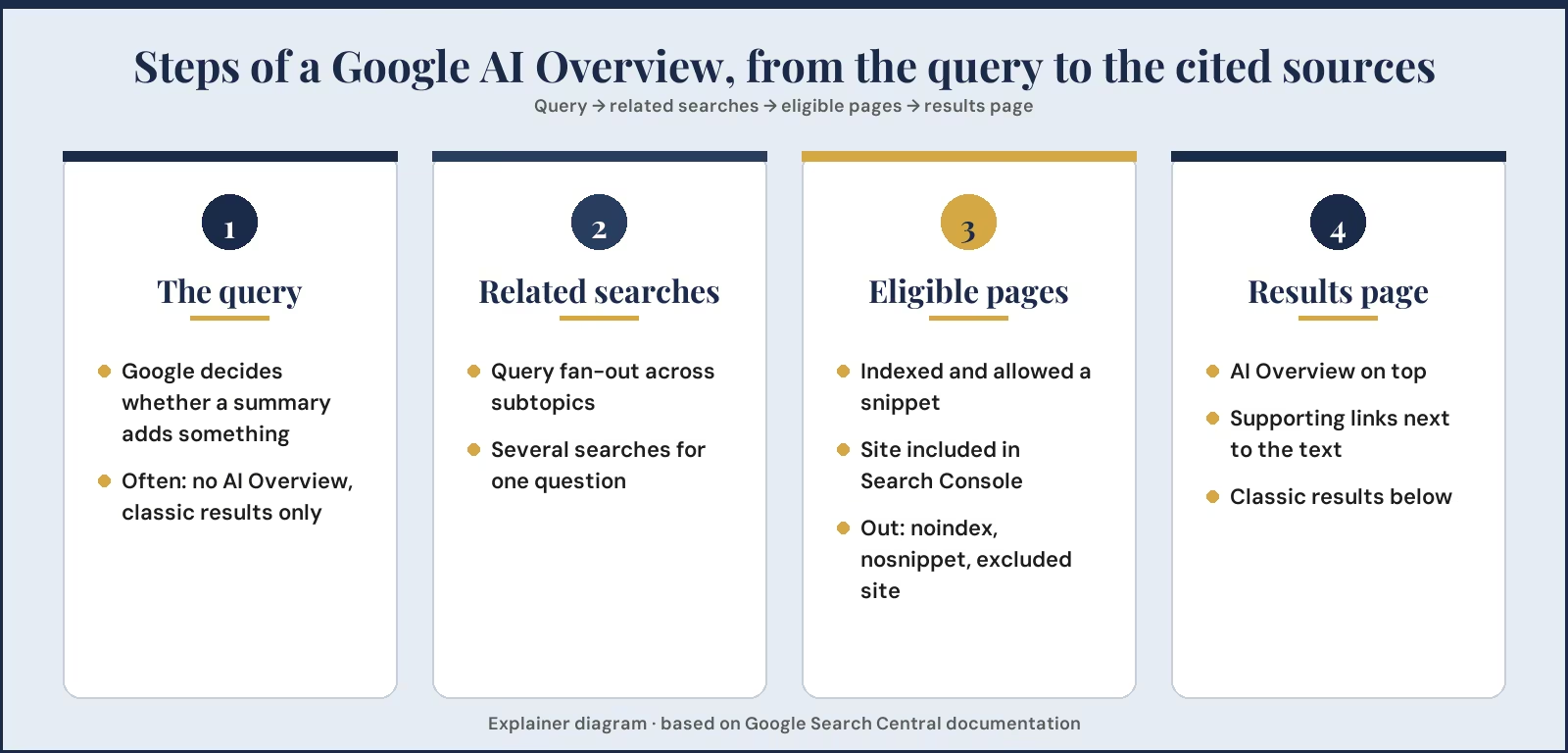
An AI Overview goes through four steps between the query and the results page.
- The query: Google's systems decide whether an AI Overview adds something beyond classic results, and as such the summary often does not appear.
- The related searches: the system may issue several related searches across subtopics to build the AI Overview, a technique Google calls query fan-out.
- The eligible pages: only indexed pages eligible for a snippet, on a site included in Search Console's generative AI setting, can become supporting links of an AI Overview.
- The summary and its links: the model writes the AI Overview and places links next to the parts of the text they support.
What is query fan-out in an AI Overview? Google defines it as "a set of concurrent, related queries generated by the model to request more information and fetch additional relevant search results to address the user's query". In our reading, a page therefore competes for AI Overviews on those sub-questions, not only on the main query. These generative summaries rest on the Search index, which is why the eligibility step decides who can be cited.
What SEO conditions must a page meet to appear in an AI Overview?
The SEO conditions a page must meet to appear in an AI Overview are three: being indexed, being eligible for a snippet in Google Search, and sitting on a site Search Console leaves included. Inclusion in Search Console's "Search generative AI control" is the default. Google Search Central states, on a page updated December 10, 2025 that predates the Search Console control, that a supporting link must come from a page "indexed and eligible to be shown in Google Search with a snippet", with "no additional requirements" and no other special optimization. Google's guide of July 10, 2026 adds the site-level condition: the site must be included in Search generative AI features in Search Console, and the Search Console Help states that "Include" is the default control.
In SEO terms, robots.txt must not block Googlebot, the page must carry no noindex and no nosnippet; the controls table further down details each one. What is the relationship between SEO and AI Overviews? AI Overviews draw on pages Google's core ranking systems already crawl and index, so the base work is SEO work. Anyone who sets out to understand search engine optimization finds these same crawling, indexing and snippet rules at its base. In our reading, eligibility is the entry ticket, not a guarantee of citation: many pages qualify, and Google picks a few.
How does Google choose the sources of an AI Overview?
Google chooses the sources of an AI Overview from its own search results for the question and for the related searches it runs. Its documentation, as read on November 12, 2026, lists no selection criteria beyond the eligibility rules. Wikipedia, YouTube and Reddit are the most frequently cited sources in Google's AI summaries and in standard results alike, according to Pew Research Center's US data of March 2025, where the three sites made up 15% of the sources listed in the summaries.
On its own name, the US AI Overview for "ai overview" cited Google-owned pages for 4 of its 6 links on desktop and for 4 of its 8 links on mobile in our measurement of November 12, 2026: Google's product page, Search Help, Search Central, Google's blog and YouTube, next to Wikipedia, two SEO-software guides and a local news site. Patent US 11,769,017 B1, "Generative summaries for search results", filed on March 20, 2023 and granted on September 26, 2023, describes summaries generated by a language model from selected search results, with each part linked to a document that verifies it. Its claims and measures belong to a reading of the patent behind AI Overviews, not to this description of AI Overviews as a Search feature. How many of the chosen sources come from the top 10 has been measured several times.
How many AI Overview sources come from the top 10?
A large share of AI Overview sources come from the top 10, but not all: the measures in the table below range from about 38% to about 76% of cited sources, depending on the date and the method. Ahrefs, an SEO-software vendor, revised its own figure in its study "Update: 38% of AI Overview Citations Pull From The Top 10" of March 2, 2026, after improving its parsing of results pages.
The four measures below give the share of cited sources found in the top 10 results, with the date and the sample of each.
| Measure | Date | Sample | Share of cited sources in the top 10 results |
|---|---|---|---|
| Ahrefs (vendor study) | July 2025 | 1.9 million citations | About 76% |
| Ahrefs (vendor study) | March 2, 2026 | 863,000 keyword SERPs and 4 million AI Overview URLs, revised parsing | 37.9% of the first 10 result blocks, SERP features included (37.1% on blue links only) |
| Our measurement, US, "ai overview", desktop | November 12, 2026 | One query, one reading | 4 of 6 cited pages |
| Our measurement, US, "ai overview", mobile | November 12, 2026 | One query, one reading | 5 of 8 cited pages |
These figures are not a trend: their samples, methods and scopes differ, and a single-query reading describes one results page on one day. The measures moved as AI Overviews themselves changed after their launch.
When did AI Overviews launch in the US?
The launch of AI Overviews in the US came on May 14, 2024, when Google began rolling them out to everyone in the United States. Google's post "Generative AI in Search: Let Google do the searching for you" tied the launch to Google I/O 2024, with more countries announced as coming soon.
The key dates of AI Overviews, from the Search Labs experiment to the worldwide expansion, are listed below with Google's announcement for each.
| Date | Milestone | Where | Source |
|---|---|---|---|
| May 10, 2023 | Google announces SGE, an experiment in Search Labs; sign-ups open, access "in the coming weeks" | US, English | Google, "Supercharging Search with generative AI" |
| May 14, 2024 | AI Overviews begin rolling out to everyone | US | Google, "Generative AI in Search: Let Google do the searching for you" |
| October 28, 2024 | Rollout begins in more than 100 countries and territories | Worldwide | Google, "AI Overviews in Search are coming to more places around the world" |
| March 5, 2025 | Gemini 2.0 for AI Overviews; teens can use them; no sign-in needed | US for Gemini 2.0 | Google, "Expanding AI Overviews and introducing AI Mode" |
| May 20, 2025 | More than 200 countries and territories, more than 40 languages | Worldwide | Google, "AI Overviews expand to over 200 countries and territories, more than 40 languages" |
Each expansion widened the searches, devices and countries where AI Overviews show today.
On which searches, devices and countries do AI Overviews show?
AI Overviews show on a minority of searches, on computers, phones and tablets, and in more than 200 countries and territories. The display of an AI Overview varies with the three facets listed below.
- Searches: about 18% of the Google searches in Pew Research Center's US sample produced an AI summary in March 2025, and seoClarity, a vendor study on a US dataset of 500+ million keywords (page updated October 2025), finds about 84% of AI Overviews on informational queries.
- Devices: Google Help documents AI Overviews for computers, Android phones and tablets, and iPhones and iPads, and Google says no sign-in has been needed to get them since March 5, 2025.
- Countries: Google announced AI Overviews in more than 200 countries and territories and more than 40 languages on May 20, 2025; Google Help's current list counts more than 240 countries and territories and more than 90 languages (our count, November 12, 2026).
Does every Google search show an AI Overview? No: about one search in five did in Pew's sample. Why one search shows it and the next does not has a precise answer.
Why does an AI Overview show for some searches and not others?
An AI Overview shows for some searches and not others because Google displays it only when its systems judge it additive to classic Search. Google Search Central states that AI Overviews "are only shown when our systems determine that it is additive to classic Search, and as such, often don't trigger". Google Help places them where "generative AI can be especially helpful", for example to understand information from a range of sources quickly.
The only user-side conditions Google Help lists are the country or territory and the language, which must appear on its availability list. Results change from one search to the next: in our measurement, two desktop readings of the same query about 13 minutes apart (November 11–12, 2026, UTC) returned top 10s with no organic title in common, with an AI Overview in both. Do you need to turn AI Overviews on? No: Google Help calls them a core Google Search feature, and they appear automatically where available. Where the summary shows, it changes what users click.
What do AI Overviews change for a site's traffic?
AI Overviews change a site's traffic because users click a classic result less often when an AI Overview shows, according to Pew Research Center. Its short read "Google users are less likely to click on links when an AI summary appears in the results", published on July 22, 2025 and based on the browsing data of 900 US adults in March 2025, found that users clicked a traditional search result in 8% of visits with an AI summary, against 15% of visits without one. A link inside the summary itself drew a click in just 1% of visits.
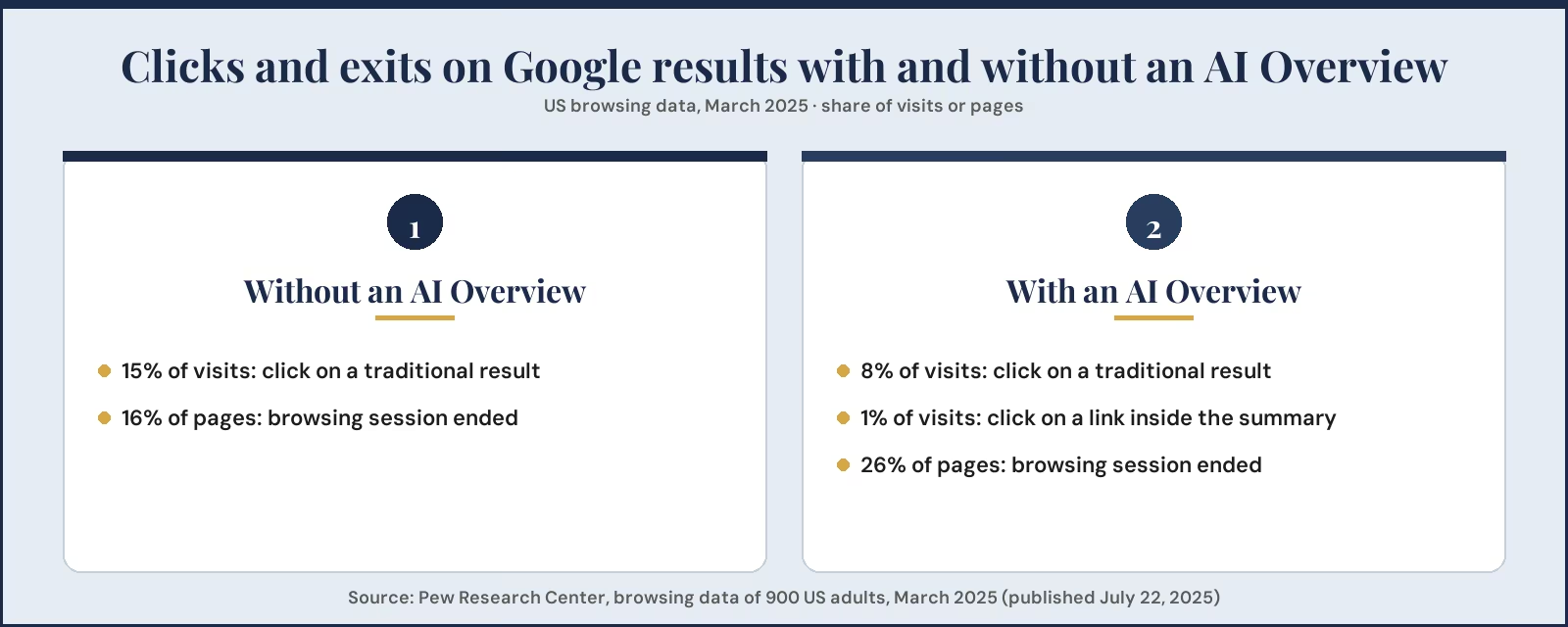
Users ended their browsing session after 26% of pages with an AI summary, against 16% of pages with traditional results only. Google gives a different reading: Liz Reid, Head of Google Search, wrote on August 6, 2025 that total organic click volume from Google Search to websites has been "relatively stable year-over-year", a statement about all organic clicks, not about pages with AI Overviews alone. Is all the traffic lost when an AI Overview shows? No: part of it remains, and the question becomes what a site receives in place of a click.
What does a site get from an AI Overview: a click or a citation?
A site gets mostly a citation from an AI Overview, a visible mention with a link, and sometimes a click, since a link inside the summary drew a click in 1% of visits in Pew's US data. Google frames those clicks differently: it states that when people click from results pages with AI Overviews, "these clicks are higher quality", meaning users are more likely to spend more time on the site.
Is an AI Overview citation worth a click? No, not click for click: it is a different unit of visibility, since Search Console counts each display of a site's link in an AI Overview as an impression, read in the measurement section below. Many users would rather not see the summary at all.
How do you turn off AI Overviews in Google Search?
You cannot turn off AI Overviews in Google Search's settings, but the "Web" filter shows the results without them. Google Help states that "Features cannot be turned off" and that the Web filter "displays only text-based links without features like AI Overviews".
Removing AI Overviews from one results page takes three steps.
- Run the search in Google as usual, with the AI Overview on top.
- Choose the "Web" filter below the search bar.
- Read the text links, which the filter lists without the AI Overview.
The same filter works on computers, iPhones and Android phones; these device steps and the position of the Web filter below the search bar are our instruction, not Google's wording. Browser extensions that hide AI Overviews form a separate category of tools, outside Google's own settings. Users ask about switching AI Overviews off far more than site owners ask about ranking in them: in our measurement of Google Ads data on November 11, 2026, "how to turn off ai overview" draws 9,900 US searches a month against 140 for "how to rank in ai overviews", about 70 times more. Site owners have controls of their own.
Can you stop Google from using your page in AI Overviews?
Yes, you can stop Google from using your page in AI Overviews, because Search Console offers a site-level setting and Google's snippet controls apply to its AI features. The six controls below are the ones Google documents for site owners; five act on AI Overviews, from the whole site to one passage, and the sixth, Google-Extended, does not.
| Control | Where it goes | Effect Google documents |
|---|---|---|
| Search generative AI control | Search Console > Settings > Search generative AI; "Include" is the default | Excluding the site keeps its links and content out of AI Overviews, AI Mode and generative AI features in Google Discover, with no traffic or impressions from them; not used as a ranking or inclusion signal for other parts of Search; rolled out to all websites worldwide on August 31, 2026, after a test that began on June 3, 2026 |
noindex | Robots meta tag or X-Robots-Tag HTTP header | The page is not shown in search results |
nosnippet | Robots meta tag | No text snippet in any result format, AI Overviews and AI Mode included, and the content is not used as direct input for them |
data-nosnippet | HTML attribute on a span, div or section element | That passage is kept out of snippets |
max-snippet | Robots meta tag with a number of characters | Limits the snippet and how much content may serve as direct input for AI Overviews and AI Mode |
Google-Extended | Robots.txt product token | Manages use of crawled content for training future Gemini models (Gemini Apps, Vertex AI API for Gemini) and for grounding in Gemini Apps and Grounding with Google Search on Vertex AI; does not impact inclusion in Google Search, nor is it a ranking signal |
Since Google-Extended leaves inclusion in Google Search unchanged, a rule on that token does not remove a page from AI Overviews. Controls 2 to 5 cost the page part of its classic presence in Google Search, which is their trade-off: noindex removes it from the results, and the three snippet controls shorten or remove its snippet. The Search Console setting leaves the rest of Search untouched. The opposite goal is getting cited.
How do you get cited in an AI Overview?
You get cited in an AI Overview by being an eligible page that ranks on the question and its related searches and holds a passage that answers on its own. No special optimization is necessary, says Google's page "AI features and your website", updated December 10, 2025, which predates the Search Console control. Why do AI Overviews matter for SEO? The summary sits above the classic results and draws clicks away from them, as the traffic data above shows.
The market calls this citation work generative engine optimization (GEO), one part of AI search optimization. The sections below cover why a well-ranked page is not always cited, which passages AI Overviews use, which signals count, how to write and where to start.
Why isn't a well-ranked page always cited in an AI Overview?
A well-ranked page isn't always cited in an AI Overview because the summary draws on the results of several related searches, not only on the original query's results page. It needs only a few passages to support its text. Google states that AI Overviews may use a "query fan-out" technique, issuing multiple related searches across subtopics and data sources.
Ahrefs reads its own drop from about 76% to about 38% the same way: "To me, that suggests AI Overviews are relying less on the direct search results and more on the sources showing up in fan out query SERPs." The same question can return a different summary and different links from one search to the next, so one check proves little. Which passage gets taken is the next question.
Which passages of a page does an AI Overview use?
The passages of a page an AI Overview uses are short, self-contained passages that answer one sub-question on their own, such as a definition, a dated figure with its source or a list of steps. The summary links the page that supports that part; this is our reading of the cited pages, not a Google statement.
Such a passage keeps its meaning when lifted out of the page, since the AI Overview shows it next to text written from other sources. Google says no specific writing style is required for generative AI search, and that there is "no requirement to break your content into tiny pieces". How a part of the summary is checked against its source is the subject of the generative summaries patent cited above.
Which signals get a page cited in an AI Overview?
Three signals get a page cited in an AI Overview, ranking on the related searches, a self-contained answer passage and information other sources lack, in our reading of Google's documentation and of the measures above. Google publishes no list of ranking signals specific to AI Overviews, and states that its generative AI features are "rooted in our core Search ranking and quality systems".
The three signals are listed below.
- Ranking: a page that ranks on the question and on its related searches enters the pool an AI Overview draws from, as query fan-out and the top-10 measures show.
- Answer passage: a self-contained passage gives the AI Overview a unit it can link to one part of its text.
- Unique information: a figure, a date or an own measurement that other sources lack gives an AI Overview something to cite, as Google asks for content that does not recycle what others have already said.
Google's patents describe their own scoring measures for such passages, a level of detail left to the patent analyses.
Does information gain help a page get cited in an AI Overview?
Yes, information gain likely helps a page get cited in an AI Overview, because Google's guide expects unique content to matter most in the long run. The guide states that content people find unique, compelling and useful "will likely influence your website's presence in generative AI search in the long run more than any of the other suggestions in this guide". Google does not use the term information gain there; the link to it is ours, through Google's patent US 11,354,342 B2, "Contextual estimation of link information gain", filed on October 18, 2018 and granted on June 7, 2022, which describes a score for the information a document adds beyond documents a user already viewed.
How do you write a page for AI Overviews?
You write a page for AI Overviews the way you write it for people first, since Google's ranking systems are designed to prioritize "helpful, reliable information that's created to benefit people". Its 2026 guide on generative AI search warns: "Don't just recycle what others on the internet have already said".
Four writing habits make a passage easy for AI Overviews to reuse; they are our method, not a Google requirement.
- A question as the heading of each passage, with its answer in the first sentence below it.
- The entity named in each passage instead of a pronoun.
- Every figure in a passage given with its source and its date.
- One idea per paragraph, so one paragraph supports one part of an AI Overview.
No writing method guarantees a citation. The order of the work matters as much as the writing.
Where should you start to appear in AI Overviews?
You should start to appear in AI Overviews with eligibility, because a page that is not indexed with a snippet, or a site excluded in Search Console's generative AI setting, cannot be cited. The five priorities below follow that order, each tied to the step of the work it serves.
- Check eligibility: indexing, snippets allowed and the Search Console setting left on "Include", the three conditions of an AI Overview source.
- Rank on the questions: target the searches that trigger an AI Overview and their related searches, where cited sources come from.
- Write answer passages: give each sub-question a self-contained passage an AI Overview can link to one part of its text.
- Add your own information: publish a measurement or a dated figure for AI Overviews to cite, the suggestion Google's guide expects to matter most in the long run.
- Measure separately: follow impressions, citations and clicks in AI Overviews one by one, as the next section describes.
How do you measure your presence in AI Overviews?
You measure your presence in AI Overviews with Search Console's generative AI performance report, which counts your links' impressions in AI Overviews and AI Mode by page, country, date and device. Repeated checks of the cited pages complete the report. Google rolled the report out to all websites worldwide on August 31, 2026. Clicks from AI features stay in the overall Performance report, within the "Web" search type, alongside the rest of Search traffic, according to Google Search Central.
Checking which pages an AI Overview cites for which question takes five steps.
- Read the generative AI performance report in Search Console for impressions by page.
- Keep a fixed list of queries and check them signed out, from the same location, on desktop and mobile.
- Take several readings over several days, since results change between searches.
- Record each URL the AI Overview cites and its organic rank.
- Follow the trend across readings, never a single reading.
In our measurement of November 12, 2026, the US AI Overview for "ai overview" cited 6 pages on desktop, 4 of them in the top 10 results, and two desktop readings about 13 minutes apart shared no organic title. Third-party AI-visibility trackers automate these readings; their figures remain samples of a results page that keeps changing. These numbers place AI Overviews inside a wider field, AI search optimization.
Where do AI Overviews sit in AI search optimization?
AI Overviews sit in AI search optimization as Google's generative summary on the classic results page, next to AI Mode, its separate AI search mode, while other answer engines generate answers outside Google. The full map of engines, crawlers and methods belongs to AI search optimization as a whole; the questions below cover what touches AI Overviews: SEO or GEO, AI Mode, llms.txt files, ads, accuracy, the future of SEO and hiring help.
Is getting cited in an AI Overview SEO or GEO?
Getting cited in an AI Overview is SEO for Google and GEO for the market. Google's AI optimization guide names "AEO" (answer engine optimization) and "GEO" (generative engine optimization) as the market's terms, and states that "optimizing for generative AI search is optimizing for the search experience, and thus still SEO". The two labels cover overlapping work, compared point by point in GEO vs SEO, with AEO as the third term.
What is the difference between AI Overviews and Google AI Mode?
The difference between AI Overviews and Google AI Mode is the place of the answer: an AI Overview is a summary on a classic results page, while AI Mode answers in a separate search mode. Google describes AI Mode as giving "a comprehensive AI-powered response with links to supporting websites" for queries that need further exploration, reasoning or complex comparisons. Google states that AI Mode and AI Overviews "may use different models and techniques, so the set of responses and links they show will vary". Is an AI Overview like ChatGPT? No: a chat assistant answers inside a conversation, while an AI Overview stays inside Google's results page.
Does an llms.txt file help a page appear in AI Overviews?
No, an llms.txt file does not help a page appear in AI Overviews, because Google Search, its generative AI capabilities included, does not use such files. According to Google's AI optimization guide, last updated July 10, 2026, creating one "will neither harm nor help your site's visibility or rankings in Google Search". The statement covers Google Search only; other services may read the file.
Are there ads in AI Overviews?
Yes, there are ads in AI Overviews in the US, because Google Ads Help lists text ads and Shopping ads within AI Overviews for English-language markets that include the United States, alongside Australia, Canada and India. Standard ads can still appear above or below an AI Overview, as they do around other results. In the US, ads in AI Overviews reached mobile users in October 2024, according to Google.
Are AI Overviews accurate?
No, AI Overviews are not always accurate, because Google states that "AI responses may include mistakes" and that AI Overviews "can and will make mistakes". Google Help asks users to check important information in more than one place and to click the links to supporting information, which is the role of the sources each AI Overview shows next to its text.
Will AI Overviews replace blue links and SEO?
No, AI Overviews will not replace blue links and SEO, because they are written from indexed, ranked pages and link to them. Is SEO dead because of AI Overviews? No: every supporting link comes from a page indexed and eligible for a snippet, the SEO conditions set out above. Google's stated reason for showing AI Overviews is to help people get to the gist of a question more quickly, on queries where the summary adds something beyond classic results.
When should you hire a GEO agency for AI Overviews?
You should hire a GEO agency for AI Overviews when a site needs both sides of the work at once, the SEO base and the citation work, and has no one to measure the result over time. A site whose team already handles indexing, answer passages and repeated readings keeps the work in house. The SEO Papers, publisher of this guide, is based in Paris, works online with clients in the US, France and worldwide, holds no on-site meetings and serves all sectors. The services and hiring steps of a GEO agency are detailed on a dedicated page.