Get audit

Generative Engine Optimization

GEO Agency: What a Generative Engine Optimization Agency Does and How to Hire One

A GEO agency is a generative engine optimization agency that makes a brand's pages retrievable, verifiable and citable in AI answers from ChatGPT, Perplexity and Google AI Overviews; GEO here is not geography, The GEO Group or a real-estate agent.

Free patent-backed SEO & GEO audit on your domain. No commitment.

Guaranteed in writing, under conditions: +33% non-brand Google clicks in 3 months, or we refund the gap. See the guarantee

GEO stands for generative engine optimization: the work that gets a page chosen and cited as a source by an engine that writes its answer instead of only listing links. This page explains what a GEO agency does, then how to hire one. The SEO Papers is a GEO agency with a Paris team, working with US clients remotely. The answers run in this order: role, 6 engines, a method read from Google's patents, then hiring criteria, remote work and pricing.

What does a GEO agency do?

What a GEO agency does is work on a brand's pages so that a generative engine retrieves them, verifies a claim with them and cites them as a source.

GEO works on the same pages as search engine optimization (SEO), but it targets the written AI answer, not only the list of links. The same work is sold as AEO (answer engine optimization) and AI search optimization, so an AEO agency and a GEO agency describe one job under two labels. A GEO agency delivers pages, not rankings reports: each intervention lands on a passage, an author, a date or a source.

That role breaks down into 8 page deliverables, and it starts from SEO.

What does a GEO agency deliver?

A GEO agency delivers 8 page elements, each tied to a mechanism a Google patent describes. In the table, "our reading" marks an application to GEO made by our team, which the patent itself does not state.

The 8 deliverables, the mechanism behind each one and its patent number are listed in the table below.

DeliverableWhat the patent describesPatent (number)
Rankings in classic resultsA summary written from documents selected among search resultsUS 11,769,017 B1
Passages that verify a claimEach portion of the summary linked to a document that verifies it, by comparing that portion with a portion of the document; a self-contained passage scores higher (our reading)US 11,769,017 B1; US 9,940,367 B1
Question headings above answersThe largest boost goes to the passage whose closest heading best matches the question; that the heading weighs most is our readingUS 9,959,315 B1
Named, reputable authorsA trustworthiness measure based, e.g., on the author, the domain or inbound links; author reputation (our reading)US 11,769,017 B1 + US 8,150,842 B2
Dated, updated pagesFreshness from the creation or update date of the documentUS 11,769,017 B1
New information vs the top resultsInformation beyond what the user has already seen (our reading)US 11,354,342 B2
Brand named as an entityThe entities most cited in the top results (our reading)US 9,477,759 B2 + US 10,235,423 B2
Corroboration by reliable sourcesConfidence that grows with the number and reliability of verifying documentsUS 11,769,017 B1

In practice, our GEO agency turns these 8 rows into work on the page itself: rankings and passages (rows 1 to 3), signed and dated pages (rows 4 and 5), new facts and a named brand (rows 6 and 7), and mentions on independent sources (row 8). Schema markup, in our reading, restates the author and the brand of rows 4 and 7 in machine-readable form. Our checks start with the first row, the rank in classic results, where the generative summary begins.

Why does a GEO agency start from SEO?

A GEO agency starts from SEO because Google's patent US 11,769,017 B1 describes a summary written from documents selected among search results. A page that ranks for nothing relevant has no path into that summary. The patent states the selection with its own modality: the subset of documents can be selected based on features of those documents.

Can GEO replace SEO? No: GEO is built on search engine optimization, keeps its crawl, index and ranking work, then adds checks specific to generative answers. Eligibility is not selection. An indexed page enters the summary only when it sits among the results the system selects, so the ranking work comes first and the GEO checks come second.

Our reading: the same principle plausibly holds for ChatGPT and Perplexity when they answer from a web search, yet no patent read by our team describes it for them. A GEO agency that skips rankings to work only on AI answers removes the first condition of the mechanism it claims to serve.

Which engines this work targets is the next question.

Which AI engines does a GEO agency work on?

A GEO agency works on 6 generative AI engines: ChatGPT, Perplexity, Gemini, Claude, Microsoft Copilot and Google AI Overviews. These 6 engines are the scope our team covers, not a count of every AI engine on the market. They differ by what is documented about how each one picks its sources, as the table below shows.

EnginePublisherWhat our method rests onStatus
ChatGPTOpenAIPrinciples of US 11,769,017 B1 (our reading)No patent read by our team: applied by inference
PerplexityPerplexity AIPrinciples of US 11,769,017 B1 (our reading)No patent read by our team: applied by inference
GeminiGooglePrinciples of US 11,769,017 B1 (our reading)No patent read by our team: applied by inference
ClaudeAnthropicPrinciples of US 11,769,017 B1 (our reading)No patent read by our team: applied by inference
Microsoft CopilotMicrosoftPrinciples of US 11,769,017 B1 (our reading)No patent read by our team: applied by inference
Google AI OverviewsGooglePatent US 11,769,017 B1Google patent read and explained

For 5 of these engines, the method of a GEO agency rests on a declared inference; only Google AI Overviews have a source choice described by a patent our team has read.

What is known about ranking in ChatGPT, Perplexity, Gemini and Claude?

About ranking in ChatGPT, Perplexity, Gemini and Claude, a GEO agency knows nothing for certain: no patent read by our team describes how these engines, or Microsoft Copilot, choose their sources.

What is known comes from Google's patent US 11,769,017 B1, which describes Google's system only. For the 5 other engines, our reading applies the same principles in 4 actions: rank on the targeted queries, write passages that each verify one claim, sign pages with reliable authors, and earn corroboration from independent sources. These 4 actions come from the Google mechanism, not from any document published about the other engines.

We assert nothing about their indexes, their partners or their ranking signals, because our team has read no primary source on them. No tactic is invented to fill that gap, and a GEO agency that sells a "ChatGPT ranking factor" without a source sells a guess. These principles belong to the wider topic of SEO and AI, beyond the choice of a GEO agency.

One of the 6 engines escapes inference: Google AI Overviews.

Why are Google AI Overviews the best-documented engine?

Google AI Overviews are the best-documented engine because Google's patent US 11,769,017 B1, "Generative summaries for search results", describes how its generative summaries choose their sources. Our GEO agency has read no equivalent text for the 5 other engines. A patent is not a deployment: it describes what Google's system can do, not what it does today. That patent anchors the method below.

How does the GEO method built on Google's patents work?

The GEO method built on Google's patents works in 3 steps: read the mechanism a patent describes, turn it into a page deliverable, then check that deliverable page by page.

Our GEO agency applies these 3 steps to 5 mechanisms, in this order: generative summaries (selection, verification, corroboration), answer passage scoring, author reputation, information gain and entity answers, which decide whether the brand exists as an entity. Each mechanism comes from a Google patent our team has read, cited by its number in the tab that covers it, with "our reading" marking every application the patent does not state.

Each patent describes what Google's system can do, not a confirmed deployment, and applying these mechanisms to the other engines stays our reading. The first mechanism decides whether a page enters a generative summary at all.

What does a GEO agency check for a page to enter Google's generative summaries?

A GEO agency checks the 3 conditions that Google's patent US 11,769,017 B1 describes for a page to enter generative summaries: being selected, verifying a claim and being corroborated.

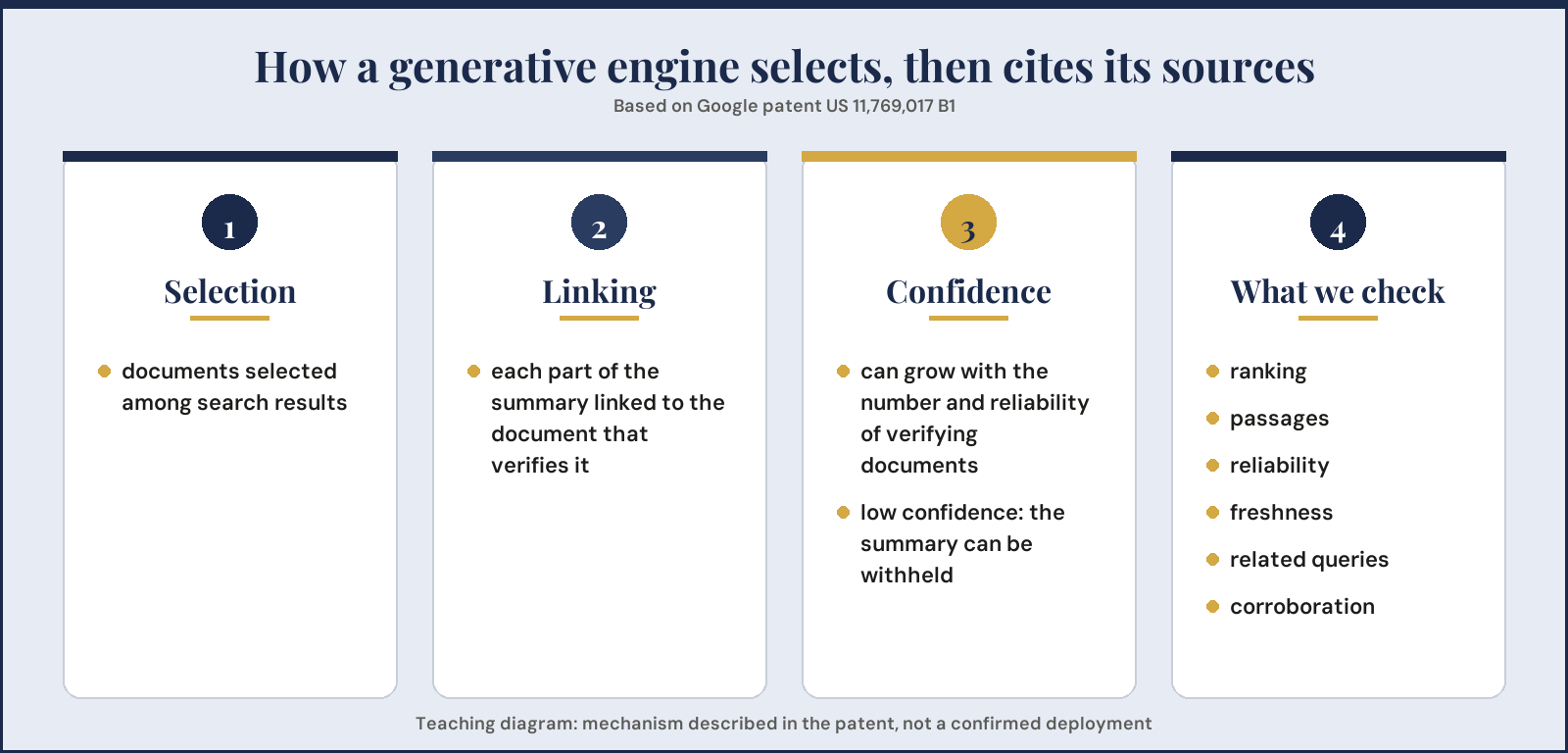
  1. Selection: the summary is generated from documents selected among the search results for a query.
  2. Verification: each portion of the summary is linked to a document that verifies it, by comparing that portion with a portion of the document; the verifying passage is what gets cited, in our reading.
  3. Corroboration: confidence in a portion can grow with the number and reliability of the verifying documents; a low-confidence summary can be withheld, leaving only classic results.

These 3 conditions form the core of what Google's generative summaries patent describes.

What we check: our GEO agency checks 6 points page by page.

  1. The page ranks in classic results for the queries a summary draws on.
  2. Each target passage verifies one statement.
  3. The page carries trustworthiness signals (author, domain, inbound links), the patent's example basis ("e.g.").
  4. The page shows its creation or update date, the basis of freshness.
  5. The page covers related and follow-up queries (the patent's terms: related, recent and implied queries).
  6. Independent, trustworthy sources corroborate the page.
How a generative engine selects and cites its sources, per Google patent US 11,769,017 B1

Verification happens at the level of a passage, which raises the question of how a passage becomes citable.

How does a passage become citable?

A passage becomes citable, in our reading, when it answers one question on its own, declaratively, under a heading that asks it.

Google's patent US 9,940,367 B1, "Scoring candidate answer passages", describes answer passage scoring for question queries; applying it to generative answers is our reading. The patent sets 5 form rules for a candidate answer passage.

  1. Candidate passages come from the top N ranked results for the query.
  2. Explanatory, declarative passages are preferred over passages that contain a question.
  3. Passages that cross headings or section breaks are penalized.
  4. Passages that open with "however" or "conversely" receive a lower score.
  5. Passages that include every step of a step list meet one of its structured-content criteria.

Google's patent US 9,959,315 B1, "Context scoring adjustments for answer passages", gives the largest boost to the passage whose closest heading best matches the question. That the heading directly above a passage weighs most is our reading. For a GEO agency, the consequence is a page built from self-contained answers, each placed under its own question.

What we check: each target passage answers one question on its own, declaratively, under a heading that asks it, without crossing into another section.

The next check concerns who signs that passage.

Why does author reputation weigh on source selection?

Author reputation weighs on source selection because Google's patent US 11,769,017 B1 names the author, the domain and inbound links as an example basis ("e.g.") of a document's trustworthiness measure. The patent gives these 3 signals as examples of what the measure can be generated from, not as requirements.

Google's patent US 8,150,842 B2, "Reputation of an author of online content", describes author reputation as a score that can be based on reviews of the content by reviewers other than the author. An authentication score is added to it, built from checks that the author is who they claim to be. Plagiarism lowers the reputation score: the patent reduces it when the author has included plagiarized content.

Our reading, for a GEO agency: a named author with a verifiable profile strengthens the trustworthiness of every page that author signs, and an unsigned page gives the trustworthiness measure one example basis fewer.

What we check: every page is signed by a named author with a verifiable profile (our reading).

A trusted author is half the check; the other half is what the page says that the top results do not.

Why must a page add new information?

A page that adds new information adds what the documents already seen do not say, which is what the information gain score of Google's patent US 11,354,342 B2 measures.

The patent, "Contextual estimation of link information gain", defines information gain for a document as the additional information it contains beyond the information in documents already presented to the user. Its own example is a spoken assistant that answers through text-to-speech: after conveying 2 possible causes of a computer error message, the assistant skips them and gives only a third, new cause.

The patent does not confirm use in generative answers; applying the score to them is our reading. Our reading, for a GEO agency: a page that repeats the top results gives a generative engine no new claim to verify and cite, whereas one first-hand fact gives it a reason to pick that page.

What we check: each page carries at least one fact the top results lack, identified before writing starts.

The last mechanism concerns the name behind that fact: the brand.

Why must a brand exist as an entity?

A brand that exists as an entity enters the computation of Google's patent US 9,477,759 B2, "Question answering using entity references in unstructured data", where the answer is the entity of the expected type that the top results cite most.

In this mechanism of entity answers, the system looks at the top results, "for example, the top ten", and uses the frequency of an entity reference, topical relevance and freshness as signals. Google's patent US 10,235,423 B2, "Ranking search results based on entity metrics", ranks Knowledge Graph results with metrics weighted by entity type, at least one of them "independent of the search query"; its relatedness comes from the co-occurrence of an entity with its type on web pages.

Our reading, for a GEO agency: a brand named next to its category, such as "SEO & GEO agency in Paris", connects to the right entity more easily than a bare brand name.

What we check: the brand is named consistently with its category on its own pages and on independent ones (our reading).

This closes the method; the next questions concern hiring a GEO agency.

// faq

How do you hire a GEO agency?

Hiring a GEO agency comes down to checking 6 criteria, choosing between an agency and a consultant, then starting with an audit. One team covers SEO and GEO, and the work is remote, including for US companies. Pricing and the guarantee, under conditions, close the section. These answers describe the offer of The SEO Papers, a GEO agency that sells SEO and GEO together.

How do you choose the best GEO agency?

Choosing the best GEO agency, meaning the most verifiable one, comes down to 6 criteria you can check before signing.

Each criterion below pairs a requirement with the way to check it.

  • A sourced method: the GEO agency cites patents by number, not "authority" in general.
  • Classic SEO included: the agency works on rankings, because generative summaries start from search results.
  • No citation promise: no provider controls what an engine cites, and a serious GEO agency says so before signing.
  • Measurement stated in advance: the agency says, before signing, how it tracks AI answers and which Google clicks it follows in Search Console.
  • Work on the pages themselves: passages, authors and the brand entity, not generic reports.
  • Published prices: the client sees each plan's price before the first call.

Vague deliverables such as "content optimization" or "AI strategy" make none of the 6 criteria checkable.

We track AI answers with a monitoring tool and follow Google clicks in Search Console. Sites that appear in Google's AI features (AI Overviews and AI Mode) are included in the overall search traffic in Search Console, reported in the Performance report within the Web search type.

The same work is sold under several labels, such as GEO, AEO and AI search optimization. In the US, "AI SEO agency" can mean an agency that uses AI tools to do SEO, a case our AI SEO agency page covers; compare criteria, not labels.

The next choice is between an agency and a consultant.

Should you hire a GEO agency or a GEO consultant?

Hiring a GEO agency or a GEO consultant depends on who executes: a GEO agency runs rankings, content, authors and mentions in one plan, while a consultant advises a team that already executes.

The first criterion is scope. GEO touches 4 workstreams at once (rankings, passage writing, author signatures and external mentions), and a GEO agency takes on the 4 together. The second criterion is execution capacity. A team with writers and a developer benefits from a consultant who sets priorities and checks results.

Our offer covers both cases: the SEO Consulting session serves teams that execute, and the Growth and Scale retainers apply when we execute. The wider choice between an agency, an SEO consultant or a freelancer follows the same logic: who advises, and who executes.

Either way, the work starts with an audit.

Why start with a GEO audit?

Starting with a GEO audit sets the order of priorities, because the audit measures where pages stand on the 8 deliverables before any work.

Like the 6 points our GEO agency checks, the audit starts with the page's rank in classic results, where the generative summary begins. At The SEO Papers, every engagement starts with a free audit of the domain, delivered within minutes. That audit includes a GEO visibility check of how AI engines would cite or skip the brand. The method behind it is described on our patent-based SEO audit page.

A GEO agency that skips this step works without a baseline, and its later reports have nothing to compare against.

The audit answers a question many buyers ask next: whether GEO needs a second agency.

Do you need a GEO agency on top of an SEO agency?

No, you do not need a GEO agency on top of an SEO agency, because GEO works on the same pages and starts from rankings.

One team covers both disciplines, with no double reporting and no contradictory recommendations; paying two agencies for overlapping work buys the same pages twice. At The SEO Papers, SEO and GEO sit in one offer: the Growth retainer includes "Ongoing SEO & GEO execution", and the Scale plan covers "Multi-market / international SEO & GEO".

The GEO vs SEO comparison fits in one line here: same pages, same starting point, extra checks for generative answers.

One offer, one team, and that team works from Paris.

Can a Paris-based GEO agency work with US clients?

Yes: The SEO Papers is a GEO agency based in Paris that works with US clients remotely.

Our administrative address is 122 rue Amelot, 75011 Paris, France, and we receive no clients on site. All work runs by video call and in writing, in English and in French; the agency has no US office. For GEO, distance changes nothing: deliverables are pages, and exchanges are about priorities. Prices are set in US dollars. The rest of the Paris offer is described on our Paris SEO agency page.

Those US dollar prices come next.

How much does a GEO agency cost?

Our GEO agency costs what our SEO & GEO offer costs, because GEO is included: 3 plans.

The 3 plans are priced in US dollars below.

  • SEO Consulting: $99 for a 45-minute session, credited to the first month of a retainer.
  • Growth: $1,389/mo, no commitment; −50% for the first 3 months with code GROWTH50, which makes $694.50/mo.
  • Scale: from $3,289/mo.

A pricing guide published by a GEO agency puts most mid-market GEO retainers at $2,000 to $10,000 per month, with enterprise programs running higher. Our Growth plan sits below that band.

Our guarantee, under conditions, targets +33% non-brand clicks from Google in 3 months, measured in the client's own Search Console against the same 3 months last year; otherwise we refund the gap, capped at the fees paid. Its 4 conditions are a site validated at the audit (no penalty, niche accepted), a client who stays 3 months and applies our recommendations on time, no link buying or off-scope site changes on the client's side, and a measurement on non-brand clicks. The full offer is on our SEO & GEO agency page.

Two questions remain: extra cost, and AI citations.

Does GEO cost extra on top of SEO?

No, GEO does not cost extra on top of SEO: the same plans cover both, with no GEO surcharge. GEO is part of the work done on each page, like ranking. At our GEO agency, the price of SEO and the price of GEO are therefore the same, from the SEO Consulting session to the Scale plan. A client on the Growth retainer gets SEO and GEO work on the same pages for one monthly fee.

Can a GEO agency guarantee AI citations?

No, a GEO agency cannot guarantee AI citations, because no agency controls what a generative engine cites. Google's patent US 11,769,017 B1 describes what Google's system can do, not what AI Overviews use today, and a low-confidence summary can be withheld. What we guarantee, under conditions, is measured in Search Console: +33% non-brand Google clicks in 3 months against the same 3 months last year, or the gap refunded, capped at the fees paid. That guarantee covers Google clicks, never AI visibility.

// investment

Start where you are. Scale when the ROI is clear.

Begin with a consulting session and free audit. Move to a retainer when the business case is proven. No mystery packages.

SEO Consulting

$99/ 45 min

Patent-backed audit on your domain, then a focused working session on your priorities.

  • Free SEO & GEO audit on your domain (delivered within minutes)
  • 45-min live walkthrough of findings and roadmap
  • Top actions ranked by impact and effort
  • Recording + written summary
  • $99 credited toward your first retainer month
Book & pay your session
Most popular

Growth retainer

−50% · first 3 months
$1,389$694.50/mo

You save $2,083.50 · then $1,389/mo · code GROWTH50

Hands-on execution for brands ready to grow organic revenue. Leave anytime.

  • Ongoing SEO & GEO execution on your roadmap
  • Topical maps, content briefs, on-page + technical SEO
  • Monthly reporting tied to revenue & leads
  • No commitment, cancel anytime
Claim 50% off: subscribe

Scale

from $3,289/mo

Expanded scope for multi-market brands, high-velocity content, and dedicated founder time.

  • Everything in Growth retainer
  • Multi-market / international SEO & GEO (hreflang, local entities)
  • High-velocity content operations and editorial QA
  • Dedicated founder strategy time and priority SLA
Book a scoping call

Consulting fee is credited toward your first retainer month. Growth: no commitment, cancel anytime. Enter code GROWTH50 at checkout for 50% off your first 3 months. Scale pricing is scoped on your audit call.

// the falsifiable guarantee

A guru never guarantees anything. A method does.

Our strategy traces to patents and published research, so we put our fee on a number you check yourself in Search Console. You pay for the share of the target we reach, and we refund the rest.

+33% non-brand Google clicks in 3 months. Or we refund the gap.

// simulate your refund

Example: Growth plan, $1,389 a month for 3 months

+22%
+0%+11%+22%+33%+44%

You pay

$2,778

We refund

$1,389

// 4 conditions, that's all

  • Your site is validated at the audit: no penalty, niche accepted.
  • You stay 3 months and apply our recommendations on time.
  • No link buying or off-scope site changes on your side.
  • Measured on non-brand clicks vs. the same 3 months last year.

Refund capped at the fees paid. Everything is written into your contract.

  • E-commerce · D2C sneaker brand · NDA

    D2C sneakers SEO: 123K organic clicks in 13 months

    13 months

    Baseline · Paid-heavy D2C · flat organic on TN & collab queries

    No visibility on high-intent sneaker queries: TN Lacoste, Air Max BW, sizing, and drop terms. Paid ads carried revenue while organic stayed flat for 18 months.

    • Topical map across sneaker models, collabs, sizing, and care entities
    • Category + PDP internal linking rebuild on PageRank principles
    • GEO comparison guides for AI citations on product intent queries

    123K

    total organic clicks (GSC)

    11.3M

    total impressions

    8

    average position

    Organic clicks · D2C sneakers

    Mar 2025 to Apr 2026 · 13 months

    Louis

    Founder · D2C sneaker brand

    Trustpilot review

    5 out of 5 stars

    Louis · You've been a game-changer for my business, guys.

    “Since Google's last update in May, the click-through rate on my website has increased by 34%. The tool and the team are very effective. I'm glad I didn't let my skepticism get the better of me. You've been a game-changer for my business, guys.”

    Read on Trustpilot
  • Recruiting · Recruitment agency · Paris BTP · NDA

    Paris BTP recruiter SEO: 3.64K organic clicks on salary queries

    16 months

    Baseline · 12 recruiters · 80% of leads from job boards

    Invisible on Paris BTP queries: salary grids, électricien, chef de chantier, paysagiste. Candidates went to Indeed; the agency paid for every application.

    • Local entity hubs for BTP trades across Île-de-France
    • Salary grid + job landing pages with JobPosting schema
    • GEO guides cited in AI job-search answers

    3.64K

    total organic clicks (GSC)

    118K

    total impressions

    3.1%

    average CTR

    Impressions & clicks · Paris BTP recruiting

    16 months · growth from Apr 2026

    Julie

    Director · Paris BTP recruitment agency

    Trustpilot review

    5 out of 5 stars

    Julie · Les heures de consulting nous ont été très utiles

    “Les heures de consulting nous ont été très utiles pour implémenter de nouvelles choses que nous n'avions pas essayé jusqu'à présent. L'approche est claire et le suivi est régulier. Nous recommandons.”

    Read on Trustpilot
  • E-commerce · Smartwatch ecommerce · NDA

    Smartwatch ecommerce SEO: 46.1K clicks from a new store

    12 months

    Baseline · New brand · zero domain authority

    Launching a connected-watch store in a crowded market: no index history, no PDPs, and Amazon dominating blood-pressure and fitness watch queries.

    • Full ecommerce SEO architecture (collections, PDPs, filters, faceted crawl)
    • Health-adjacent entity hubs (tension artérielle, musculation, sleep tracking)
    • GEO comparison pages with sourced specs and E-E-A-T signals

    46.1K

    total organic clicks (GSC)

    2.73M

    total impressions

    1.7%

    average CTR

    Organic clicks · smartwatch ecommerce

    Mar 2025 to Mar 2026 · 12 months

    Christophe Roux

    Founder · Smartwatch ecommerce

    Trustpilot review

    5 out of 5 stars

    Christophe Roux · 1 mois maintenant que je outsource le SEO à theseopapers

    “1 mois maintenant que je outsource le SEO à theseopapers. Je suis très satisfait de leur rapidité et de leur suivi et mes clients aussi.”

    Read on Trustpilot

Trustpilot reviews

What clients say on Trustpilot

Swipe on mobile, 3 reviews side by side on laptop. All 6 reviews from our Trustpilot profile.

View profile on Trustpilot
5 out of 5 stars

1 mois maintenant que je outsource le SEO à theseopapers

“1 mois maintenant que je outsource le SEO à theseopapers. Je suis très satisfait de leur rapidité et de leur suivi et mes clients aussi.”

C

Christophe Roux

Verified on Trustpilot · FR

Read review
5 out of 5 stars

Les heures de consulting nous ont été très utiles

“Les heures de consulting nous ont été très utiles pour implémenter de nouvelles choses que nous n'avions pas essayé jusqu'à présent. L'approche est claire et le suivi est régulier. Nous recommandons.”

5 out of 5 stars

Call de 45 min très intéressant et utile

“Call de 45 min très intéressant et utile. Merci.”

5 out of 5 stars

Really good

“Really good. Ludovic helped me achieve the results I wanted for my website. My website actually ranked higher than I expected. Great job.”

5 out of 5 stars

30 min de call de grande qualité avec Ludovic

“30 min de call de grande qualité avec Ludovic. Beaucoup d'information et de valeurs transmises + rapport semantic seo complet + todo list que j'ai commencé à appliquer et avoir les résultats. Je recommande.”

5 out of 5 stars

You've been a game-changer for my business, guys.

“Since Google's last update in May, the click-through rate on my website has increased by 34%. The tool and the team are very effective. I'm glad I didn't let my skepticism get the better of me. You've been a game-changer for my business, guys.”

TrustScore 4.2 · 6 reviews on Trustpilot

Free patent-backed SEO & GEO audit on your domain. No commitment.