SEO (search engine optimization) is the work that helps search engines understand a website and helps people find it in organic, unpaid results. Google crawls, indexes, and ranks pages; SEO work then splits into three pillars (technical, content, and links) before reaching local SEO, AI search, and the point where you hand the work to an agency. The exact definition comes first.
What is SEO (search engine optimization)?
SEO is the practice of helping search engines understand your content and helping people find your site and choose to visit it from search results. In its SEO Starter Guide, Google Search Central describes SEO, short for search engine optimization, as being “about helping search engines understand your content, and helping users find your site and make a decision about whether they should visit your site through a search engine.” The same guide states that “SEO is about taking the next step and working on improving your site’s presence in Search.” SEO therefore goes beyond a ranking position: it joins machine understanding with a human click decision. The acronym itself carries that vocabulary.
What does SEO stand for?
SEO stands for Search Engine Optimization. Google Search Central spells the acronym out at the top of the SEO Starter Guide, and the terms search engine optimization, organic search optimization, and natural search name the same field. The table below lists the acronym next to the terms it works with on a results page.
| Term | Meaning |
|---|---|
| SEO | Search Engine Optimization |
| Organic results | Unpaid results that SEO works to earn |
| PPC | Pay-per-click advertising, the paid side of the results page |
| SERP | Search Engine Results Page |
How does SEO work on Google?
SEO works on Google across three stages: crawling, indexing, and ranking. Google discovers a page with automated programs called crawlers, stores it in its index if the page qualifies, then ranks it against other indexed pages for each query. Google Search Central’s How Google Search Works guide states that “Google Search works in three stages, and not all pages make it through each stage”: crawling, indexing, and serving search results. Ranking happens at the serving stage, where Google returns the pages most relevant to the query. The systems behind that ranking are detailed in how Google ranks pages, from link analysis to entity understanding. The three pillars of SEO organize the work on your side.
What are the three pillars of SEO?
The three pillars of SEO are technical SEO, content, and links. Beginner guides group SEO work this way as a teaching convention, not as a Google classification.
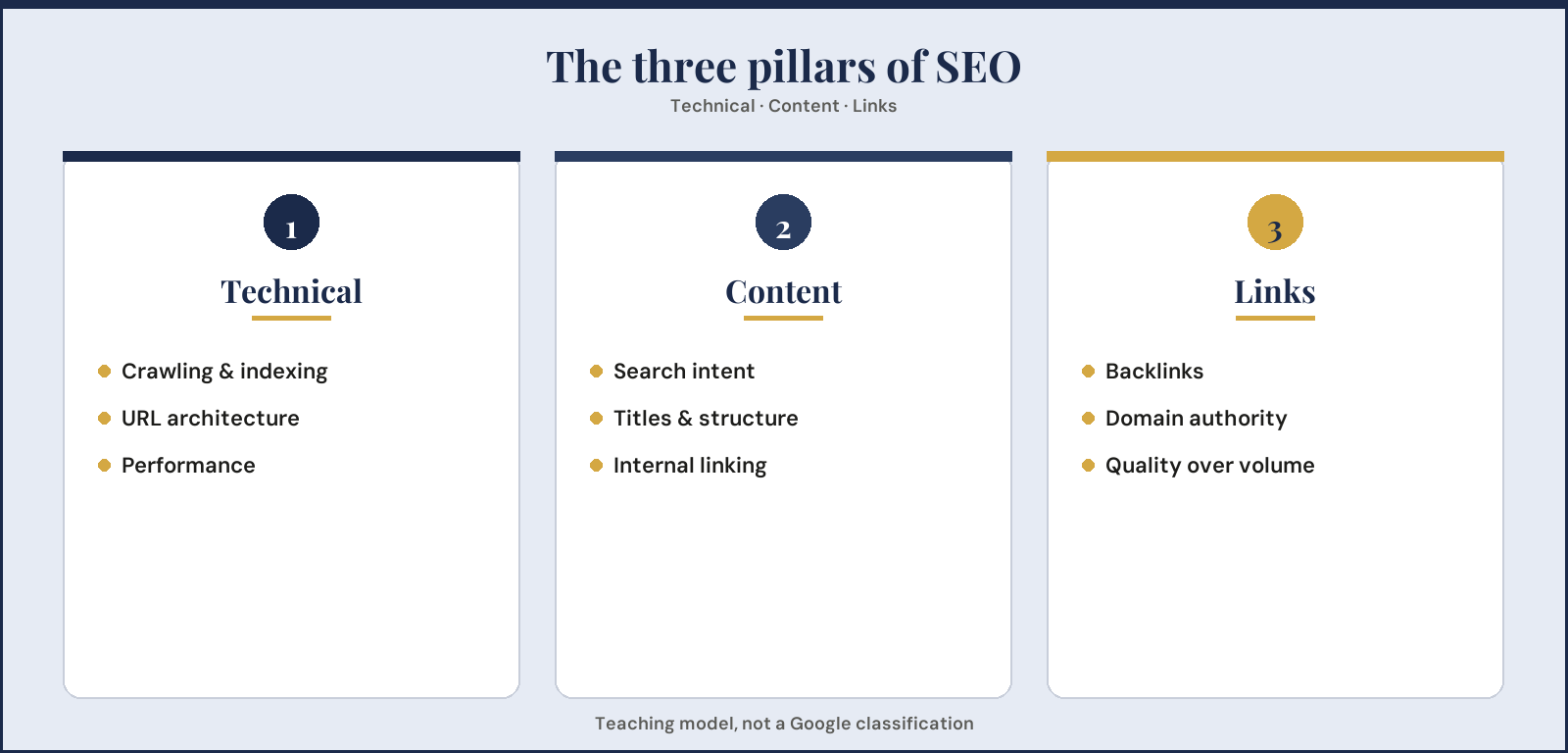
The three pillars of SEO cover technical health, content, and links.
- Technical. The technical pillar of SEO covers crawling, indexing, and page access performance. Without a sound technical base, content and links stay partly invisible to crawlers.
- Content. The content pillar of SEO covers search intent, headings, and internal linking. The text answers the query; the structure guides both the reader and the search engine.
- Links. The links pillar of SEO covers inbound links and the perceived authority of the domain. Link quality weighs more than raw link volume.
Technical SEO
Technical SEO makes a site crawlable, indexable, and fast enough for crawlers and visitors. Robots.txt rules, indexing tags, URL architecture, and measurable page performance shape this work. Every other SEO effort depends on that base.
Content (on-page SEO)
On-page SEO aligns each page with one search intent through its text, headings, and internal links. Each URL answers a clear query; headings structure relevance; internal links spread context between pages. Google interprets that content through Knowledge Graph entities, not keyword strings alone.
Links (off-page SEO)
Link popularity rests on quality backlinks from relevant sites, and manipulative link schemes put it at risk. A useful backlink passes a trust signal; a manipulated link network exposes the site to a loss of visibility. Link analysis at Google traces back to the PageRank patent.
What does local SEO change?
Local SEO adds a geographic layer to SEO: the local pack, the Google Business Profile, and reviews. A “near me” query or a query with a city name triggers map results and business profiles, where the profile and its reviews weigh alongside the website. Google’s Business Profile Help Center states that “Local results are mainly based on relevance, distance, and popularity.” The patents behind local prominence signals detail how those factors combine.
How does AI change SEO visibility?
AI changes SEO visibility by placing generated answers, such as Google’s AI Overviews and AI Mode, above or beside the classic blue links. Being cited in a generative summary and ranking in organic results coexist, and source content stays the material those systems summarize. Google Search Central states that “There are no additional requirements to appear in AI Overviews or AI Mode, nor other special optimizations necessary.” Work aimed at these surfaces is often called GEO (generative engine optimization), and the AI Overviews patents cover how generated answers select their sources.
What is the difference between SEO and PPC?
The difference between SEO and PPC is how a result appears: SEO earns organic positions without paying per click, while PPC (pay-per-click, called SEA or paid search in some markets) buys ad space on the results page. Google Search Central states that “Google doesn’t accept payment to rank pages higher, and ranking is done programmatically.” SEO and PPC share the same results page; only the lever and the cost model differ.
When should you hire an SEO agency?
Hire an SEO agency when technical, content, and link work exceeds your in-house capacity, or when you need an outside audit to set priorities. The checklist below helps you compare agencies; it does not replace an audit. The SEO agency page details how an engagement runs.
What should you check before choosing an SEO agency?
Check three things before choosing an SEO agency: method, proof, and market fit.
- Method. The agency names crawling, content, and links in its method and promises no guaranteed position. Google’s SEO Starter Guide states that no secret automatically ranks a site first.
- Proof. The agency shows measured cases (organic traffic, queries, timelines) instead of slogans, as published agency case studies do.
- Market fit. The agency works in your language and market, with tools and reporting that fit search engine optimization for an English-speaking business.