Google Search crawls billions of pages and ranks them for every query, and the Google ranking algorithm is not one formula but a set of ranking systems that crawl, index, and order organic results. This guide gives Google’s own definition, the plurality of ranking systems, the three stages documented by Google Search Central, then public signals, links, entities, core updates, patents, and myths, before the question of hiring an agency for Google SEO.
What is the Google ranking algorithm in SEO?
The Google ranking algorithm, in SEO, is the set of automated systems that sort indexed pages for each query in Google Search. Google Search Central’s In-depth guide to how Google Search works states that “Google Search is a fully-automated search engine that uses software known as web crawlers that explore the web regularly to find pages to add to our index.” The algorithm is neither a single black box nor a fixed list of 200 factors: Google documents its mechanisms (crawling, indexing, relevance) without publishing the full ranking formula. Useful Google SEO starts from that line between documented automation and undisclosed weighting.
Does Google use a single ranking algorithm?
No, Google does not use a single ranking algorithm: Google Search stacks specialized ranking systems for query understanding, quality, and spam that act at different stages. Google’s guide to Google Search ranking systems states that “Google uses automated ranking systems that look at many factors and signals about hundreds of billions of web pages and other content in our Search index to present the most relevant, useful results, all in a fraction of a second.” The plurality starts at crawl time, since “Googlebot uses an algorithmic process to determine which sites to crawl, how often, and how many pages to fetch from each site.” The guide names systems such as BERT, RankBrain, neural matching, and SpamBrain; RankBrain “is an AI system that helps us understand how words are related to concepts.” Other systems surfaced outside Google’s documentation, such as the Navboost signal described in the United States v. Google antitrust case. Google publishes no exhaustive map of every module.
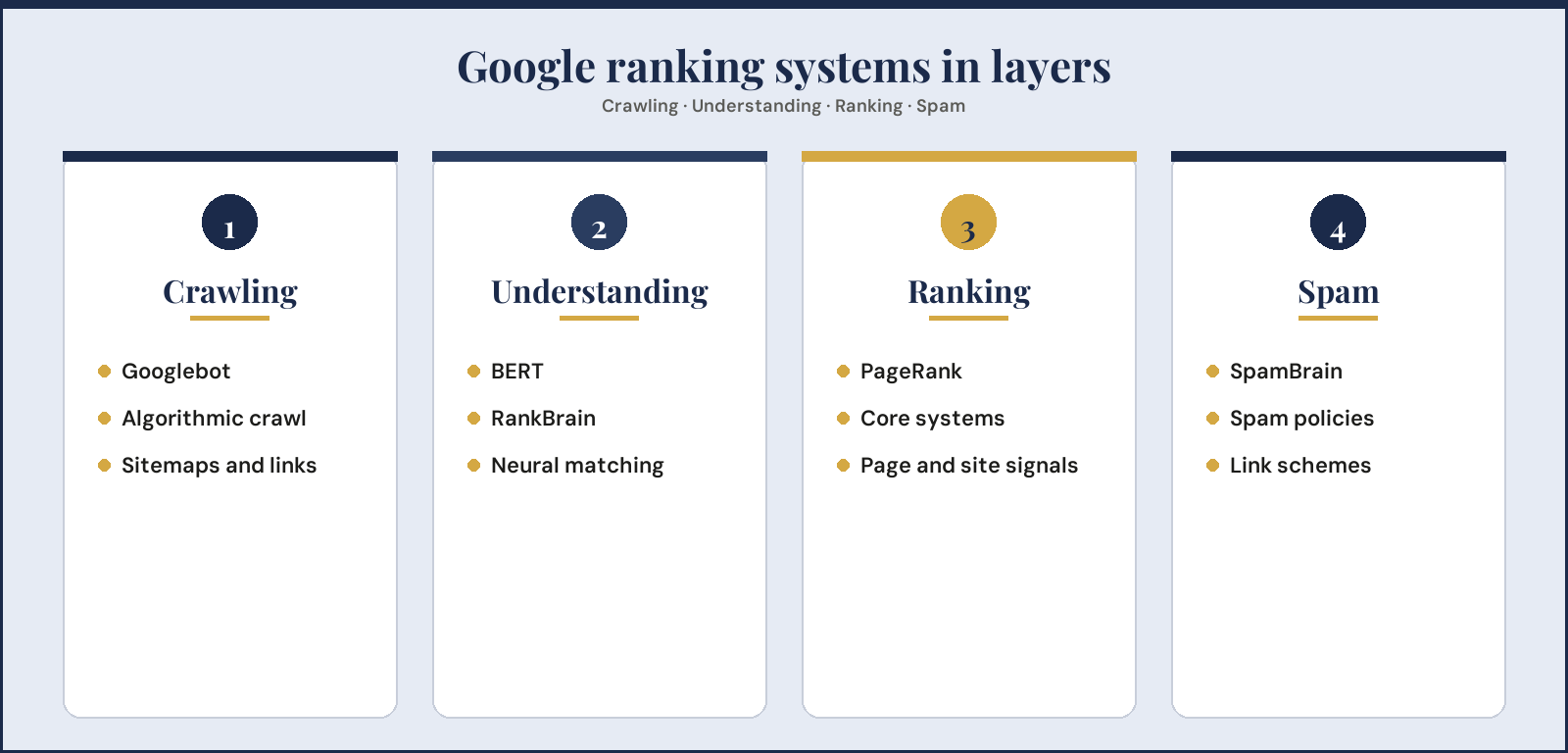
Google’s ranking systems stack in layers rather than merging into one block.
How does Google Search crawl, index, and rank pages?
Google Search crawls, indexes, then serves eligible pages ranked by estimated relevance to the query. Google Search Central’s How Google Search works guide states that “Google Search works in three stages, and not all pages make it through each stage”: crawling, indexing, and serving search results. That sequence structures Google SEO: without crawling, Google does not know the URL; without indexing, the page is not a ranking candidate; without serving, the page gets no organic visibility.
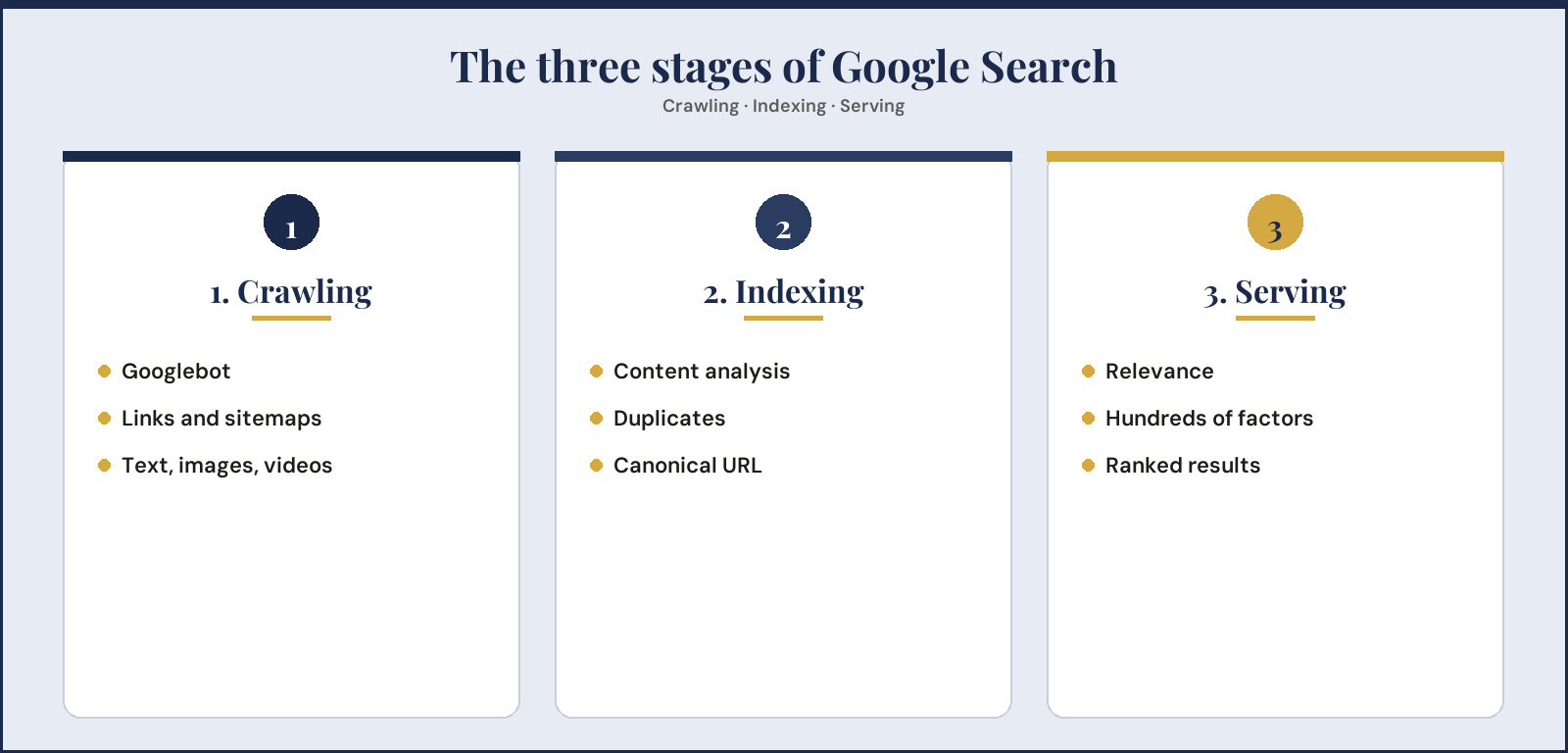
The three stages of Google Search chain crawling, indexing, and ranked results.
- Crawling. Crawling downloads text, images, and videos with automated programs called crawlers (Googlebot), which discover URLs through links and sitemaps.
- Indexing. Indexing analyzes the text, tags, and media on the page, then stores the information in the Google index, where Google groups duplicate pages and selects a canonical URL.
- Ranking (serving). Serving selects, from the index, the pages most relevant to the user’s query: at this stage the Google ranking algorithm orders the visible results.
Which ranking signals does Google document publicly?
Google publicly documents ranking signals across content quality, page experience, links, and user context, without an exhaustive checklist. The How Google Search works guide states that “Relevancy is determined by hundreds of factors, which could include information such as the user’s location, language, and device (desktop or phone).” The ranking systems guide adds that Google ranks at the page level, with site-wide signals and classifiers contributing to its understanding of pages. Neither guide replaces an audit: both set the bounds of what Google admits as possible inputs. Our SEO guide places the Google ranking algorithm within search engine optimization as a whole, and E-E-A-T (experience, expertise, authoritativeness, trustworthiness) covers the quality angle.
What role do links and PageRank play today?
Links remain an authority signal in the Google ranking algorithm, alongside relevance and page experience, without being the only lever in Google Search. The ranking systems guide describes link analysis systems that “understand how pages link to each other as a way to determine what pages are about and which might be most helpful in response to a query.” PageRank, one of the core ranking systems in use when Google launched, still counts: “How PageRank works has evolved a lot since then, and it continues to be part of our core ranking systems.” Today the quality and context of links weigh more than raw volume. Our breakdown of the PageRank patent details the original method.
Why does SEO focus on entities?
SEO focuses on entities because Google Search connects queries, documents, and structured facts beyond the exact keyword. Indexing processes text, tags, and media; Google clusters pages with similar content and selects the most representative one as canonical, which favors one consistent representation of each topic. The ranking systems guide describes neural matching as a system that matches “representations of concepts in queries and pages.” The Knowledge Graph and structured data extend that logic on the site side. Our analysis of Knowledge Graph entities goes deeper.
How do core updates change rankings?
Core updates change rankings by broadly reassessing how Google’s systems evaluate content, without targeting a named URL. Google Search Central states that “Several times a year, Google makes significant, broad changes to our search algorithms and systems.” On the same page, Google adds that “These changes are broad in nature, and don’t target specific sites or individual web pages.” A core update redistributes organic visibility between comparable sites on a topic, and Google guarantees neither indexing nor position. A drop after an update calls for a Search Console, content, and link diagnosis, not a single trick. Google’s list of ranking updates records each rollout date.
What do Google patents reveal about ranking?
Google patents reveal possible ranking mechanisms, not proof that each idea runs in production in Google Search. A patent describes a filed invention; the live Google ranking algorithm combines systems that Google does not map patent by patent. Google itself points readers to “the original PageRank research paper and patent” in its ranking systems guide. For SEO, patents supply testable hypotheses on links, entities, and queries to prioritize an audit, read from primary sources and with no promise of full reverse engineering. The Google ranking patents index covers each mechanism in depth.
Which myths about the Google algorithm persist?
Three myths about the Google algorithm persist: a fixed list of 200 factors, secret tricks, and paying Google to crawl more often or rank higher. Google Search Central answers the third directly: “Google doesn’t accept payment to crawl a site more frequently, or rank it higher. If anyone tells you otherwise, they’re wrong.” The same guide states that “ranking is done programmatically,” and it describes “hundreds of factors” rather than a closed list. Serious Google SEO relies on documentation and measurement, not hidden formulas. Other SEO myths fall to the same test.
When should you hire an agency for Google SEO?
Hire an agency for Google SEO when reading the Google algorithm, public signals, core updates, or Google patents exceeds your in-house capacity, or when a ranking in Google Search drops without an obvious technical cause. An agency engagement covers a post-update audit, editorial priorities, and patent interpretation; it does not replace Search Console. A patent-based SEO method frames this kind of engagement.
What should you check after a ranking change?
Check crawling, indexing, and documented signals after a ranking change in Google Search, before any rushed redesign. Google recommends “waiting at least a full week after a core update completes before analyzing your site in Search Console.”
- Search Console. Compare coverage, queries, and the pages affected by the change in Search Console.
- Content and intent. Confirm that each affected page still answers the intent the Google ranking algorithm rewards on its target query.
- Links and spam. Audit inbound links so that they stay natural and no link scheme exposes the site to Google’s spam detection systems.