
An SEO audit is the diagnosis of a website against the way Google crawls it, indexes it, ranks it and cites it. In a patent-based SEO audit, every check rests on a patent (one of Google's, or the PageRank patent US6285999B1, filed by its inventor Lawrence Page and assigned to Stanford University) or on a Google Search Central document, read as the description of a mechanism and not as proof of how live rankings behave. These checks fall into four axes, in this order: technical, semantic, backlinks and GEO.
The SEO audit follows fixed steps and ends in a report, whose price depends on whether a free tool or a human auditor produces it. Then comes the choice of who to hand it to. Start with what an SEO audit is, exactly.
Free patent-backed SEO & GEO audit on your domain. No commitment.
What is an SEO audit?
An SEO audit is the analysis of a website that measures what stops Google from crawling, indexing, ranking and citing it, then ranks each fix by priority. A website SEO audit, or SEO site audit, starts from the three stages that Google Search Central describes for Google Search: crawling, indexing and serving results, and not every page makes it through each stage. SEO, or search engine optimization, is the work of optimizing a site for these stages. In practice, the meaning of an SEO audit is a check of crawler access, content relevance, link authority and citation in AI answers, closed by a report that ranks each fix by priority. Running an SEO audit makes sense before a site redesign, after a drop in organic traffic and before hiring outside SEO help.
The next question is what changes when every check of the audit rests on a patent or a Google document.
What does a patent-based SEO audit change?
A patent-based SEO audit changes the proof: each finding cites the patent or the Search Central page it rests on, so the client checks the source of every fix. These Google ranking patents and documents describe mechanisms; they do not prove that Google applies each method as written in its current ranking. The table below ties each audit axis to the document its check rests on.
| Audit axis | What is checked | Patent or Google document the check rests on | What the document establishes |
|---|---|---|---|
| Technical | Crawling, indexing, robots.txt, sitemap, canonical URL, noindex, JavaScript rendering, Core Web Vitals, structured data, HTTPS | Google Search Central documentation: how Search works, robots.txt, sitemaps, canonical URLs, noindex, JavaScript SEO, Core Web Vitals, structured data, page experience | Google Search works in three stages, crawling, indexing and serving results, and not all pages make it through each stage |
| Semantic | Query–document relevance, new information | Patent US7536408B2 « Phrase-based indexing in an information retrieval system »; patent US11354342B2 « Contextual estimation of link information gain » | Documents are indexed by the phrases they contain and by the related phrases that predict other phrases; the information gain score measures the information a document adds beyond the documents the user already viewed |
| Backlinks | Backlink profile, weight of each link, link spam | PageRank patent US6285999B1 (inventor Lawrence Page, assignee Stanford University); patent US7716225B1; Google's guide to its ranking systems; Google's spam policies | The rank of a document is calculated from the ranks of the documents citing it; under the reasonable surfer model, some links on a page are followed with a higher probability than others; Google lists PageRank among its link analysis systems; link spam means creating links primarily to manipulate rankings |
| Site quality | Quality at the level of the whole domain | Patents US9767157B2 « Predicting site quality », US9031929B1 « Site quality score » and US8682892B1 « Ranking search results »; Google's guide to its ranking systems | A quality score is computed for an entire site; Google uses site-wide signals and classifiers, and its Panda system, announced in 2011, became part of its core ranking systems in 2015 |
| GEO | Citation of the site in AI Overviews | Patent US11769017B1 « Generative summaries for search results »; Search Central page on AI features; Search Central guide « Optimizing your website for generative AI features on Google Search » | A generative summary answers the query with links to the documents that verify each portion; a page that is indexed, eligible for a snippet and on a site included in « Search generative AI features » in Search Console is eligible as a supporting link |
This tie to a document sets the method apart from the pages that rank for the query. On 11 November 2026, in the United States, none of the 11 sources cited by Google's AI Overview for « seo audit » nor the readable organic results mentioned a patent, and none tied each of its checks to a Google document.
These checks group into four SEO audit axes.
What are the types of SEO audit?
There are four types of SEO audit, told apart by the layer of Google's processing that each check targets. The four types are listed below.
- Technical SEO audit: how Google crawls, renders and indexes the pages.
- Semantic SEO audit: the relevance of the content, the coverage of the topic and the internal links.
- Backlink audit: the links pointing to the site and their weight.
- GEO audit: the citation of the site in the answers Google's AI generates.
WebFX's service page says an SEO audit checks three main areas: technical SEO, on-page SEO and off-page SEO. Google's AI Overview in the United States, on 11 November 2026, listed four pillars: indexation and crawlability, technical health, on-page optimization, and content and authority. The four axes of this SEO audit take the three areas, with on-page becoming the semantic audit, internal links and architecture included, and off-page becoming the backlink audit, then add GEO. These areas follow from the definition of optimizing for search engines. Keyword, ranking and on-page audits are checks inside the semantic audit.
The first axis, the technical SEO audit, conditions all the others.
What does a technical SEO audit check?
A technical SEO audit checks that Google crawls, renders and indexes every useful page of the site, based on the Google Search Central documentation. The checks of a technical SEO audit, and the Google document each one rests on, are listed below.
- Crawling: the robots.txt file tells crawlers which URLs they can access, and Google states it is not a mechanism for keeping a page out of its results (robots.txt documentation).
- Sitemap: Google reads the sitemap file to crawl the site more efficiently (sitemaps documentation).
- Crawl budget: Google writes this guide for sites of 1 million or more unique pages changing about once a week, or 10,000 or more pages changing daily (crawl budget guide).
- Indexing: the canonical tag names the preferred URL among duplicate pages, and the noindex rule blocks indexing (canonical URL and noindex documentation).
- JavaScript rendering: Google processes JavaScript web apps in three main phases, crawling, rendering and indexing (JavaScript SEO documentation).
- Core Web Vitals: these metrics measure loading, interactivity and visual stability, and Google highly recommends good scores (Core Web Vitals documentation).
- Structured data and HTTPS: structured data describes and classifies the page content, and HTTPS belongs to the page experience checks (structured data and page experience documentation).
A site crawled and indexed without errors stays invisible if its content misses the queries it targets.
What does a semantic SEO audit check?
A semantic SEO audit checks that the site's content covers the attributes of its topic and answers the queries it targets, without two URLs competing for the same query. In an SEO audit, this axis takes the on-page area and adds internal links and architecture to it. The checks of a semantic SEO audit are listed below.
- Topical map coverage: the attributes of the topic the site covers, against the missing ones.
- Cannibalization: two or more URLs ranking for the same query and splitting its signals.
- Internal links and anchors: the links between pages of one topic and the text of each anchor.
- Source context: the fit between the published content and the real business of the site.
- Query–document relevance: the presence of the related phrases expected for each query.
That last check rests on Google's patent US7536408B2, which describes phrase-based indexing: some phrases predict the presence of other phrases in documents, and documents are indexed by the phrases they contain. Keyword and ranking audits supply the input queries of the semantic SEO audit.
Relevance is half the picture: a page's authority comes from the links it receives.
What does a backlink audit check?
A backlink audit checks the number, the quality and the context of the links pointing to the site. In an SEO audit, this axis rests on the PageRank patent US6285999B1, filed by its inventor Lawrence Page and assigned to Stanford University, under which the rank of a document is calculated from the ranks of the documents citing it; Google's guide to its ranking systems lists PageRank among its link analysis systems. The checks of a backlink audit are listed below.
- Backlink profile: the domains linking to the site and the rank of each.
- Weight of each link: the reasonable surfer model, described in patent US7716225B1, gives some links on a page a higher probability of being followed than others.
- Anchors and link context: patent US8577893B1 ranks the linked page from the rare words found around the link.
- Link velocity: patent US8407231B2 describes a drop in the rate of new links that leads to classifying a document as stale and lowering its score.
- Link spam: Google's spam policies define link spam as creating links primarily to manipulate search rankings, for example buying or selling links.
Links feed the classic results; the fourth axis checks the site's citation in AI answers.
What does a GEO audit check?
A GEO audit checks, for each target query, whether the site is among the sources cited by Google's AI Overview or AI Mode. The method of this SEO audit axis takes three steps: list the queries, record whether an AI Overview appears and which URLs it cites, then compare those citations with the organic rank. Eligibility rests on three conditions: the Search Central page on AI features sets two, a page indexed and eligible to be shown with a snippet, and Google's guide on generative AI features in Search adds the third, the inclusion of the site in « Search generative AI features » in Search Console. Google's patent US11769017B1 on generative summaries describes the mechanism: a large language model writes a summary in answer to the query and links portions of it to the documents that verify them. The patent describes a method, not the exact workings of AI Overviews.
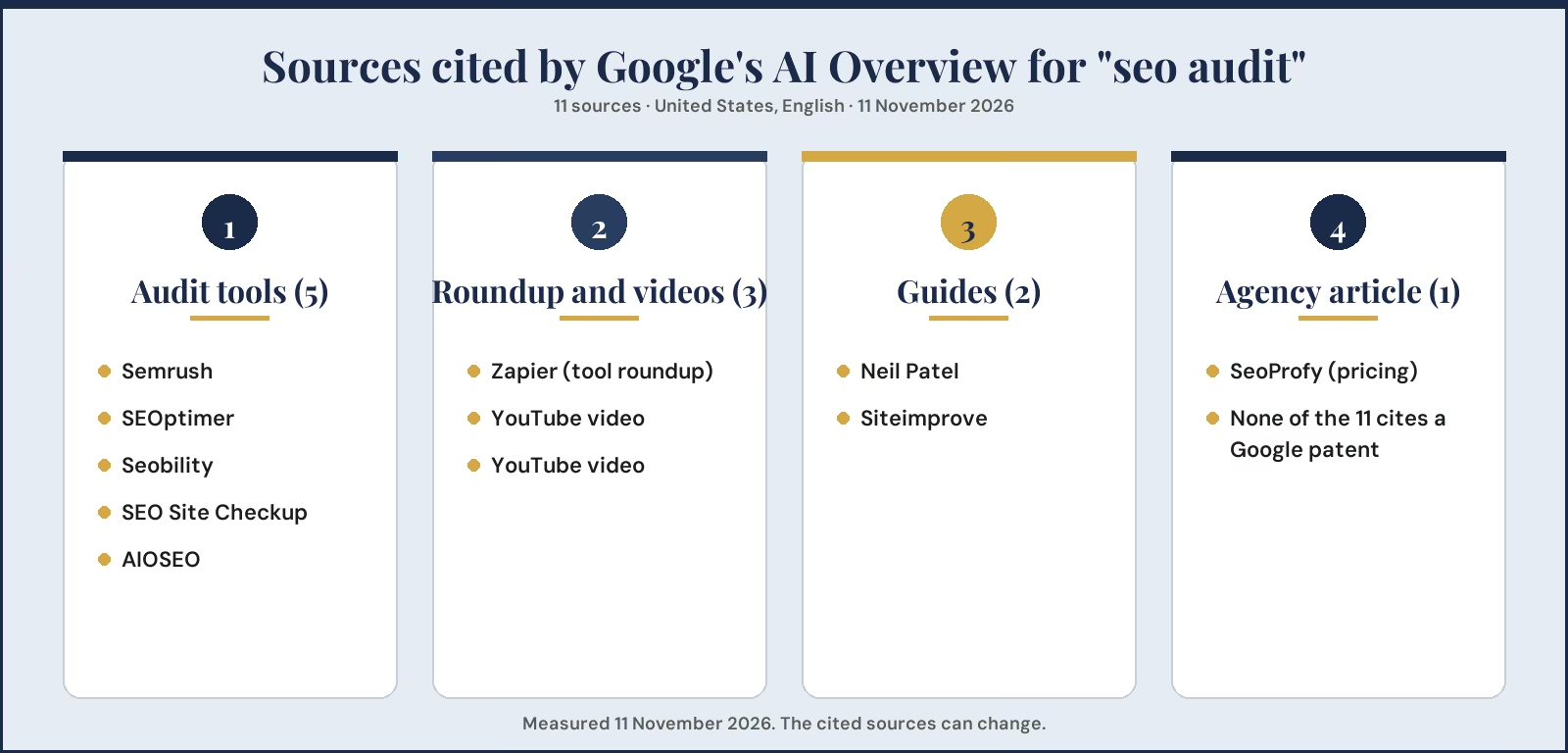
On 11 November 2026, in the United States and in English, Google's AI Overview for the query « seo audit » cited 11 sources: 5 audit tools (Semrush, SEOptimer, Seobility, SEO Site Checkup, AIOSEO), 1 tool roundup (Zapier), 2 YouTube videos, 2 guides (Neil Patel, Siteimprove) and 1 agency pricing article (SeoProfy). None of these 11 sources cites a Google patent. This list of sources can change from one day to the next.
The full GEO audit, query by query, is the work of our GEO agency. The four SEO audit axes then run in a fixed order, from scoping to tracking.
How do you run an SEO audit?
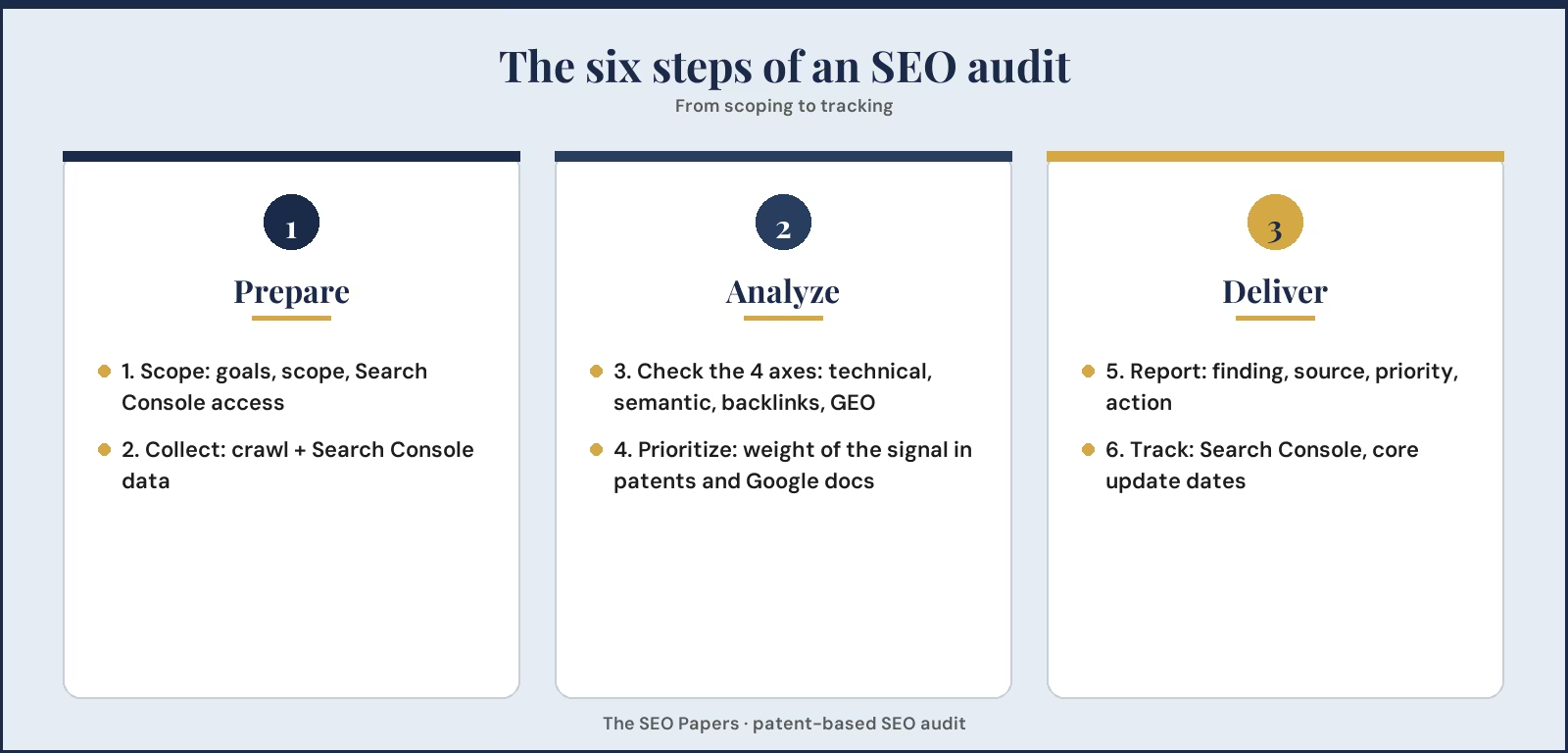
You run an SEO audit in six steps, from scoping the pre-audit to tracking the fixes. The steps stay the same from one site to another, but some checks change for a WordPress site, an ecommerce or Shopify site and a local business. The six steps of an SEO audit are, in order:
- Scope the pre-audit: set the goals, the scope and the access to Search Console.
- Collect the data: crawl the site and export the Search Console data.
- Check the four axes: technical, semantic, backlinks and GEO.
- Prioritize the findings by the weight of the signal in the patents and the Google documentation.
- Write the report: tie each finding to its source, its priority and its action.
- Track the fixes: measure their effect in Search Console, against the dates of each Google core update.
How long an SEO audit takes depends on who runs it. SEOmator states that its free audit runs 172 checks and returns the report in about 30 seconds; WebFX names a turnaround of 30 or 60 days as one of the factors that set an audit's price. The free audit from The SEO Papers arrives within minutes.
The steps stay the same, but the CMS or the type of site changes part of the checks.
How do you audit a WordPress site?
Auditing a WordPress site adds the checks specific to the CMS to the SEO audit: SEO plugins, archives, theme and attachment pages. The WordPress checks of an SEO audit are listed below.
- SEO plugins: two SEO plugins active at the same time duplicate the title, canonical or meta description tags.
- Archives and tags: indexed archive, tag and author pages create thin pages that look alike.
- Theme: the weight of the theme and its scripts weighs on speed and Core Web Vitals.
- Attachments: WordPress creates one page per media file, to noindex or redirect to the file.
An ecommerce site multiplies these duplicates across its catalog.
How do you audit an ecommerce or Shopify site?
Auditing an ecommerce or Shopify site focuses the SEO audit on the URLs the catalog generates: facets, product pages, pagination and collections. The ecommerce checks of an SEO audit are listed below.
- Faceted navigation: filters generate parameter URLs, to open to crawling or to exclude.
- Duplicate product pages: variants and supplier descriptions produce near-identical pages.
- Category pagination: each category page stays crawlable and linked to the next ones.
- Shopify collections: a product reachable through /products/ and through /collections/…/products/ creates duplicate URLs, which the canonical tag ties to one.
After the SEO audit, the work on a store's category and product pages belongs to an ecommerce SEO agency.
A local business raises another question: its visibility in one area.
What changes in a local SEO audit?
A local SEO audit changes the scope: it checks the Google Business Profile, the consistency of the business name, address and phone number (NAP) across the web, the reviews and the site's local pages. This axis serves businesses whose customers come from one area. Whatever the type of site, the SEO audit ends in one deliverable: the report.
What is in an SEO audit report?
An SEO audit report contains the summary, the findings by axis, the proof behind each finding, its priority, the action plan and the follow-up. The sections of an SEO audit report, as the market practices them, are listed below.
- Summary: the state of the site and the priority fixes.
- Findings by axis: technical, semantic, backlinks and GEO.
- Proof per finding: the Google document, the URL or the data behind the finding.
- Priority: the rank of each fix in the order of work.
- Action plan: the fix, its owner and its deadline.
- Follow-up: the Search Console metrics to read again after the fixes.
A complete SEO audit covers all four axes; a report limited to technical checks remains a technical SEO audit. An SEO audit example is judged on this structure: each finding cites its source and its priority. At The SEO Papers, the audit report is delivered as an HTML link and a PDF.
That leaves the cost of such a report.
How much does an SEO audit cost?
An SEO audit costs from $0 for an automated tool to $15,000 for a comprehensive audit of a large site, according to the surveys and offers in the table below.
| Audit type | Observed range (USD) | Source and date |
|---|---|---|
| SEO audit, most common price | $101 to $750 (43% of businesses) | WebFX survey of 250 US businesses, 2026 pricing guide |
| Comprehensive audit of a large site | $12,001 to $15,000 | WebFX survey, 2026 pricing guide |
| Agency SEO audit, small site under 50 pages | $650 to $1,500 | WebFX service page, read on 11 November 2026 |
| Agency SEO audit, ecommerce site | $2,500 to $7,500 | WebFX service page, read on 11 November 2026 |
| Technical audit | $100 to $5,000 | Clutch 2025 data, quoted by SeoProfy |
| On-page audit work | $375 to $2,500 | Clutch 2025 data, quoted by SeoProfy |
| Backlink audit | $399 to $1,399 | Clutch 2025 data, quoted by SeoProfy |
| Agency SEO audit (SeoProfy) | $750 to $2,500 | SeoProfy, read on 11 November 2026 |
Automated SEO audit tools such as Semrush's free SEO checker or SEOmator cost nothing. At The SEO Papers, the free audit costs $0, and the « SEO Consulting » session costs $99 for 45 minutes, credited toward the first month of a retainer. For the budget of full, ongoing SEO, our agency pricing page shows what serious SEO costs.
The cheapest SEO audit is free and online; what it measures is the next question.
What is the difference between a free SEO audit tool and a human patent-based audit?
The difference between a free SEO audit tool and a human patent-based audit lies in scope: the tool reads each page on its own, the human checks site-level, query-level and citation signals. A free SEO audit tool measures tags, speed and HTTP errors well: SEOmator states that its free audit runs 172 checks with an AI visibility score, and Semrush lists more than 140 technical and on-page checks for its paid Semrush One plan. A general AI assistant such as ChatGPT reviews the text, tags or code you give it, but it has no access to your Search Console data, no crawl of the whole site and no record of which sources AI Overviews cite for your queries, so it replaces neither kind of SEO audit. The table below compares what each type of SEO audit sees.
| Criterion | Free online SEO audit tool (automated) | Human patent-based audit |
|---|---|---|
| Number of checks | 172 checks (SEOmator, free), read page by page | Checks chosen across the four axes for the audited site |
| Site-wide quality | Page-by-page reading, no quality score for the whole site | Quality of the whole site, per patents US9767157B2 and US9031929B1 and the site-wide signals Google describes |
| Query–document relevance (related phrases) | Editorial checks on each page: tags, keywords | Related phrases expected for each query, per patent US7536408B2 |
| Cannibalization and internal links | Broken internal links and click depth, without comparing URLs that target the same query | URLs competing for one query, anchors and links between pages of one topic |
| Citation in AI Overviews | Out of reach of a page tool: citation shows in the results page | Presence of the site among the cited sources, query by query, per patent US11769017B1 and the Search Central page on AI features |
Each human check in the table points to one of the Google patents explained one by one.
With the difference set, the choice is who runs the SEO audit.
Who should you hand an SEO audit to?
You hand an SEO audit to yourself, an agency, a consultant or a freelancer, depending on your time, your budget and the level of proof you expect. The sections below cover the self-run audit, compare the agency, the consultant and the freelancer, list the proof to ask for before you sign, and answer whether the audit needs a meeting. The SEO Papers, for example, is an SEO and GEO agency whose audits rest on Google's patents.
Can you do an SEO audit yourself?
Yes, you can do an SEO audit yourself, as long as you stick to the checks a tool reads. There are three ways to get one: on your own with a free tool, with a consultant guiding you through a session, or through a professional audit. On your own, a free tool covers tags, speed and HTTP errors. A self-run SEO audit stops at the quality of the whole site, cannibalization and citation in AI Overviews, which the tool does not compare.
Agency, consultant or freelancer: who should run your SEO audit?
Choosing between an agency, a consultant and a freelancer for an SEO audit comes down to choosing a scope, a person who signs the report and a budget. An agency brings a team: it covers the four axes of an SEO audit and moves on to the fixes. The SEO Papers is an SEO and GEO agency whose every audit rests on Google's patents and documentation.
A consultant commits one named person, who runs the SEO audit and presents it; the quality of the report follows that person's experience.
A freelancer works alone, without an agency behind them, and their availability depends on their workload. The choice rests on criteria you can check, not on a ranking.
What results should you ask for before handing over an SEO audit?
Before handing over an SEO audit, ask for four kinds of proof, listed below.
- Named auditor: the person who signs the SEO audit and their background.
- Google source per finding: the patent or the Search Central page behind each fix.
- Sample report: the structure, the proof and the priority of each finding.
- Verifiable case studies: results readable in the client's Search Console.
The SEO Papers publishes its client results as case studies, to read against these four criteria. Its auditor is its founder, Ludovic (@LudovicRrd), based in Paris; its About page states « 9+ years » in SEO and marketing and a past as a former agency founder in ecommerce and B2B.
Does an SEO audit require an on-site meeting?
No, an SEO audit does not require an on-site meeting: the audit runs remotely on the site and Search Console data, and its findings are presented by video call. The SEO Papers has its offices in Paris and works online with clients in France and worldwide, with no on-site meetings. The form at the top of this page starts the free SEO audit of your domain.