Ecommerce SEO
Ecommerce SEO Agency: Category Pages, Product Pages and Store Platforms
An ecommerce SEO agency is a search engine optimization provider that earns rankings and organic clicks for an online store's category pages and product pages, on the URLs its catalog generates. The SEO Papers is an SEO and GEO agency built on Google's patents that works with every sector; ecommerce is one of them, with two stores measured in Search Console.
Free patent-backed SEO & GEO audit on your domain. No commitment.



SEO Consulting: $99 / 45 min, credited toward your first retainer month. See the offer Prices in USD. No VAT added (French micro-enterprise VAT exemption, art. 293 B of the French tax code).
This page covers, in this order, the role of an ecommerce SEO agency, its work on category pages, product pages and faceted navigation, the Shopify, Magento and BigCommerce specifics, then the results to ask for, hiring and pricing.
What does an ecommerce SEO agency do?
An ecommerce SEO agency makes a store's catalog crawlable, unique and internally linked, so its pages rank on buying queries.
The search results describe this work through four pillars: technical SEO (facets, filters, crawl, speed), category and product pages, links, and user experience. The market gives the same provider other names: e-commerce SEO agency, ecommerce SEO company or ecommerce SEO firm, and ecommerce SEO expert or ecommerce SEO specialist when one person does the work.
This role breaks down into seven deliverables, and it differs from SEO for a service website by the number of URLs a catalog generates.
What do ecommerce SEO services include?
Ecommerce SEO services include seven deliverables, one for each kind of page a store generates.
| Deliverable | Store pages concerned | What we check |
|---|---|---|
| Topical map of categories | Categories and subcategories | Each category answers one family of queries |
| Internal linking | Categories and product pages | Authority flows to the pages that sell |
| Unique product pages | Product pages and variants | One canonical URL per product, no reused supplier text |
| Faceted crawl rules | Filters, parameter URLs, pagination | URLs to open or exclude, canonical tags |
| Technical SEO | Templates, speed, product structured data | Pages crawlable and indexable |
| AI answer visibility | Product pages and comparison pages | Content that generative engines can cite |
| Reporting | Search Console | Organic clicks tied to revenue and leads |
The middle column answers which pages each deliverable works on. Topical maps, on-page and technical SEO and monthly reporting tied to revenue and leads are part of our Growth retainer. An ecommerce SEO agency packages these seven deliverables, and none of these catalog pages exists on a service website.
How does ecommerce SEO differ from SEO for a service website?
Ecommerce SEO differs from SEO for a service website because it applies search engine optimization to a catalog, where filters, variants and supplier texts multiply the URLs of one product or one list.
The first criterion is the number of URLs generated: faceted navigation creates parameter URLs, variants and supplier descriptions produce near-identical pages, and pagination splits each category. The second criterion is the kind of page: in a store, categories and product pages sell, while a service website mostly holds pages that inform. Stores with many products, variants and filters therefore need this work most. Fewer alternative URLs for the same content is the advice of Google Search Central, whose ecommerce URL documentation asks to "minimize the number of alternative URLs that return the same content".
SEO for ecommerce still rests on classic SEO, crawl, content and links, and an ecommerce SEO agency starts there; our guide to understanding SEO explains how Google ranks pages. How the agency treats the extra URLs is what sets the method.
How does the patent-based ecommerce SEO method work?
The patent-based ecommerce SEO method works by tying every rule applied to category pages, product pages and facets to a mechanism Google describes.
An ecommerce SEO agency that follows it works on three kinds of page. For category pages, Google patent US 7,716,225 B1 describes link weighting: a link passes authority according to the probability that a real user clicks it. For product pages, Google patent US 6,658,423 B1 handles near-duplicate content and keeps only one version of near-identical pages. For facets, Google Search Central's faceted navigation documentation recommends keeping unneeded filter URLs out of crawling. The same method served a D2C sneakers store, with 123K organic clicks in 13 months, and a new smartwatch store, with 46.1K clicks in 12 months. The patents describe what Google's system can do; they do not confirm which features Google weighs today, or how much. Category pages come first.
How does an ecommerce SEO agency optimize category pages and their internal links?
An ecommerce SEO agency optimizes category pages and their internal links by making each category answer one family of queries and linking it to close pages: its subcategories, its products and neighboring categories.
Google patent US 7,716,225 B1 bases link weighting on click probability and counts a link's position, in running text, in a footer or in a sidebar, among its features; links between topically related documents have a higher selection probability, and footer or sidebar links can be discounted if users ignore them. We therefore place links to subcategories and products in the body of the category page, not in the footer. Does a category page need text? Yes, if it adds information beyond the pages already ranking, which Google patent US 11,354,342 scores as information gain. For the D2C sneakers store, our team rebuilt category and product-page internal linking on PageRank principles.
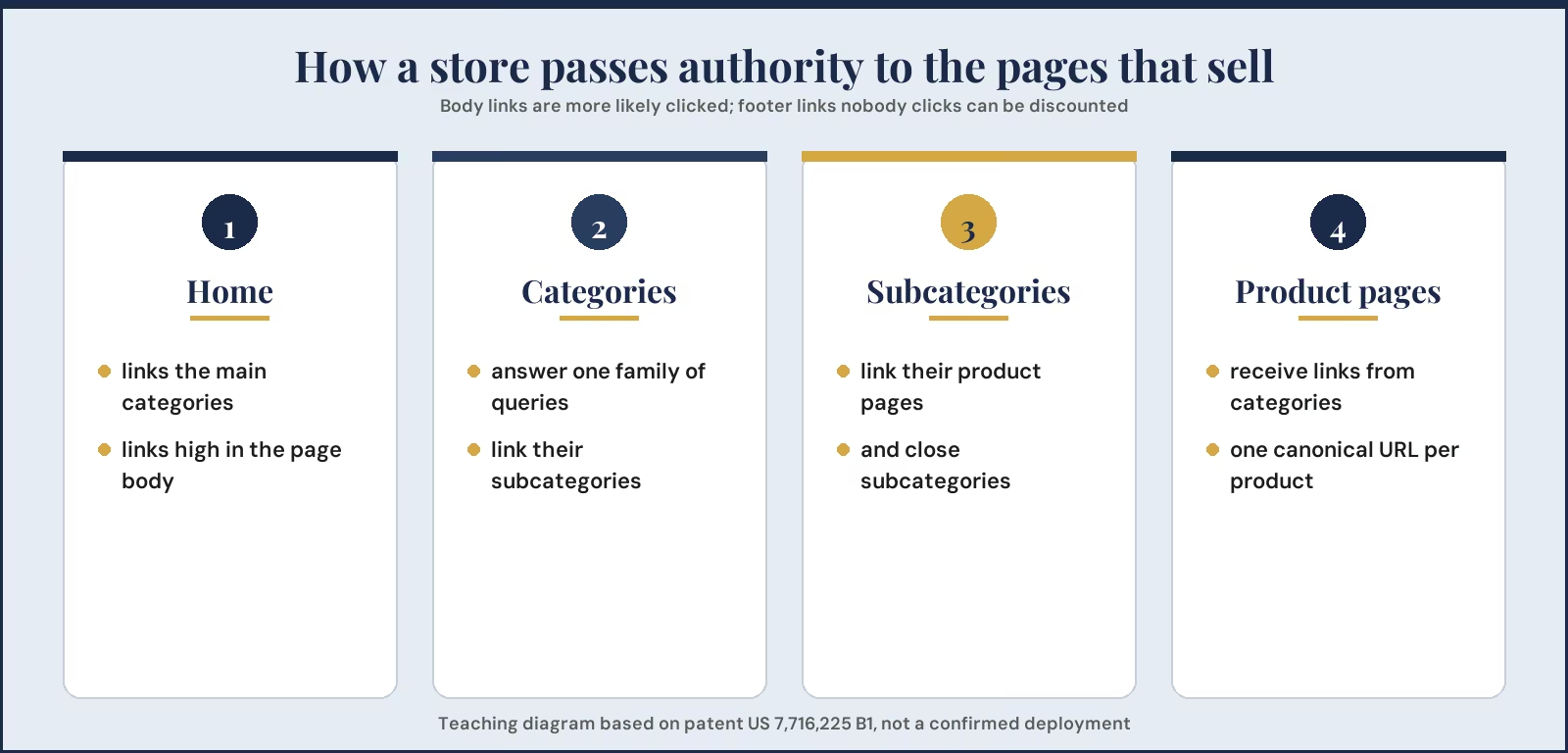
What we check: where each link to a category sits, in running text rather than in the footer, as the patent on link weighting describes, for every link down to the product pages.
How does an ecommerce SEO agency prevent duplicate product pages?
An ecommerce SEO agency prevents duplicate product pages by giving each product one canonical URL and a text that does not reuse the supplier's description.
Google patent US 6,658,423 B1 fingerprints near-duplicate content to keep only one version, and its own example is a product page found at 5 URLs that differ only by category path, crawl date or title. Two rules follow for your catalog: every category links to the product's canonical URL, and supplier descriptions are rewritten. For size or color variants, Google Search Central's ecommerce URL documentation asks that each variant be identifiable by a separate URL, a path segment or a query parameter, and that every variant page carry the canonical product URL.
What we check on each product page: a technical SEO review from our team lists every URL that serves the same product, then checks that canonical tags and internal links point to the same version. This review applies the patent on near-duplicate content to the catalog and its filter URLs.
How does an ecommerce SEO agency handle faceted navigation?
An ecommerce SEO agency handles faceted navigation by deciding, filter by filter, which URLs deserve crawling and indexing, then blocking or canonicalizing the others.
If you don't need faceted URLs indexed, Google recommends preventing their crawling, and it calls rel=canonical generally less effective in the long term, according to its faceted navigation documentation. The agency applies this rule in four steps.
- Open to crawling the filters that match a searched query, such as a color combined with a product type.
- Exclude from crawling the filter combinations that match no demand.
- Tie with the canonical tag the filter URLs that stay reachable for shoppers, a method Google rates less effective in the long term.
- Keep each paginated category page crawlable and linked to the next pages.
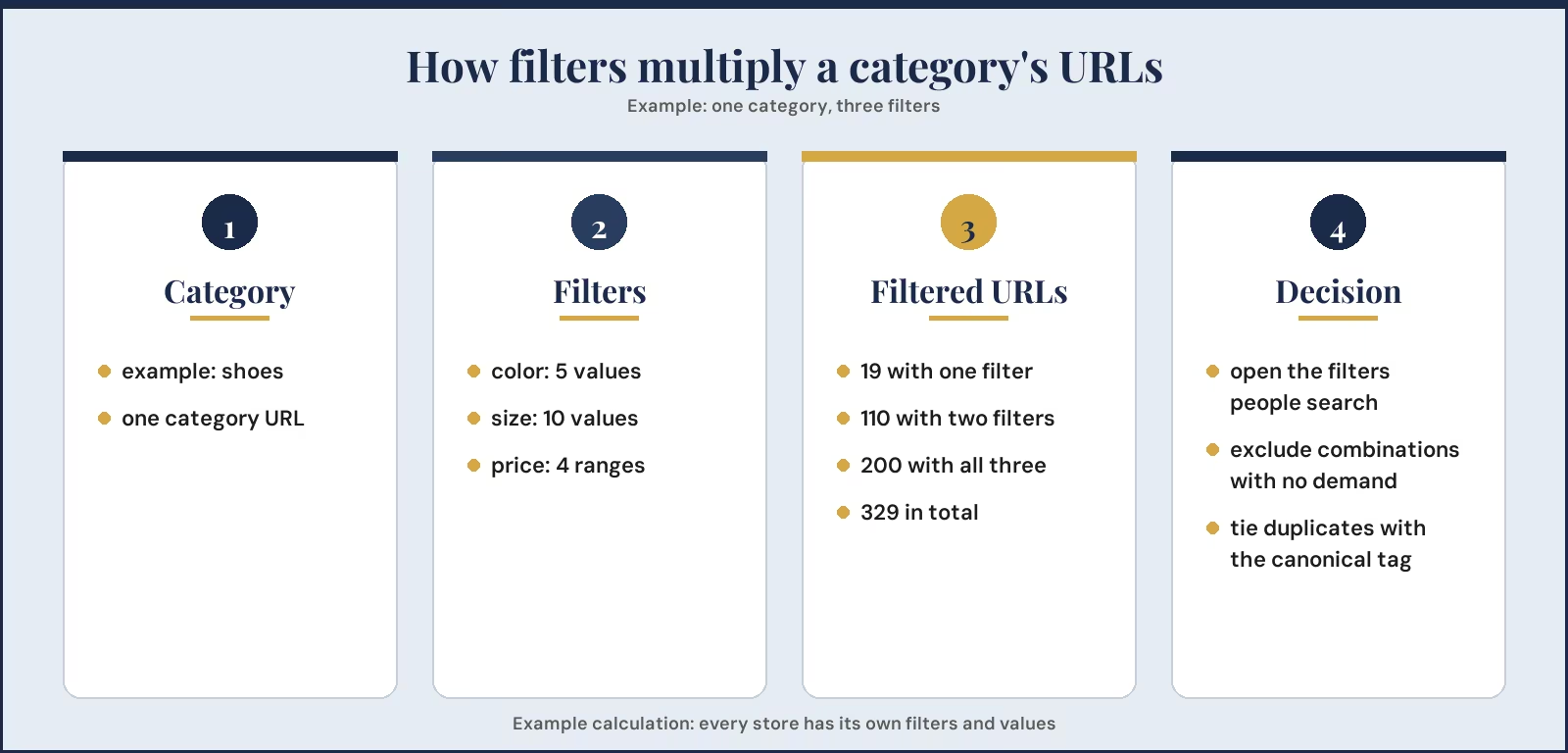
For the smartwatch store, the filter and facet crawl rules and the canonical strategy were written before the first SKU went live. Each store platform generates these URLs its own way.
Which store platform changes the SEO work: Shopify, Magento, BigCommerce or WooCommerce?
The store platform changes what Shopify, Magento, BigCommerce or WooCommerce generate by themselves and which SEO settings they leave to an ecommerce SEO agency.
The method for categories, product pages and facets stays the same on every platform; only the settings change. Shopify generates its sitemap, robots.txt file and canonical tags itself; Adobe Commerce, the Magento edition Adobe documents, sets its canonical tag separately for categories and products; BigCommerce applies an SEO-friendly URL structure by default. WooCommerce installs on a WordPress site, according to its publisher, so a WooCommerce SEO agency starts from the WordPress SEO settings. The three platforms with their own settings are detailed below.
What are the SEO specifics of Shopify?
The SEO specifics of Shopify start with what the platform generates itself: sitemap.xml and robots.txt files, and auto-generated canonical tags against duplicate content, according to the Shopify Help Center.
The sitemap links to all products, the primary product image, pages, collections and blog posts, at the root directory of the store's domain. The default robots.txt file works for most stores; customizing it requires a robots.txt.liquid template, and Shopify Support can't help with edits to that file. Title tags, meta descriptions and URLs are editable for each page. With Shopify Markets, hreflang tags are generated automatically and each version has a self-referencing canonical URL; Shopify asks to use either your own tags or the automatic ones, not both.
Any ecommerce SEO agency, a Shopify SEO agency included, checks these settings first. Applied to Shopify SEO, our method makes collections link to one product URL and changes robots.txt.liquid only with a documented reason. On Adobe Commerce, the canonical tag is a setting instead.
What are the SEO specifics of Magento (Adobe Commerce)?
The SEO specifics of Magento (Adobe Commerce) start with the canonical meta tag, set separately for categories and for products, according to Adobe's Experience League documentation for Adobe Commerce.
This tag "tells search engines which page to index when multiple URLs have identical or similar content", and Adobe recommends enabling it for both categories and products as a best practice. Filters run through layered navigation, which makes it easy to find products by category, price range or any other available attribute; its filter URLs follow the faceted navigation rules above. A Magento SEO agency therefore turns the canonical tag on for both page types, the first rule an ecommerce SEO agency applies on Adobe Commerce. On BigCommerce, the first decision is the URL structure.
What are the SEO specifics of BigCommerce?
The SEO specifics of BigCommerce start with its URL structure: SEO-friendly by default, with product URL presets such as SEO Optimized (Short), yourdomain.com/product-name, according to the BigCommerce Help Center.
BigCommerce warns that incorrectly modifying store URLs "can have a drastic impact on your SEO" and highly recommends leaving them set to SEO Optimized (Short). Page titles, descriptions and keywords can be filled in for categories, products, content pages, blog posts and brands. A BigCommerce SEO agency decides the URL structure once, before launch or with redirects, and applies the faceted navigation rules to filters. Across all three platforms, an ecommerce SEO agency works on the same objects: category pages, product pages, facets and the URLs they generate, and choosing who handles them comes next.
// faq
How do you hire an ecommerce SEO agency?
You hire an ecommerce SEO agency by asking for verifiable results first, then comparing criteria, the audit and the price. Hiring an SEO is a big decision that can improve visibility and save time, with a risk of damage to the site and its reputation, according to Google Search Central. The answers below follow that order: results, criteria, agency or consultant, doing it yourself, the audit, the engagement, links, GEO, remote work, timeline, price and the guarantee, with the founder involved from the first audit to the reporting.
What results should an ecommerce SEO agency be able to show?
An ecommerce SEO agency should be able to show organic clicks verified in the client's Search Console, like those of the two stores in our case studies.
- A D2C sneakers brand: 123K organic clicks and 11.3M impressions in 13 months, at an average position of 8, detailed in our D2C sneakers SEO case study.
- A smartwatch store launched from zero domain authority: 46.1K clicks and 2.73M impressions in 12 months, from March 2025 to March 2026, detailed in our smartwatch ecommerce SEO case study.
Both clients stay confidential: neither the brand nor the domain is published. Ask any ecommerce SEO agency for the Search Console click curve, not a screenshot of positions.
How do you choose the best ecommerce SEO agency?
You choose the best ecommerce SEO agency for your store with six verifiable checks before you sign: the best is the one that passes all six.
- Verifiable store results: organic clicks read in the client's Search Console, with their period.
- A sourced method: each recommendation on categories or product pages names the mechanism behind it.
- A precise answer on facets and duplicate product pages: which filter URLs it opens and how it ties variants together.
- Measurement announced in advance: non-brand clicks in Search Console, with read-only access, as Google advises.
- No ranking promise: "No one can guarantee a #1 ranking on Google," Google Search Central states.
- Published prices: the price of each offer known before the first call.
These checks do not rank agencies; they apply whether the provider is an agency or a consultant.
Should you hire an ecommerce SEO agency or an ecommerce SEO consultant?
You should hire an ecommerce SEO agency or an ecommerce SEO consultant depending on who executes: an agency carries strategy, content, technical work and follow-up in one plan, a consultant fits a team that already executes.
In a catalog, categories, product pages, facets and reporting move together, which favors one roadmap; a team with its own writers and developer gets more from advice that sets the priorities. Who works on your store at The SEO Papers? The founder, with 9+ years in SEO, who works with you directly and sells a 45-minute SEO Consulting session to teams that execute themselves. The comparison of both models is on our SEO consultant page.
Can you do your store's SEO yourself?
Yes, you can do your store's SEO yourself for the basics, titles, product texts and category texts, provided facets and duplicate product pages are handled. The free audit lists those priorities by impact before any work. A chatbot such as ChatGPT can draft product texts; in our reading, deciding which URLs to open, block or canonicalize stays a site decision for your team or an ecommerce SEO agency.
Why start with an ecommerce SEO audit?
You start with an ecommerce SEO audit because it measures where the catalog's URLs stand before any work: facets, duplicate product pages, pagination and collections.
These are the controls of the product-page and facet answers above, and the review an ecommerce SEO agency runs on every product URL. What does the free audit give? An SEO and GEO audit of your domain, delivered within minutes for $0: semantic gaps, technical issues and GEO visibility, ranked by impact, then a 30-minute call to walk through the findings.
Free patent-backed SEO & GEO audit on your domain. No commitment.
The human audit comes with the SEO Consulting session, priced below, and either audit opens the engagement.
How does an ecommerce SEO engagement run?
An ecommerce SEO engagement runs in four steps, which an ecommerce SEO agency carries from the free audit to measurement in Search Console.
- Free audit of the domain: delivered within minutes, then a 30-minute call on its findings.
- Roadmap: the SEO Consulting session ranks the top actions by impact and effort.
- Ongoing execution: the Growth retainer carries out the roadmap with topical maps, content briefs, on-page and technical SEO.
- Measurement: the store's clicks are tracked in Google Search Console, with monthly reporting tied to revenue and leads.
Links to the store are part of this work, under one condition.
Does the agency handle link building for your store?
Yes, without buying links: the agency handles link building for your store by advising on the links and mentions to earn, the way an ecommerce SEO agency builds authority without paying for it. Our guarantee writes the same rule into its conditions: no link buying on the client's side.
Why does ecommerce SEO include GEO?
Ecommerce SEO includes GEO because Google patent US 11,769,017 B1, "Generative summaries for search results", describes a summary written from documents selected among search results.
GEO, generative engine optimization, is visibility as a cited source in AI answers, so the same work on categories, product pages and comparisons serves both. The patent describes what Google's system can do, not what AI Overviews use today, and applying it to ChatGPT and other engines is our reading. On our two stores, this work took the form of GEO comparison guides for the sneakers brand and GEO-ready product content for the smartwatch store. An ecommerce SEO agency therefore works on both at once, and our GEO agency page covers generative engine optimization in full.
Do you need a GEO agency on top of an ecommerce SEO agency?
No, you do not need a GEO agency on top of an ecommerce SEO agency: one team covers both, because GEO works on the same pages. Our Growth retainer includes "Ongoing SEO & GEO execution on your roadmap".
How does a remote ecommerce SEO agency work with US stores?
A remote ecommerce SEO agency works with US stores by video call and in writing: The SEO Papers, an SEO and GEO agency, is based in Paris, works with US clients remotely and has no US office.
Our office is in Paris (122 rue Amelot, 75011 Paris, France); we do not receive clients there, and all work runs remotely, in English or French, with prices in US dollars. We work with e-commerce sites and service companies, from Paris to anywhere in the world, so a store looking for an ecommerce SEO agency in the USA works with us like any other client. This remote model is how our patent-based agency works across sectors.
How long does an ecommerce SEO agency take to show results?
An ecommerce SEO agency shows results on Google's timeline for any change: from a few hours to several months, according to Google's SEO Starter Guide, which advises waiting a few weeks before assessing an effect.
On a retainer, our first measured checkpoint is month 3, the guarantee check, since measurable gains within 3 months are what our guarantee is built on. Our two stores grew over 13 and 12 months of measured clicks: a context, not a promise of a date for any ranking. That timeline shapes what a store pays for.
How much does an ecommerce SEO agency cost?
Ecommerce SEO costs $500 to $7,500 per month for 71% of businesses, according to a survey of 250 US-based marketing and sales professionals published by the agency WebFX, last updated September 22, 2025.
Our prices are published: the free SEO and GEO audit costs $0; SEO Consulting costs $99 for 45 minutes, credited toward your first retainer month; Growth costs $1,389 per month with no commitment; Scale starts from $3,289 per month, with pricing scoped on your audit call.
Prices in USD. No VAT added (French micro-enterprise VAT exemption, art. 293 B of the French tax code).
Our Growth retainer sits inside that market range. Where an ecommerce SEO agency's price follows the size of the catalog, ours follows published packages. The benchmarks behind what serious SEO costs are on our pricing page.
Does the price depend on the catalog size?
No, at The SEO Papers the price does not depend on the catalog size for SEO Consulting and Growth, two fixed published prices; Scale pricing is scoped on your audit call. The market range does: WebFX names product count, site size and competition as what decides where a store lands in it. Before signing, ask any ecommerce SEO agency which of these factors its price follows.
Can an ecommerce SEO agency guarantee results?
No for a ranking, yes for measured clicks: an ecommerce SEO agency cannot guarantee a position, and The SEO Papers guarantees clicks instead, on a Growth or Scale retainer, under 4 conditions. The guarantee is +33% non-brand Google clicks in 3 months against the same 3 months last year, or we refund the gap, capped at the fees paid. The 4 conditions are a site validated at the audit, a client who stays 3 months and applies our recommendations on time, no link buying or off-scope site changes on the client's side, and measurement on non-brand clicks.