
A Google core update is a broad change to Google's search algorithms and systems, made several times a year, according to Google Search Central. As of November 11, 2026, the November 2026 core update has been rolling out since November 10, 2026, at 10:06 a.m. PST; Google says the rollout may take up to 2 weeks. The box below shows whether a core update is rolling out right now and which Google update was rolling out on the date your traffic moved.
Right now
Is a core update rolling out right now?
YesThe November 2026 core update has been rolling out since November 10, 2026 (day 5).
Google says the rollout may take up to 2 weeks: finished by November 24, 2026 at the latest, per that announcement.
The last 10 core updates took 18 days at the median, which would point to November 28, 2026. Google advises waiting one week after the end before measuring the impact.
Enter the date of the rise or the drop: the tool tells you which Google update was rolling out that day.
Source: Google Search Status Dashboard, ranking history since November 2021, re-read every hour. Days in Pacific Time.
What is a Google core update?
A Google core update is a significant, broad change to Google's search algorithms and systems, released several times a year, that targets no specific site or page, according to Google Search Central. The aim of each core update is to keep presenting helpful and reliable results to searchers, per Google's documentation on core updates. A page that moves down after a core update is not necessarily "bad," Google explains: other pages now rank above it in the top results.
A core update therefore changes how Google ranks pages without a list of targeted sites, since the changes of a core update are broad in nature. Google gives notice of every core update on its list of Google Search ranking updates, the Google Search Status Dashboard, with a start date and an end date. The smaller core updates Google makes continually stay unannounced, because they are not widely noticeable. Searchers name the same event a "Google algorithm update" or a Google "algorithm change."
Google sorts the ranking updates it announces into several types.
What types of ranking updates does Google announce?
The ranking updates Google announces fall into seven types: the Google Search Status Dashboard lists 42 ranking entries since the November 17, 2021 core update, ordered here by number of entries.
- Core update: 17 entries, including the November 2026 core update. Each core update makes broad changes to Google's search algorithms and systems.
- Spam update: 11 entries, including the December 2022 link spam update. A spam update is a notable improvement to Google's automated spam detection systems, such as SpamBrain; a link spam update deals with link spam specifically.
- Reviews update: 7 entries, named "product reviews update" until February 2023. The reviews system behind each reviews update aims to better reward high-quality reviews with insightful analysis and original research, written by experts or enthusiasts.
- Helpful content update: 3 entries, in August 2022, December 2022 and September 2023. Announced in 2022, the helpful content system became part of Google's core ranking systems in March 2024, and no helpful content update appears on the dashboard after September 2023.
- Ranking incident: 2 entries, in October 2023 and August 2024. A ranking incident marks an ongoing ranking issue on the dashboard, not a planned update.
- Discover update: 1 entry, the February 2026 Discover update, specific to the Discover feed.
- Page experience update: 1 entry, rolled out for desktop in February 2022. This update concerned page experience, which Google's core ranking systems look to reward.
The most recent core update in this list is the November 2026 core update.
What is the latest Google core update?
The latest Google core update is the November 2026 core update, released on November 10, 2026, at 10:06 a.m. PST (18:06 UTC) and still rolling out as of November 11, 2026, according to Google. The previous one, the May 2026 core update, rolled out from May 21 to June 2, 2026, in 12 days, per the Google Search Status Dashboard. The November rollout is the third Google core update of 2026, after March 27 – April 8 and May 21 – June 2.
Searches for the "latest Google algorithm update" and for "Google algorithm updates 2026" point to this core update, which Google describes as significant, broad changes to its search algorithms and systems, with no algorithm name published. Its rollout is followed in Google's announcement and compared with the length of past core updates.
What do we know about the November 2026 core update?
The November 2026 core update applies globally and to all languages, with a rollout announced at up to 2 weeks, according to Google's announcement on the Google Search Status Dashboard. By that announcement, the rollout is finished by November 24, 2026 at the latest.
Past core updates give an estimate, not a forecast. The median length of the last 10 finished core updates is 17.5 days, by our calculation on the dashboard durations; the box above rounds that median to 18 days. That median puts a likely end around November 28, 2026, and a traffic analysis from the week of December 5, 2026, after the one-week wait Google recommends. Both dates are estimates.
Google published no target for this core update; its effects are read after the rollout ends. The rollout log below quotes each Google post, in Pacific Time.
- November 10, 2026, 10:07 a.m. PST: Google released the November 2026 core update. The core update "applies globally and to all languages," and "the rollout may take up to 2 weeks to complete."
Which Google ranking update was rolling out on a given date?
The Google ranking update rolling out on a given date is read from the Google Search Status Dashboard history, which dates every rollout since the November 17, 2021 core update. The "My traffic moved on…" field in the box above does that reading for the date you enter. Five cases follow from the date you enter.
- Date inside one rollout: the tool names the update, its type and the rollout day, "day N of M," with the start and end days included. May 25, 2026 falls on day 5 of 13 of the May 2026 core update.
- Date inside two or more rollouts: the tool lists every update rolling out, the core update first. March 5, 2024 combines the March 2024 core update and the March 2024 spam update, which started on the same day; August 15, 2024 combines the August 2024 core update and a ranking incident; October 5, 2023 combines the October 2023 core update, a ranking incident and the October 2023 spam update, rolling out since October 4.
- Date with no rollout, but an update within 10 days: the tool gives the closest update, before or after the date. On June 30, 2026, the June 2026 spam update had finished 4 days before.
- Date with no update within 10 days: the cause of a traffic move lies in a technical, seasonal or competitive change, as on October 25, 2026, 17 days after the end of the September 2026 spam update and 16 days before the November 2026 core update.
- Date before November 17, 2021: the dashboard lists no update date before the November 2021 core update, so Google confirms no update for that date.
Days are counted in Pacific Time, the zone in which Google's dashboard shows every time. The dashboard feed stores times in UTC, so a core update released late in the Pacific afternoon already falls on the next day in UTC. An answer of "No" does not mean nothing changed: Google continually updates its search algorithms with smaller, unannounced updates, which change how Google ranks pages without a published date.
The full calendar of core updates gives these dates one by one.
What are the dates of every Google core update since 2021?
The dates of every Google core update since 2021 cover 17 core updates, each dated to the day on the Google Search Status Dashboard, from November 17, 2021 to November 10, 2026. The table below lists the 17 core updates from newest to oldest, with their days in Pacific Time and their rollout length in days.
| Core update | Start | End | Duration (days) |
|---|---|---|---|
| November 2026 core update | Nov 10, 2026 | Rolling out | — |
| May 2026 core update | May 21, 2026 | Jun 2, 2026 | 12 |
| March 2026 core update | Mar 27, 2026 | Apr 8, 2026 | 12 |
| December 2025 core update | Dec 11, 2025 | Dec 29, 2025 | 18 |
| June 2025 core update | Jun 30, 2025 | Jul 16, 2025 | 17 |
| March 2025 core update | Mar 13, 2025 | Mar 26, 2025 | 14 |
| December 2024 core update | Dec 12, 2024 | Dec 18, 2024 | 6 |
| November 2024 core update | Nov 11, 2024 | Dec 4, 2024 | 24 |
| August 2024 core update | Aug 15, 2024 | Sep 3, 2024 | 19 |
| March 2024 core update | Mar 5, 2024 | Apr 19, 2024 | 45 |
| November 2023 core update | Nov 2, 2023 | Nov 27, 2023 | 26 |
| October 2023 core update | Oct 5, 2023 | Oct 19, 2023 | 14 |
| August 2023 core update | Aug 22, 2023 | Sep 7, 2023 | 16 |
| March 2023 core update | Mar 15, 2023 | Mar 28, 2023 | 13 |
| September 2022 core update | Sep 12, 2022 | Sep 26, 2022 | 14 |
| May 2022 core update | May 25, 2022 | Jun 9, 2022 | 15 |
| November 2021 core update | Nov 17, 2021 | Nov 30, 2021 | 13 |
The days since the December 2025 core update follow the exact times Google published, converted to Pacific Time; the earlier rows follow the start day listed in the history and the day on which the listed duration ends. The durations are Google's listed rollout lengths, rounded to the nearest day, while the start and end are calendar days, so a few rows span one day less than their duration.
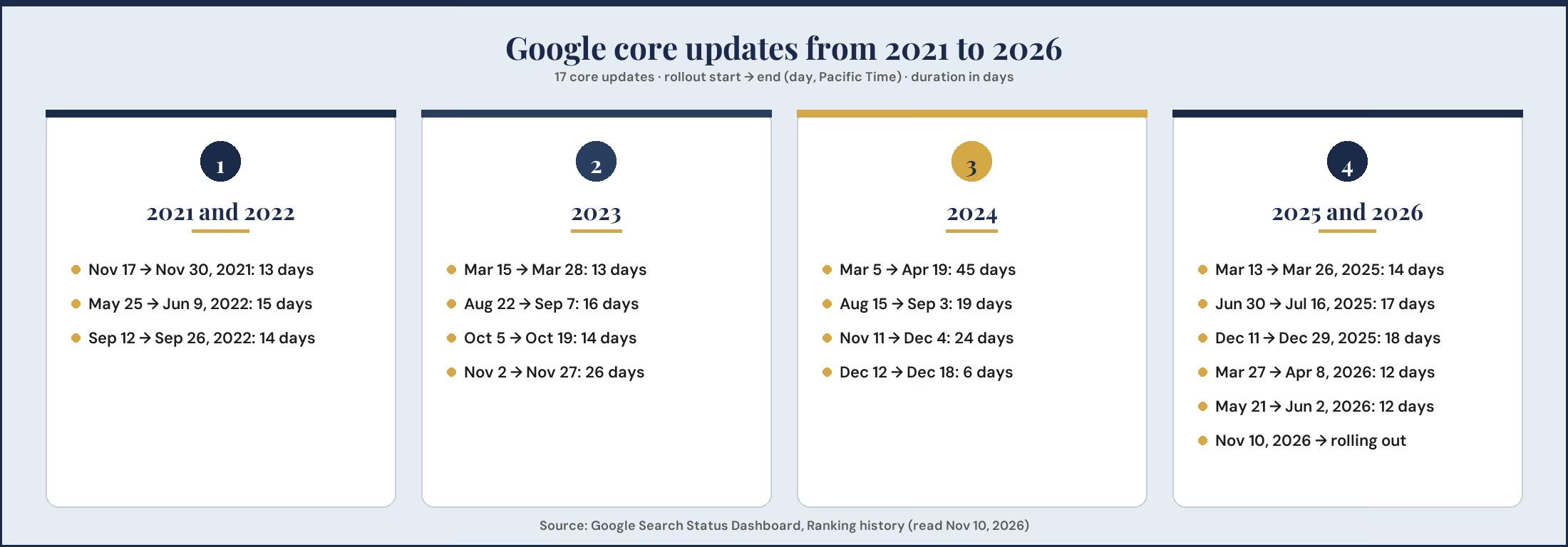
These dates give three readings: the length of a rollout, the frequency of core updates and the other updates around them.
How long does a core update rollout take?
A core update rollout takes 6 to 45 days, with a median of 17.5 days over the last 10 finished core updates, by our calculation on the Google Search Status Dashboard durations. The shortest is the December 2024 core update, rolled out in 6 days. The longest is the March 2024 core update, rolled out in 45 days: Google described it as more complex than its usual core updates, involving changes to multiple core systems, with a rollout that could take up to a month.
In 2026, the March and May core updates took 12 days each. Across the 16 core updates finished since November 2021, the median drops to 14.5 days. For the November 2026 core update, Google announced up to 2 weeks, or 14 days. These durations are Google's listed rollout lengths, rounded to the day. The length of a rollout reads alongside the gap between two core updates.
How often does Google release core updates?
Google releases core updates several times a year, according to Google Search Central. The dashboard counts 2 in 2022, 4 in 2023, 4 in 2024, 3 in 2025 and 3 in 2026, including the November 2026 core update still rolling out. The history holds 1 core update in 2021, from November 17, its starting point. The median gap between the starts of two consecutive core updates is 109.5 days, about 3.6 months, within a range of 28 to 189 days, by our calculation. The same calendar lists the ranking updates that rolled out outside a core update.
Which other Google ranking updates have rolled out since 2021?
The other Google ranking updates rolled out since 2021 are 25 entries outside a core update, listed in the same Google Search Status Dashboard history. The table below sorts these 25 updates from newest to oldest, with their type, their days in Pacific Time and their duration in days.
| Update | Type | Start | End | Duration (days) |
|---|---|---|---|---|
| September 2026 spam update | spam update | Sep 24, 2026 | Oct 8, 2026 | 14 |
| August 2026 spam update | spam update | Aug 18, 2026 | Aug 21, 2026 | 3 |
| June 2026 spam update | spam update | Jun 24, 2026 | Jun 26, 2026 | 2 |
| March 2026 spam update | spam update | Mar 24, 2026 | Mar 25, 2026 | 1 |
| February 2026 Discover update | Discover update | Feb 5, 2026 | Feb 27, 2026 | 22 |
| August 2025 spam update | spam update | Aug 26, 2025 | Sep 21, 2025 | 27 |
| December 2024 spam update | spam update | Dec 19, 2024 | Dec 26, 2024 | 7 |
| Ranking is experiencing an ongoing issue (August 2024) | ranking incident | Aug 15, 2024 | Aug 19, 2024 | 4 |
| June 2024 spam update | spam update | Jun 20, 2024 | Jun 27, 2024 | 7 |
| March 2024 spam update | spam update | Mar 5, 2024 | Mar 19, 2024 | 15 |
| November 2023 reviews update | reviews update | Nov 8, 2023 | Dec 7, 2023 | 29 |
| Ranking is experiencing an ongoing issue (October 2023) | ranking incident | Oct 5, 2023 | Oct 31, 2023 | 26 |
| October 2023 spam update | spam update | Oct 4, 2023 | Oct 19, 2023 | 16 |
| September 2023 helpful content update | helpful content update | Sep 14, 2023 | Sep 27, 2023 | 13 |
| April 2023 reviews update | reviews update | Apr 12, 2023 | Apr 25, 2023 | 13 |
| February 2023 product reviews update | reviews update | Feb 21, 2023 | Mar 7, 2023 | 14 |
| December 2022 link spam update | spam update | Dec 14, 2022 | Jan 12, 2023 | 29 |
| December 2022 helpful content update | helpful content update | Dec 5, 2022 | Jan 12, 2023 | 38 |
| October 2022 spam update | spam update | Oct 19, 2022 | Oct 21, 2022 | 2 |
| September 2022 product reviews update | reviews update | Sep 20, 2022 | Sep 26, 2022 | 6 |
| August 2022 helpful content update | helpful content update | Aug 25, 2022 | Sep 9, 2022 | 15 |
| July 2022 product reviews update | reviews update | Jul 27, 2022 | Aug 2, 2022 | 6 |
| March 2022 product reviews update | reviews update | Mar 23, 2022 | Apr 6, 2022 | 14 |
| Page experience update for desktop | page experience update | Feb 22, 2022 | Mar 3, 2022 | 9 |
| December 2021 product reviews update | reviews update | Dec 1, 2021 | Dec 21, 2021 | 20 |
Some of these updates sit close to a core update. The March 2026 spam update, from March 24 to March 25, 2026, ended two days before the March 2026 core update started, on March 27, 2026. Such overlaps weigh on the analysis of a traffic drop.
How do you analyze a traffic drop after a core update?
To analyze a traffic drop after a core update, wait at least one full week after the rollout ends, then compare that week in Search Console with the week before the rollout started, according to Google. Google's method for analyzing a drop after a core update comes down to seven steps.
- Check that the core update rollout is complete on the Google Search Status Dashboard, and note its start and end dates.
- Wait at least one full week after the core update completes before analyzing the drop in Search Console.
- Compare that week with a week before the core update started rolling out.
- Measure the size of the position drop: a small drop, such as from position 2 to 4, needs no drastic action; a large drop, such as from position 4 to 29, calls for a deeper assessment, according to Google.
- Analyze search types separately to locate the drop: Web Search, Google Images, Video mode or the News tab.
- Read Google's self-assessment when the drop after the core update is large, sustained and hits the site as a whole.
- Avoid quick-fix changes after the drop: for Google, deleting content is a last resort, only for content that can't be salvaged.
The comparison in step 3 rests on two precise weeks of the calendar.
Which weeks should you compare in Search Console?
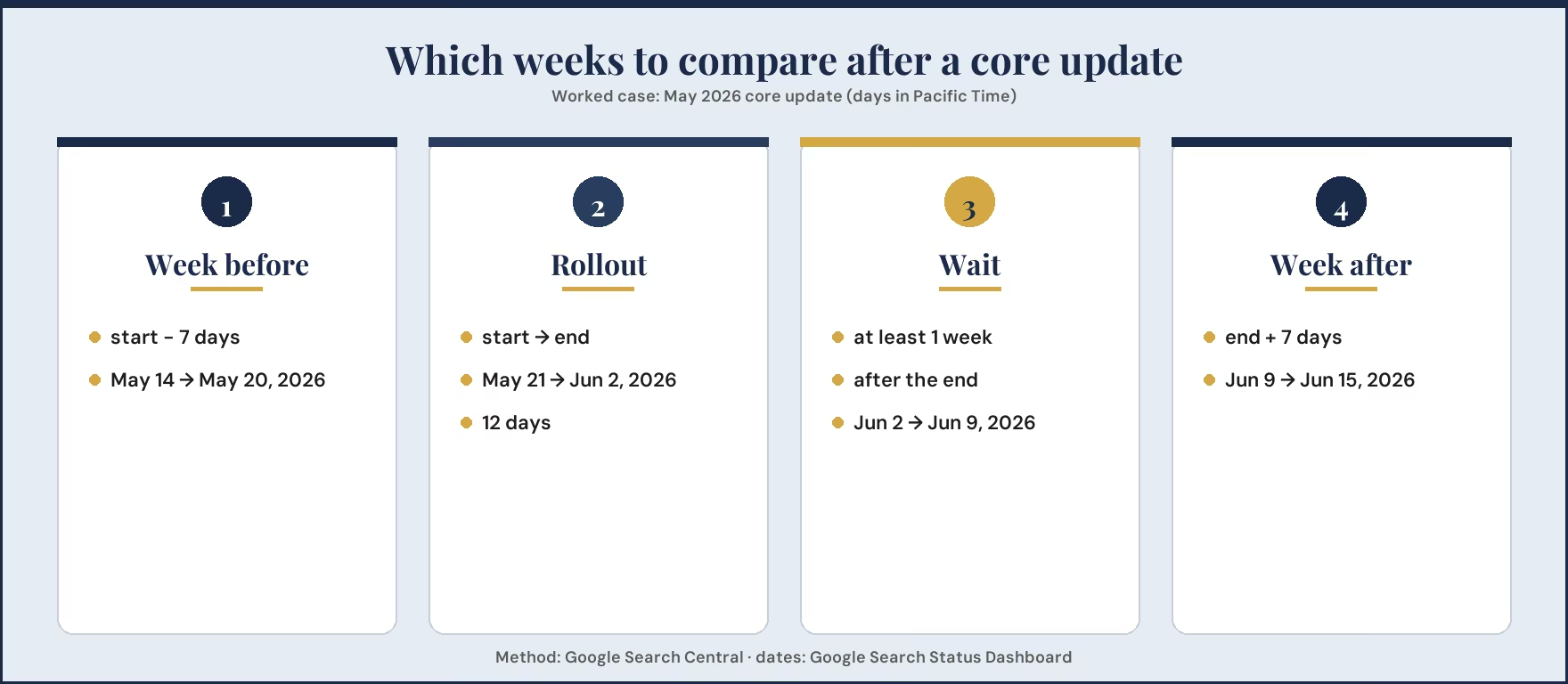
The weeks to compare in Search Console are the week that starts 7 days after the rollout ends and the week that starts 7 days before the rollout began. This formula, week after = end + 7 days and week before = start − 7 days, puts Google's recommendation into dates for a core update; it is our arithmetic reading, and the box above applies the same one. Three recent core updates show the calculation.
- May 2026 core update: start May 21, 2026, end June 2, 2026, so the week of June 9, 2026 is compared with the week of May 14, 2026.
- March 2026 core update: start March 27, 2026, end April 8, 2026, so the week of April 15, 2026 is compared with the week of March 20, 2026. That baseline week contains the March 2026 spam update, on March 24 and 25, 2026, so the baseline is not neutral.
- November 2026 core update, still rolling out: the week before is the week of November 3, 2026; the week after is computed when the rollout completes. Estimate: the week of December 5, 2026, if the rollout lasts the rounded 18-day median.
A drop confirmed by this comparison raises the question of recovery time.
How long does it take to recover from a core update?
Recovering from a core update takes from a few days to several months, according to Google Search Central. Some changes can take effect in a few days, while Google's systems could take several months to learn and confirm a site's improvements. On real sites, our SEO and GEO results track client traffic over several months. With no effect after a few months, Google says that could mean waiting until the next core update, and the median gap between two core updates is 109.5 days by our calculation. Between two core updates, smaller unannounced updates can lift improved content, Google adds. Before that wait, the site itself is checked on three points.
What should you check on your site around a Google core update?
Around a Google core update, checking your site comes down to three questions: is Discover traffic affected, does the drop come from another cause, and is it time to get the site audited? The answers below stay short, because they concern the site more than the core update itself.
Does a Google core update affect Discover?
Yes, sometimes: a Google core update can sometimes produce Discover traffic changes, because Discover is an extension of Search, according to Google Search Central's Discover documentation. Discover received its own update, the February 2026 Discover update, from February 5 to February 27, 2026, or 22 days.
Is every traffic drop caused by a Google update?
No, not every traffic drop is caused by a Google update: positions in Google Search results aren't static or fixed in place, according to Google Search Central. That constant change can cause both gains and drops in organic Search traffic. Outside a core update, the causes to check are technical, seasonal or competitive, the three leads the box gives when no update sits near the date you enter. These leads come back to the basics of optimizing for search engines, which our guide sets out.
When should you get your site audited after a core update?
You should get your site audited after a core update when the week comparison shows a large, sustained drop, such as the fall from position 4 to position 29 that Google gives as an example. For that case, Google points to its self-assessment of the site as a whole, and suggests asking trusted people unaffiliated with the site to do it. Our proposal, separate from Google's guidance, starts with a before-and-after comparison of your site one week after the rollout ends, then a whole-site audit by our SEO agency covering technical, semantic and generative engine optimization (GEO) factors.
Update followed: November 2026 core update, rolling out.