This guide explains how a site gets cited by ChatGPT: what OpenAI documents about its crawlers and search, what published studies measure, and which SEO levers are our reading. It covers how ChatGPT chooses pages, the crawlers, the search step, the searches launched, the pages that come back, the levers, measuring, ads and the hand-off to an agency for a site that wants to be mentioned by ChatGPT.
What does it mean to be cited by ChatGPT?
ChatGPT SEO is the work that makes a site visible as a source in ChatGPT's answers, which is what being cited by ChatGPT means.
That definition is ours. OpenAI names the feature "ChatGPT's search features" and says OAI-SearchBot "is used to surface websites in search results" in it, according to its page "Overview of OpenAI Crawlers", read on November 17, 2026; this guide writes "ChatGPT's search" for these features. The subject of this guide is neither the use of ChatGPT to write SEO content nor the citation of ChatGPT as a source in academic work.
ChatGPT includes a first-party web search tool, and on ChatGPT web, workspace settings can limit whether search is available, according to OpenAI's ChatGPT documentation page "Web search", read on November 17, 2026.
Searches for "how to get cited by chatgpt" in the United States went from 10 a month in October 2025 to 720 in September 2026, in a keyword-research estimate dated November 17, 2026. That demand raises the question of how ChatGPT chooses the pages it cites.
How does ChatGPT choose the pages it cites?
ChatGPT's choice of the pages it cites includes one documented gate: a site that refuses OAI-SearchBot does not appear in ChatGPT's search answers, except as a navigational link.
OpenAI states the gate in its page "Overview of OpenAI Crawlers", read on November 17, 2026, which, in our reading, does not describe how ChatGPT chooses among the sites it can show. What conditions must a page meet to be cited by ChatGPT? The one condition that page documents is access for OAI-SearchBot; it lists no further condition comparable to the eligibility conditions Google sets for its generated answers, which belong to Google's surfaces. How the gate works depends on the three OpenAI crawlers and the use each one covers.
Which OpenAI crawlers affect whether ChatGPT cites a page?
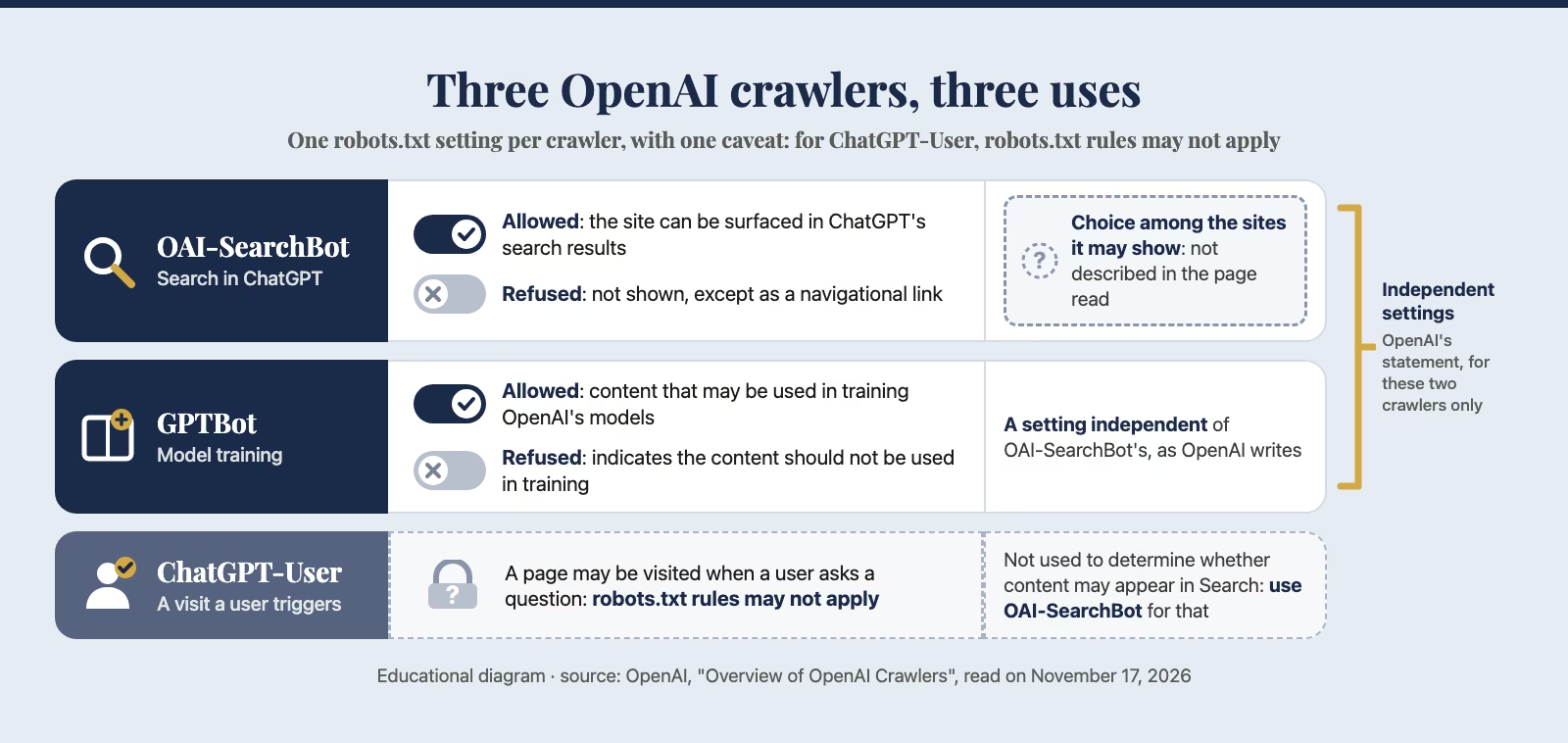
Three OpenAI crawlers bear on whether ChatGPT cites a page, each for a distinct use: OAI-SearchBot for search, GPTBot for model training and ChatGPT-User for visits a user triggers.
OpenAI describes the three roles in its page "Overview of OpenAI Crawlers", read on November 17, 2026, and the table sets them side by side for a site that wants to be cited by ChatGPT. The table compares the three robots.txt tokens, with the use OpenAI states for each and what OpenAI writes about robots.txt for it.
| robots.txt token | Use stated by OpenAI | What OpenAI writes about robots.txt for it |
|---|---|---|
| OAI-SearchBot | OAI-SearchBot is used to surface websites in search results in ChatGPT's search features. | OAI-SearchBot: a setting independent of GPTBot's, as OpenAI writes. |
| GPTBot | GPTBot is used to crawl content that may be used in training OpenAI's generative AI foundation models. | GPTBot: a setting independent of OAI-SearchBot's, as OpenAI writes. |
| ChatGPT-User | ChatGPT-User covers certain user actions in ChatGPT and Custom GPTs: a page may be visited when a user asks a question, and the agent is not used for crawling the web in an automatic fashion. | ChatGPT-User: robots.txt rules may not apply, because OpenAI describes these actions as initiated by a user. |
OpenAI's own example is a webmaster who allows OAI-SearchBot to appear in search results while disallowing GPTBot, and OpenAI writes that when a site allows both, it may use the results from just one crawl for both use cases to avoid duplicative crawling. Our guide to AI search optimization lists 22 tokens from 10 vendors, as their pages read on November 11, 2026; this guide keeps to the three OpenAI tokens that bear on ChatGPT. Which of these crawlers to refuse depends on the use a site wants to stop.
How do you stop ChatGPT from using a page?
To stop ChatGPT from using a page, a site disallows in its robots.txt file the crawler that matches the use it wants to refuse: OAI-SearchBot for search answers, GPTBot for training.
Disallowing GPTBot indicates that a site's content should not be used in training generative AI foundation models, OpenAI writes in "Overview of OpenAI Crawlers", read on November 17, 2026. ChatGPT-User is not used to determine whether content may appear in Search, and OpenAI asks sites to use OAI-SearchBot in robots.txt for managing Search opt outs and automatic crawl. Our reading: refusing ChatGPT-User in robots.txt is not a reliable lever for those visits, since OpenAI writes that robots.txt rules may not apply to them.
For search results, it can take about 24 hours from a robots.txt update for OpenAI's systems to adjust, OpenAI writes; our reading: a robots.txt change that opens or closes the way to being cited by ChatGPT in search answers is not immediate.
ChatGPT's cloud browser is a separate visitor: OpenAI's page "Help ensure cloud browser access to your site" (developers.openai.com), read on November 17, 2026, says it can already use a site without an allowlist, and that a site's security settings may unintentionally block these visits. The page adds that ChatGPT uses Web Bot Auth to identify certain automated browser requests, built on the HTTP Message Signatures standard (RFC 9421), and that these visits happen on a user's behalf and are separate from OpenAI's web crawlers, including OAI-SearchBot for search. With the crawlers set, the open point is the search step that ChatGPT relies on to find pages.
Which search step does ChatGPT rely on to find pages?
ChatGPT's search step has no named index provider in OpenAI's crawler page, which says only that OAI-SearchBot is used to surface websites in ChatGPT's search features.
The page is "Overview of OpenAI Crawlers", read on November 17, 2026; in our count, it names no index provider and describes no ranking.
OpenAI uses the phrase "the search index" in another context: its guide "Partner Playbook Overview" (developers.openai.com), read on November 17, 2026, describes, for sellers of physical goods, a product feed that enhances the search index with current products, images, prices and availability. That sentence names no provider and does not say which index feeds ChatGPT's answers; for the pages cited by ChatGPT, the index stays without a named provider in the pages read. The searches ChatGPT launches from a question complete the picture of its search step.
Which searches does ChatGPT launch from one question?
OpenAI does not describe, in the pages read on November 17, 2026, the searches ChatGPT launches from a question; its API documentation covers only the API's web search tool.
For that tool, OpenAI's API guide "Web search", read on November 17, 2026, says the model can choose to search the web or not based on the content of the input prompt, and that a reasoning model can refine its searches as it reads results; both statements concern the API, not ChatGPT.
Does ChatGPT run a web search for every question? ChatGPT can answer without a web search and run one in some cases, in our reading, since OpenAI's ChatGPT documentation describes web search as a tool that ChatGPT includes; no page we read answers the question directly.
An observational study measures the searches launched before pages are cited by ChatGPT: "Understanding ChatGPT Citations: Evidence from Production Web Search Across Model Generations" (Jiang, Zhang, Xing, Chang and Xiao; Xi'an Jiaotong University and National University of Singapore; arXiv:2610.15382, October 11, 2026), a preprint on arXiv, with no peer-review mention on the page. Its authors observed ChatGPT on the web in four configurations, three quick-answer and one reasoning. The study's 80 queries come from Search Arena, in English and Chinese, 40 of each by our calculation, and in no other language. Two of the four configurations cover the same 80 queries between March 29 and July 29, 2026, at 20 runs per query; the two others, withdrawn before the collection ended, cover 32 and 30 queries, and the study page does not give the collection period of these two configurations.
For the three quick-answer configurations, the authors report between 1.06 and 2.36 queries per run depending on the configuration, and a search query identical to the user's question in 0% of the runs for two of them and in 5.5% of the runs for the third. Those configurations "remain mostly single-round", yet the share of runs that issue several queries runs from 6.2% to 100.0% depending on the configuration. The reasoning configuration, studied on a smaller set of queries, launches 11.82 queries per run on average over 3.20 retrieval rounds. The study gives no single figure for ChatGPT as a whole: each figure belongs to one configuration.
The general mechanism of query fan-out, which splits one query into several searches, goes beyond ChatGPT; this guide keeps to what the pages read and the study say about ChatGPT. What the answers show of those searches is the pages that come back.
Which pages come back in ChatGPT's answers?
The pages that come back in ChatGPT's answers appear as citations in the conversation.
On ChatGPT web, search results and citations appear in the chat when ChatGPT uses web search, according to OpenAI's ChatGPT documentation page "Web search", read on November 17, 2026. OpenAI's crawler page names no criterion that decides which accessible page is cited by ChatGPT, in our reading of that page. Two questions detail those pages: what published studies show about them, and why a well-ranked page is not always cited.
What do published studies show about the pages ChatGPT cites?
Three published studies measure how the pages ChatGPT cites relate to Google's results, with different methods, periods and scopes.
The first, "Understanding ChatGPT Citations: Evidence from Production Web Search Across Model Generations" (Jiang, Zhang, Xing, Chang and Xiao; Xi'an Jiaotong University and National University of Singapore; arXiv:2610.15382, October 11, 2026), is an observational preprint on arXiv, with no peer-review mention on the page. Its authors test whether Google Search and the OpenAI Responses API, combined, recover the URLs that ChatGPT cites: on the two configurations that cover the same 80 queries in English and Chinese, they recover only about one quarter, which is 26.2% to 28.3% of the cited URLs depending on the configuration, against 48.7% to 50.3% of the cited hostnames. The authors report that candidates retrieved more often across runs are more likely to be cited, and that a source may appear in external search or retrieval results without being cited by ChatGPT. Their own limit is stated in one sentence: "Our study does not directly evaluate GEO strategies."
The second, "Only 12% of AI Cited URLs Rank in Google's Top 10 for the Original Prompt" (Louise Linehan with Xibeijia Guan, Ahrefs, August 11, 2025), covers 15,000 long-tail prompts, with data collected in early July 2025; the page gives no language, and its example queries are mostly in English. For ChatGPT, 8.00% of in-text citations and 6.10% of references are in Google's top 10 for the same prompt. The authors write that results may have changed since the collection. The 12% of the title is an average over links cited by ChatGPT, Gemini and Copilot, so it is not ChatGPT's figure.
The third, "Is ChatGPT Really Powered by Google? 118,931 Fan-Out Queries Analyzed" (Si Quan Ong with Xibeijia Guan, Ahrefs, August 20, 2025), finds 6.82% of ChatGPT's search results in the top 10 of Google's results for the same queries. The page states no collection period, language or country.
Our reading: the two studies that measure Google's top 10 give a share under 10%, and the first study measures another thing. None of the three states that its figure holds for a given market: the first covers English and Chinese queries, the second gives no language, the third gives no language or country, and the two Ahrefs studies date from summer 2025. They show that ranking and citation are two filters, not a rate a site can expect from ChatGPT SEO. The two filters raise a question about the page that ranks well.
Why isn't a well-ranked page always cited by ChatGPT?
A well-ranked page is not always cited by ChatGPT, because ranking and citation are two separate filters: a site can rank well on Google and still refuse OAI-SearchBot.
This is our reading. The first filter is the ranking on the targeted queries; the second is the access a site grants or refuses to OAI-SearchBot, and OpenAI's crawler page, in our count, mentions no ranking. The general explanation of the gap between a ranked page and a cited page belongs to the guide that compares SEO and GEO. The gap leads to the levers a site can use.
What can a site do to get cited by ChatGPT?
To get cited by ChatGPT, a site first lets OAI-SearchBot read its pages, then applies SEO principles; in the pages read, OpenAI documents only the first.
The access point is OpenAI's wording; the principles are our reading, drawn from SEO practice and never a documented rule of ChatGPT. A site that wants to increase its visibility in ChatGPT uses both, and the two voices stay labeled apart. Four questions detail that work: where to start, which signals, where ChatGPT SEO sits within SEO and AI search, and what does not help.
Where should you start to get cited by ChatGPT?
To get cited by ChatGPT, a site starts by opening access to OAI-SearchBot, checks that the access holds, then works its pages on the queries it targets.
Four steps take a site from access to page work.
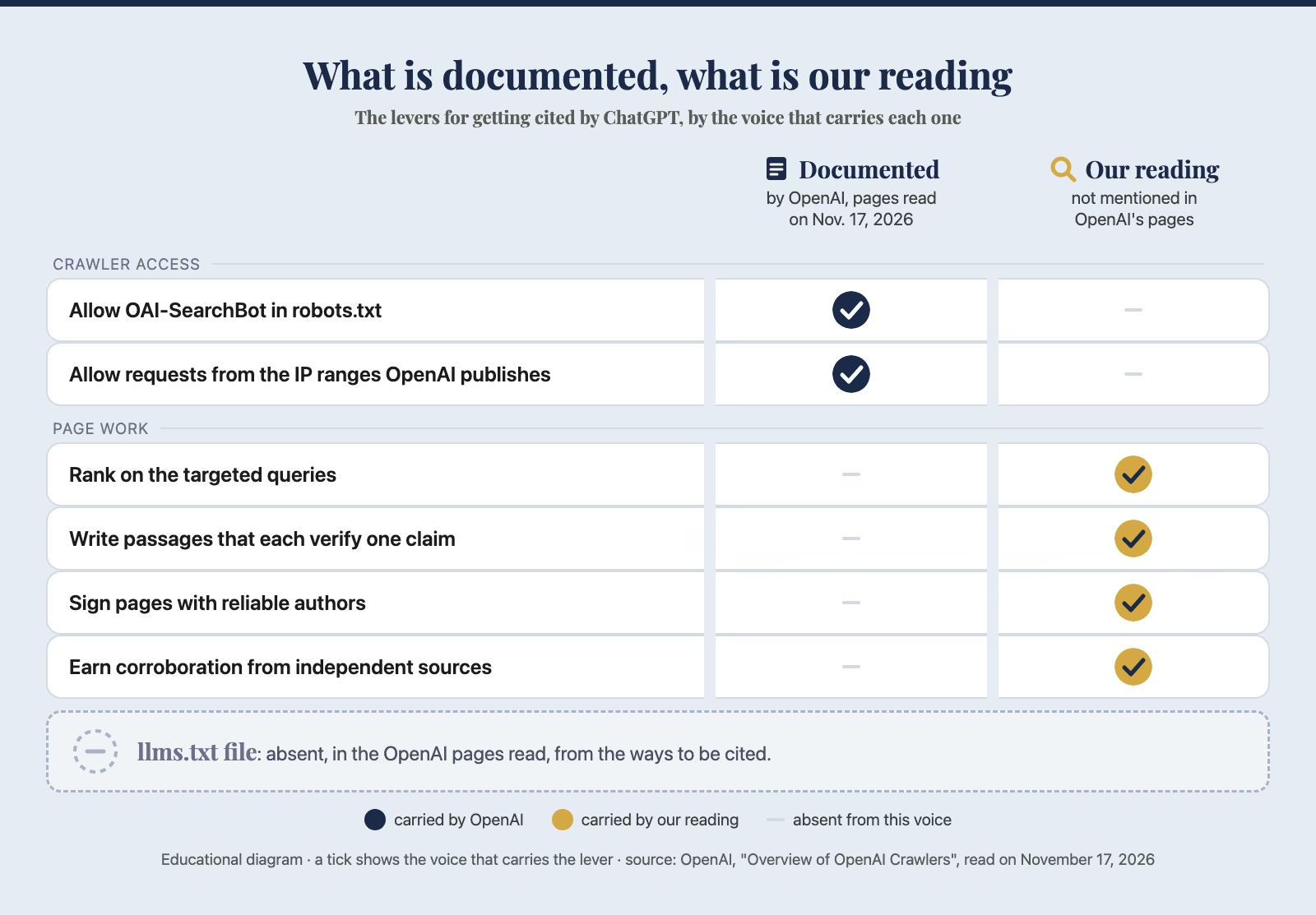
- For ChatGPT, allow OAI-SearchBot in the robots.txt file and allow requests from the IP ranges OpenAI publishes: "Overview of OpenAI Crawlers", read on November 17, 2026, recommends both to help ensure a site appears in search results.
- For ChatGPT, check that the published robots.txt file and the CDN or firewall rules say what the site intends, our reading.
- For ChatGPT, confirm in the server logs that the crawler arrives.
- For ChatGPT, work the pages on the targeted queries, our reading.
Whether to start with SEO or with GEO is the question of the guide that compares the two. Access and page work leave open which signals make a cited page.
Which signals get a page cited by ChatGPT?
In the OpenAI pages we read, no signal that gets a page cited by ChatGPT is documented; our reading retains four.
We counted no mention of a ranking factor, a signal, a backlink, structured data or freshness in nine OpenAI pages on crawlers, cloud-browser access, web search, commerce and ads, read on November 17, 2026. The four signals of our reading vary by the part of the work they serve: ranking, writing, signing and corroboration.
- For ChatGPT, rank on the targeted queries, our reading: SEO ranking remains the base of the work.
- For ChatGPT, write passages that each verify one claim, our reading: a passage with one verifiable claim stands alone.
- For ChatGPT, sign pages with reliable authors, our reading: an identifiable author name ties each claim to a person.
- For ChatGPT, earn corroboration from independent sources, our reading: a claim confirmed elsewhere can be checked.
The writing of those passages, answer first and one statement per passage, belongs to the guide on AEO.
A published test of on-page changes measures visibility in generative engines, on two engines other than ChatGPT. The paper "GEO: Generative Engine Optimization" (Aggarwal, Murahari, Rajpurohit, Kalyan, Narasimhan and Deshpande; Indian Institute of Technology Delhi, Princeton University and two independent researchers; arXiv:2311.09735, submitted November 16, 2023, revised June 28, 2024; accepted to KDD 2024, Proceedings of the 30th ACM SIGKDD Conference) reports that GEO can boost visibility "by up to 40% in generative engine responses". The authors tested two generative engines, one of them publicly available, and in our reading of the paper neither is ChatGPT; they did not evaluate effects on search rankings. On the engine the authors built, the three best methods, adding statistics, adding quotations and citing sources, improve by 30 to 40% in relative terms the position-weighted share of an answer's words attributable to a source, and by 15 to 30% the subjective impression. The subjective impression is a score a language model gives, which includes its estimate of how likely a user is to click the citation; neither measure counts real clicks or traffic. This test is not evidence about ChatGPT. Where ChatGPT SEO sits within SEO and AI search is the next question.
Where does ChatGPT SEO sit within SEO and AI search?
ChatGPT SEO is one part of AI search optimization: it keeps classic SEO as its base and adds access for OpenAI's crawlers.
This place is our reading. AI search optimization goes by three common names, GEO (generative engine optimization), AEO (answer engine optimization) and LLMO (large language model optimization), for the same target: a site's visibility in AI answers. The guide to GEO, AEO, ChatGPT and AI Overviews details what stays of classic SEO in AI search optimization.
Is getting cited by ChatGPT SEO or GEO? In our reading, SEO covers the access and the ranking and GEO covers the citation, and the guide on GEO owns that classification. What ChatGPT SEO adds to classic SEO is the handling of three crawlers with distinct uses, which OpenAI documents; Google's eligibility conditions for its generated answers do not transpose to ChatGPT. Google AI Overviews and Google AI Mode follow Google's own conditions, and the guides on those two surfaces hold the comparison with ChatGPT. Will ChatGPT replace blue links and SEO? No OpenAI page we read says so, and the search OpenAI describes shows websites, so in our reading links remain part of the answer. That leaves what does not help a page get cited.
What does not help a page get cited by ChatGPT?
The llms.txt file is not among the ways OpenAI's pages give for being cited by ChatGPT, and no source we consulted shows that it gets a page cited, in our reading on November 17, 2026.
OpenAI's page "Overview of OpenAI Crawlers", read on November 17, 2026, names llms.txt only in the banner that points to OpenAI's documentation index, and for ChatGPT's search it documents robots.txt tokens, user-agent strings and IP lists only. The published data on the llms.txt file are gathered in the guide devoted to it. Whether a site can see the effect of its work is the question of measuring.
How do you measure your presence in ChatGPT?
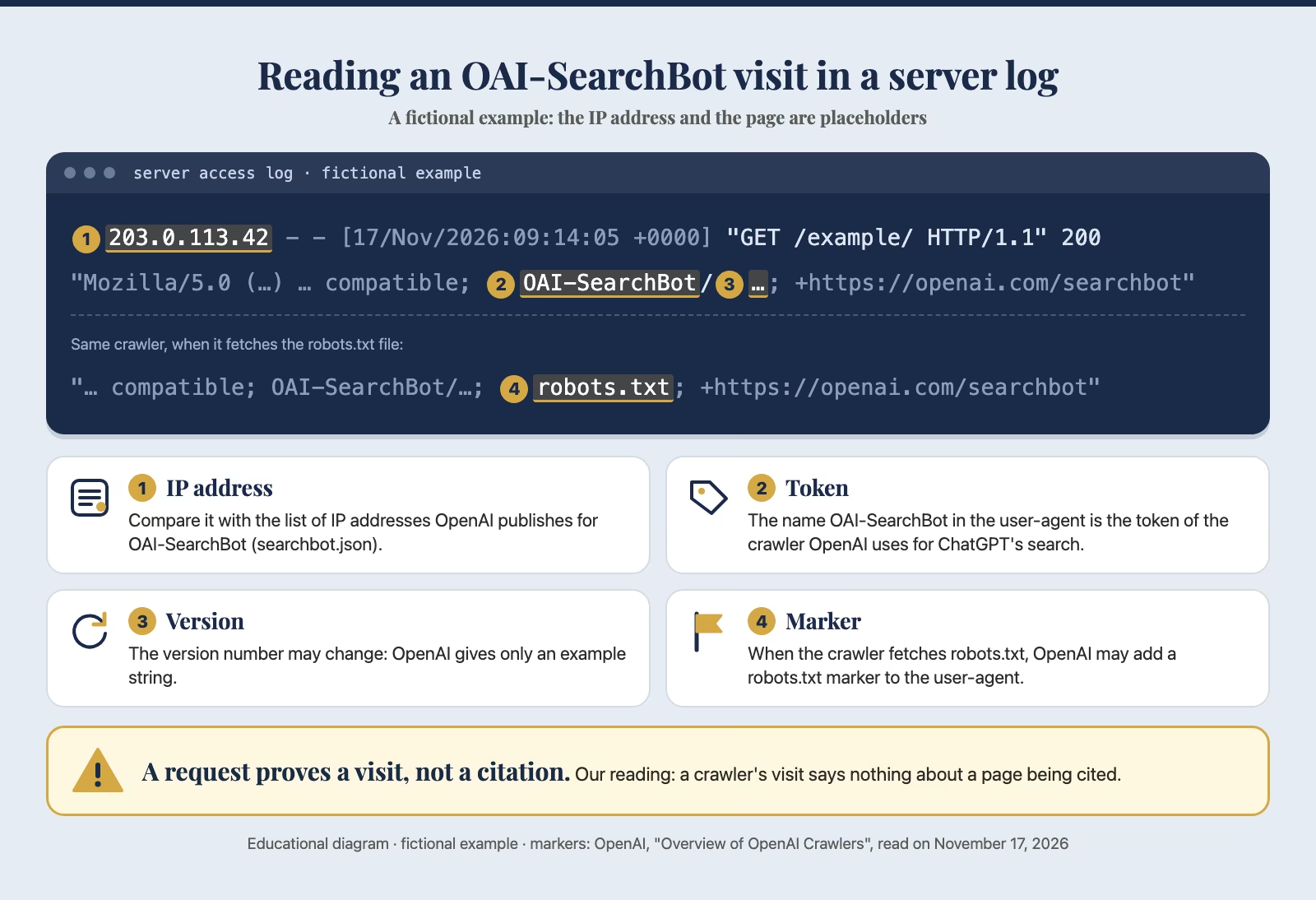
To measure its presence in ChatGPT, a site reads its server logs and compares the requests with the IP addresses OpenAI publishes for each crawler.
OpenAI publishes the IP ranges of OAI-SearchBot, GPTBot and ChatGPT-User in three files, searchbot.json, gptbot.json and chatgpt-user.json, which we opened on November 17, 2026, according to its page "Overview of OpenAI Crawlers". The page gives an example user-agent string for OAI-SearchBot and for GPTBot, with the note that the version number may change, and a full user-agent string for ChatGPT-User. OpenAI writes that, when OAI-SearchBot or GPTBot fetches robots.txt files, it may use a user-agent string with an additional robots.txt marker, which helps site owners distinguish those requests from requests for other resources; the page describes no such marker for ChatGPT-User.
A request in a log proves a crawler's visit, not a page cited by ChatGPT, in our reading. The measure of AI visibility in general, with Search Console's Performance report for Google and repeated questions for the other engines, belongs to our guide to AI search optimization. One OpenAI crawler serves neither search nor training: the one that checks pages submitted as ads.
Are there ads in ChatGPT?
Yes, there are ads in ChatGPT: OpenAI documents a crawler, OAI-AdsBot, that validates the safety of web pages submitted as ads on ChatGPT.
OAI-AdsBot only visits pages submitted as ads, and the data it collects is not used to train generative AI foundation models, OpenAI writes in "Overview of OpenAI Crawlers", read on November 17, 2026. OpenAI publishes documentation to create ads in ChatGPT and measure website conversions, and its "Platform Targeting" page (developers.openai.com), read on November 17, 2026, lets advertisers choose which ChatGPT apps and web browsers can show their ads. Location targeting exists to choose countries, regions or markets, but the countries where ads are shown are not listed in the pages we read, which point to a location catalog, a CSV download, that could not be opened on November 17, 2026.
Ads and search rest on two distinct crawlers, OAI-AdsBot for ads and OAI-SearchBot for search results; in our reading, a page submitted as an ad is not thereby cited by ChatGPT in its search answers. The remaining question is who carries this work.
When should you hand off your ChatGPT visibility to a GEO agency?
A site hands off its ChatGPT visibility to a GEO agency when crawler access, page writing and follow-up take more time or skill than its team has. These conditions are our reading.
No patent our team read describes how ChatGPT chooses its sources, and the OpenAI pages we read do not describe the choice among the sites it can show. The published studies observe citation behavior. ChatGPT SEO therefore rests on a declared inference, the four principles of our reading, and a GEO agency does not sell a page cited by ChatGPT: it works on access, pages and follow-up.
Hiring a GEO agency for ChatGPT visibility means separating what OpenAI documents from our reading. The guide to GEO agencies explains what a GEO agency does and how to hire one.